

Borohydride
Any chemical compound having a borohydride anion
- 2 min read
- 4 chapters

Related on Lably
Through Hydrogen, Reducing agent and Alkali metal
History
Alkali metal borohydrides were first described in 1940 by Hermann Irving Schlesinger and Herbert C. Brown. They synthesized lithium borohydride Li[BH4] from diborane B2H6:
- 2 MH + B2H6 → 2 M[BH4], where M = Li, Na, K, Rb, Cs, etc.
Current methods involve reduction of trimethyl borate with sodium hydride.
Sign in to keep reading
3 more chapters are free with a Lably account.
Structure
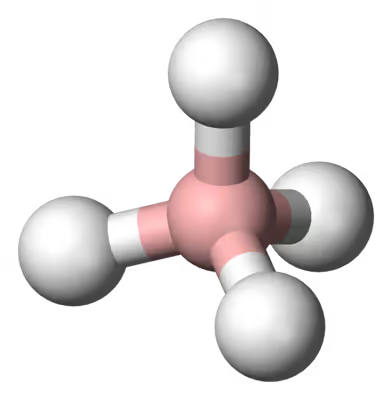
In the borohydride anion and most of its modifications, boron has a tetrahedral structure. The reactivity of the B−H bonds depends on the other ligands. Electron-releasing ethyl groups as in triethylborohydride render the B−H center highly nucleophilic. In contrast, cyanoborohydride is a weaker reductant owing to the electron-withdrawing cyano substituent. The countercation also influences the reducing power of the reagent.
Uses
Sodium borohydride is the borohydride that is produced on the largest scale industrially, estimated at 5000 tons/year in 2002. The main use is for the reduction of sulfur dioxide to give sodium dithionite:
- Na[BH4] + 8 NaOH + 8 SO2 → 4 Na2S2O4 + NaBO2 + 6 H2O
Dithionite is used to bleach wood pulp. Sodium borohydride is also used to reduce aldehydes and ketones in the production of pharmaceuticals including chloramphenicol, thiophenicol, vitamin A, atropine, and scopolamine, as well as many flavorings and aromas.
Potential applications
Because of their high hydrogen content, borohydride complexes and salts have been of interest in the context of hydrogen storage. Reminiscent of related work on ammonia borane, challenges are associated with slow kinetics and low yields of hydrogen as well as problems with regeneration of the parent borohydrides.
Coordination complexes
Borohydride being a Lewis base, forms coordination complexes. The borohydride ligand binds to the metal by means of one to three bridging hydrogen atoms. Metal borohydride complexes can often be prepared by a simple salt elimination reaction:
- ZrCl4 + 4 Li[BH4] + → Zr(BH4)4 + 4 LiCl
Decomposition
Some metal tetrahydroborates transform on heating to give metal borides. When the borohydride complex is volatile, this decomposition pathway is the basis of chemical vapor deposition (CVD), a way of depositing thin films of metal borides. For example, zirconium diboride ZrB2 and hafnium diboride HfB2 can be prepared through CVD of the zirconium(IV) tetrahydroborate Zr[BH4]4 and hafnium(IV) tetrahydroborate Hf[BH4]4:
- M[BH4]4 → MB2 + B2H6 + 5 H2
Metal diborides find uses as coatings because of their hardness, high melting point, strength, resistance to wear and corrosion, and good electrical conductivity.