

Bortle scale
Scale for measuring the brightness of the night sky
- 2 min read
- 3 chapters

Related on Lably
Through Night sky, Astronomical object and Naked eye
Scale
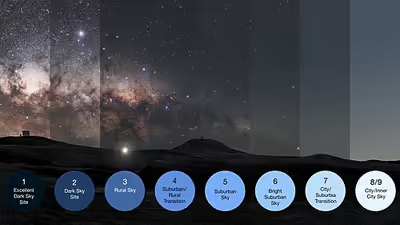
The scale ranges from Class 1, the darkest skies available on Earth, through to Class 9, inner-city skies. The classes are described primarily in terms of the visibility of notable celestial objects and light sources in the sky, but correspond closely with naked-eye limiting magnitude (NELM) and sky quality meter (SQM) measurement of skyglow. At higher classes, light pollution above the horizon is obvious, diffuse light sources such as the Milky Way and Messier objects are invisible to the naked eye, and fewer point light sources such as stars and planets can be seen. At lower classes, light pollution domes are only present in the direction of cities or are absent altogether, the sky is filled with stars, and faint diffuse light sources such as the zodiacal light are contrastful and brilliant.
Sign in to keep reading
2 more chapters are free with a Lably account.
Table of dark-sky classifications
Bortle's descriptions of the classes are summarized in the table.
Reception
The Bortle scale has attained widespread usage among amateur and professional astronomers. It quantifies the link between artificial lighting and reduced night sky quality in an intuitive manner, making it a common tool in scientific communication. A wide database of SQM measurements has been created, allowing the Bortle rating to be estimated for anywhere in the world.
Bortle was motivated to publish the scale in 2001 by increasing light pollution making true dark-sky sites inaccessible to many amateur astronomers. Ongoing urbanization and the global transition to LED lighting have continued this trend. James Brodrick of the US Department of Energy wrote in 2018 that "All manmade lighting is 'unnatural' and thus, has potentially undesirable side effects. Some of these are unavoidable if we're to continue to enjoy the benefits."
The higher light temperature of LED lights has been a particular contributor to increasing light pollution, in ways sometimes not reflected in older studies of light pollution. However, The Washington Post wrote in 2023 that "there is a world where more energy-efficient LED lights exist and don't significantly disrupt nightscapes or our health." DarkSky International calls for responsible outdoor lighting that is carefully targeted, no brighter than necessary, and warm-colored.
2014 research suggests Bortle may have overestimated the visibility of dim objects for the typical observer, even in the darkest skies. Diffuse light sources such as M33 are more difficult to see than point light sources of the same visual magnitude; Bortle's description of M33 (V 5.72) as a naked-eye object is atypical. A naked-eye limiting magnitude (NELM) over 7.1, which Bortle suggests for Class 2, represents a "substantial raising of achievement and expectation". A NELM of 6.0 to 6.5 is a more commonly cited figure. Bortle was aware of NELM varying with the visual acuity of the observer, and he devised the scale as an alternative to raw NELM.