

Camellia sinensis
Species of evergreen shrub
- 10 min read
- 8 chapters

Related on Lably
Through Species, Shrub and Flowering plant
Tea leaves used to make white tea, yellow tea, green tea, oolong, dark tea (which includes pu'er tea) and black tea are all made from two of the five varieties of C. sinensis that form the bulk of the tea crops now grown, C. sinensis var. sinensis and C. sinensis var. assamica, but are processed differently to attain varying levels of oxidation, with black tea being the most oxidized and white being the least. Kukicha (twig tea) is also made from C. sinensis, but uses only twigs and stems rather than leaves and buds.
Names
The name sinensis is a compound meaning "from China" in Botanical Latin. The two parts are sin from Latin meaning China and -ensis the suffix meaning place of origin.
The generic name Camellia is taken from the Latinized name of Rev. Georg Kamel, SJ (1661–1706), a Moravian-born Jesuit lay brother, pharmacist, and missionary to the Philippines.
Camellia sinensis is widely known by the common name tea tree, a name in use since 1760. However, it is also used to refer to shrubs or trees of the myrtle family from Australia and New Zealand, most frequently species in Leptospermum or Melaleuca the first usage dating to 1790. Tea trees are also variously called tea-bushes, tea-shrubs, and tea-plants.
Sign in to keep reading
7 more chapters are free with a Lably account.
Description
Camellia sinensis is a woody shrub or tree that is typically 1 to 5 m (3.3 to 16.4 ft) tall, but can be as tall as 20 m (66 ft). It is usually trimmed to a height of about 1 m (3.3 ft) with a flat top when in commercial tea plantations. The bark on trunks is smooth and gray with a yellow or brown tone. Young branches are yellow with a gray cast to them while new twigs are red-purple with white hairs. In older trees the trunk reaches as much as 40 cm in diameter.
In seedlings the taproot is dominant, but in mature plants the distribution of roots depends upon individual plant characteristics and growing conditions. In areas with shallow soils or high water tables tea bushes will have a shallow, fibrous root system while in areas with deep soils root have been found at depths of 5.5 m. Tea bushes reach peak productivity at ages of 30 to 50 years, but can remain productive for over a century.
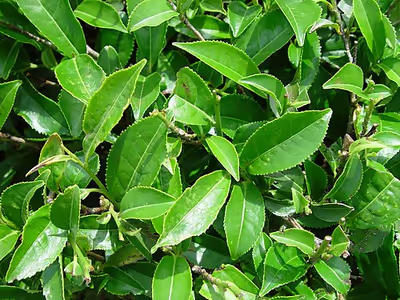
The leaves are an attractive green and tend to be smaller on cultivated plants than wild ones, ranging in size from 4 to 22 cm (1.5 to 8.5 in) and a width of 2 to 7.7 cm (0.8 to 3.0 in). Their shape is elliptic, oblong-elliptic, or oblong, and they have a leathery texture. The upper surface is shining dark green and hairless while the underside is pale green and can be hairless or pubescent, covered in plant hairs. The center vein is raised above the surface of the leaf on both sides as are the smaller seven to nine veins to each side. The netlike veins between are also visible. The leaf tip has a wide angle and the edges are serrate to serrulate, having asymmetrical teeth that point forwards to very fine serrations.
The flowers are white, 2.5 to 3.5 cm (1 to 1.5 in) across with six to eight petals. They bud in the leaf axils and can be solitary or have up to three in a cluster. On the back of the flower there will be five sepals 3–5 mm long. One to three of the petals will be somewhat sepal-like and hidden behind the five visible at the front of the flower. The center of the flower is filled with numerous hairless stamens 8–13 mm long. They are arranged in as many as five concentric circles called whorls.
The fruit is a capsule with globe shape, usually flattened at the ends and measuring 1–1.5 cm top to bottom and 1.5-3.5 cm in diameter. Each fruit will have one to three round chambers with one or two seeds in each. The seeds are brown to almost black in color and are round, half-spheres, or have mulpile flat faces. They measure 1 to 2 cm and are hairless.
Taxonomy
Linnaeus did not consider this plant a Camellia but placed it in a separate genus Thea. Then in 1818, Robert Sweet merged the two genera, selecting Camellia for the merged genus, and shifted all the former Thea species to that genus.
Five varieties of Camellia sinensis are accepted:
Camellia sinensis has 82 synonyms of the species or of four of its five varieties. This includes 45 species names.
In 2017, Chinese scientists sequenced the genome of C. s. var. assamica. It contains about three billion base pairs, which is larger than most plants previously sequenced.
The Cambodia type tea ("C. assamica subsp. lasiocalyx") was originally considered a type of Assam tea. However, later genetic work showed that it is a hybrid between Chinese small leaf tea and Assam tea.
- Chinese (small leaf) tea [C. sinensis var. sinensis]
- Chinese Western Yunnan Assam (large leaf) tea [C. sinensis var. assamica]
- Indian Assam (large leaf) tea [C. sinensis var. assamica]
- Chinese Southern Yunnan Assam (large leaf) tea [C. sinensis var. assamica]
Chinese (small leaf) tea may have originated in southern China possibly with hybridization of unknown wild tea relatives. However, since no wild populations of this tea are known, the precise location of its origin is speculative.
Given their genetic differences forming distinct clades, Chinese Assam type tea (C. s. var. assamica) may have two different parentages – one being found in southern Yunnan (Xishuangbanna, Pu'er City) and the other in western Yunnan (Lincang, Baoshan). Many types of Southern Yunnan Assam tea have been hybridized with the closely related species Camellia taliensis. Unlike Southern Yunnan Assam tea, Western Yunnan Assam tea shares many genetic similarities with Indian Assam type tea (also C. s. var. assamica). Thus, Western Yunnan Assam tea and Indian Assam tea both may have originated from the same parent plant in the area where southwestern China, Indo-Burma, and Tibet meet. However, as the Indian Assam tea shares no haplotypes with Western Yunnan Assam tea, Indian Assam tea is likely to have originated from an independent domestication. Some Indian Assam tea appears to have hybridized with the species Camellia pubicosta.
Assuming a generation of 12 years, Chinese small leaf tea is estimated to have diverged from Assam tea around 22,000 years ago; this divergence would correspond to the last glacial maximum, while Chinese Assam tea and Indian Assam tea diverged 2,800 years ago.
Chinese small leaf type tea was introduced into India in 1836 by the British and some Indian Assam type tea (e.g. Darjeeling tea) appear to be genetic hybrids of Chinese small leaf type tea, native Indian Assam, and possibly also closely related wild tea species.
Range and habitat
The origins of tea plants is obscured by its long history of cultivation. The natural range is unknown, though it is reasonably certain that the species comes from East Asia with the exact location being debated by experts. One theory is that the species originated in the borderlands of far eastern India, north Myanmar, and southwestern China. Alternatively, other experts point to an origin to the northeast in Yunnan province within China. In the Plants of the World Online database many more places are listed as part of the native range including not only southcentral and southwest China, Assam and the eastern Himalayas in India, and Myanmar, but also Laos, Thailand, and Vietnam.
Cultivation
Camellia sinensis is mainly cultivated in tropical and subtropical climates, in areas with at least 127 cm (50 in) of rainfall a year. Tea plants prefer a rich and moist growing location in full to part sun, and can be grown in hardiness zones 7–9. However, the species is commercially cultivated from the equator to as far north as Scotland, with the northernmost tea plantation at 59°N latitude on Shapinsay in the Orkney Islands. Many high quality teas are grown at high elevations, up to 2,200 m (7,200 ft), as the plants grow more slowly and acquire more flavour.
Tea plants will grow into a tree if left undisturbed, but cultivated plants are pruned to waist height for ease of plucking. Two principal varieties are used, the small-leaved Chinese variety plant (C. s. var. sinensis) and the large-leaved Assamese plant (C. s. var. assamica), used mainly for black tea. Tea trees can remain productive for many years.
Chinese teas
The Chinese plant is a small-leafed bush with multiple stems that reaches a height of some 3 m (9.8 ft). It is native to southeast China. The first tea plant variety to be discovered, recorded, and used to produce tea dates back 3,000 years ago; it yields some of the most popular teas.
C. s. var. waldenae was considered a different species, C. waldenae by SY Hu, but it was later identified as a variety of C. sinensis. This variety is commonly called Waldenae Camellia; it is grown on Sunset Peak and Tai Mo Shan in Hong Kong, and also occurs in Guangxi province.
Indian teas
Three main kinds of tea are produced in India:
- Assam, from C. s. var. assamica, comes from the near sea-level heavily forested northeastern section of India, the state of Assam. Tea from here is rich and full-bodied. The first tea estate in India was established in Assam in 1837. Teas are manufactured in either the orthodox process or the "crush, tear, curl" (CTC) process.
- Darjeeling, from C. s. var. sinensis, is from the cool and wet Darjeeling highland region, tucked in the foothills of the Himalayas. Tea plantations could be at altitudes as high as 2,200 m (7,200 ft). The tea is delicately flavoured, and considered to be one of the finest teas in the world. The Darjeeling plantations have three distinct harvests, termed 'flushes', and the tea produced from each flush has a unique flavour. First (spring) flush teas are light and aromatic, while the second (summer) flush produces tea with a bit more bite. The third, or autumn flush gives a tea that is lesser in quality.
- Nilgiri is from a southern region of India almost as high as Darjeeling. Grown at elevations between 1,000 and 2,500 m (3,300 and 8,200 ft), Nilgiri teas are subtle and rather gentle, and are frequently blended with other, more robust teas.
Japanese teas
Tea culture in Japan from as far back as the 9th century has resulted in various types. Japanese cultivars include:
- Benifuuki
- Fushun
- Kanayamidori
- Meiryoku
- Saemidori
- Okumidori
- Yabukita
Products
The seeds of the tea bush and oil-seed camellia (Camellia oleifera) can be pressed to yield tea oil, a sweetish seasoning and cooking oil that should not be confused with tea tree oil, an essential oil that is used for medical and cosmetic purposes, and originates from the leaves of a different plant.
Pests and diseases
Tea leaves are eaten by some herbivores, such as the caterpillars of the willow beauty (Peribatodes rhomboidaria), a geometer moth.
Health effects
There is no high-quality clinical evidence to indicate that drinking tea has any effect on human health. The United States Food and Drug Administration has approved a specific green tea extract ointment for treating genital warts.
Biosynthesis of caffeine
Fresh leaves contain about 4% caffeine, as well as related compounds including theobromine. Caffeine functions as a secondary metabolite and acts as a natural pesticide: it can paralyze and kill herbivorous insects feeding on the plant. Caffeine is a purine alkaloid and its biosynthesis occurs in young tea leaves and is regulated by several enzymes. The biosynthetic pathway in C. sinensis is similar to other caffeine-producing plants such as coffee or guayusa. Analysis of the pathway was carried out by harvesting young leaves and using reverse transcription PCR to analyze the genes encoding the major enzymes involved in synthesizing caffeine. The gene TCS1 encodes caffeine synthase. Younger leaves feature high concentrations of TCS1 transcripts, allowing more caffeine to be synthesized during this time. Dephosphorylation of xanthosine-5'-monophosphate into xanthosine is the committed step for the xanthosines entering the beginning of the most common pathway. A sequence of reactions turns xanthosine (9β-D-ribofuranosylxanthine) into 7-methylxanthosine, then 7-methylxanthine, then theobromine (3,7-dimethylxanthine), and finally into caffeine (1,3,7-trimethylxanthine).