

Legume
Plants in the family Fabaceae
- 8 min read
- 6 chapters
- 4 labs on Lably

Learn it on Lably
Most legumes have symbiotic nitrogen-fixing bacteria, Rhizobia, in structures called root nodules. Some of the fixed nitrogen becomes available to later crops, so legumes play a key role in crop rotation.
Terminology
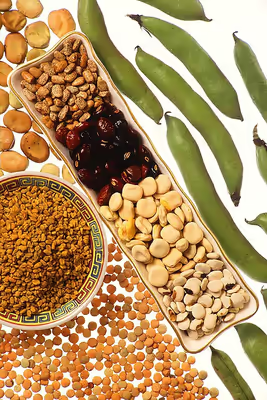
The term pulse, as used by the United Nations' Food and Agriculture Organization (FAO), is reserved for legume crops harvested solely for the dry seed. This excludes green beans and green peas, which are considered vegetable crops. Also excluded are seeds that are mainly grown for oil extraction (oilseeds like soybeans and peanuts), and seeds which are used exclusively for sowing forage (clovers, alfalfa). However, in common usage, these distinctions are not always clearly made, and many of the varieties used for dried pulses are also used for green vegetables, with their beans in pods while young.
The Food and Agriculture Organization (FAO) recognizes 11 primary pulses, excluding green vegetable legumes (such as green peas) and legumes used mainly for oil extraction (for example, soybeans and groundnuts) or used only as seed (such as clover and alfalfa).
- Dry beans
- Kidney bean, navy bean, pinto bean, black turtle bean, haricot bean (Phaseolus vulgaris)
- Lima bean, butter bean (Phaseolus lunatus)
- Adzuki bean, azuki bean (Vigna angularis)
- Mung bean, golden gram, green gram (Vigna radiata)
- Black gram, urad (Vigna mungo)
- Scarlet runner bean (Phaseolus coccineus)
- Ricebean (Vigna umbellata)
- Moth bean (Vigna aconitifolia)
- Tepary bean (Phaseolus acutifolius)
- Dry broad beans
- Horse bean (Vicia faba equina)
- Broad bean (Vicia faba)
- Field bean (Vicia faba)
- Dry peas
- Garden pea (Pisum sativum var. sativum)
- Protein pea (Pisum sativum var. arvense)
- Chickpea (also known as garbanzo and Bengal gram)
- Dry cowpea, black-eyed pea, blackeye bean
- Pigeon pea (aka Arhar/Toor, cajan pea, Congo bean, gandules)
- Lentil
- Bambara groundnut (aka earth pea)
- Vetch, common vetch
- Lupins
- Pulses NES including:
- Lablab, hyacinth bean (Lablab purpureus)
- Jack bean (Canavalia ensiformis), sword bean (Canavalia gladiata)
- Winged bean (Psophocarpus tetragonolobus)
- Velvet bean, cowitch (Mucuna pruriens var. utilis)
- Yam bean (Pachyrhizus erosus)
Sign in to keep reading
5 more chapters are free with a Lably account.
Distribution
Legumes are widely distributed as the third-largest land plant family in terms of number of species, behind only the Orchidaceae and Asteraceae, with about 751 genera and some 19,000 known species, constituting about seven percent of flowering plant species.
Ecology
Nitrogen fixation
Many legumes contain symbiotic bacteria called Rhizobia within root nodules of their root systems (plants belonging to the genus Styphnolobium are one exception to this rule). These bacteria have the special ability of fixing nitrogen from atmospheric, molecular nitrogen (N2) into ammonia (NH3). The chemical reaction is:
- N2 + 8 H+ + 8 e− → 2 NH3 + H2
Ammonia is converted to another form, ammonium (NH+4), usable by (some) plants, by the following reaction:
- NH3 + H+ → NH+4
This arrangement means that the root nodules are sources of nitrogen for legumes, making them relatively rich in nitrogenous amino acids and protein. Nitrogen is therefore a necessary ingredient in the production of proteins.
When a legume plant dies in the field, for example following the harvest, all of its remaining nitrogen, incorporated into amino acids inside the remaining plant parts, is released back into the soil. In the soil, the amino acids are converted to nitrate (NO−3), making the nitrogen available to other plants, thereby serving as fertilizer for future crops.
In many traditional and organic farming practices, crop rotation or polyculture involving legumes is common. By alternating between legumes and non-legumes, or by growing both together for part of the growing season, the field can receive a sufficient amount of nitrogenous compounds to produce a good result without adding nitrogenous fertilizer. Legumes are often used as green manure.
Sri Lanka developed the polyculture practice known as coconut-soybean intercropping. Grain legumes are grown in coconut (Cocos nuficera) groves in two ways: intercropping or as a cash crop. These are grown mainly for their protein, vegetable oil and ability to uphold soil fertility. However, continuous cropping after 3–4 years decrease grain yields significantly.
Pests and diseases
A common pest of grain legumes that is noticed in the tropical and subtropical Asia, Africa, Australia and Oceania are minuscule and highly destructive flies that belong to the family Agromyzidae, dubbed "bean flies". The host range of these flies is very wide amongst cultivated legumes. Infestation of plants starts from germination through to harvest, and they can destroy an entire crop in early stage. Black bean aphids are a serious pest to broad beans and other beans. Common hosts for this pest are fathen, thistle and dock. Pea weevils and bean weevils damage leaf margins, leaving characteristic semi-circular notches. Stem nematodes are very widespread but will be found more frequently in areas where host plants are grown.
Common legume diseases include anthracnose, caused by Colletotrichum trifolii; common leaf spot caused by Pseudomonas syringae pv. syringae; crown wart caused by Physoderma alfalfae; downy mildew caused by Peronospora trifoliorum; root rot caused by Fusarium spp.; rust caused by Uromyces striatus; crown and stem rot caused by Sclerotinia trifoliorum; Southern blight caused by Sclerotium rolfsii; pythium (browning) root rot caused by Pythium spp.; fusarium wilt caused by Fusarium oxysporum; root knot caused by Meloidogyne hapla. These are all classified as biotic problems.
Abiotic problems include nutrient deficiencies, (nitrogen, phosphorus, potassium, copper, magnesium, manganese, boron, zinc), pollutants (air, water, soil, pesticide injury, fertilizer burn), toxic concentration of minerals, and unfavorable growth conditions.
Storage
Seed viability decreases with longer storage time. Studies of vetch, broad beans, and peas show that they last about 5 years in storage. Environmental factors that are important in influencing germination are relative humidity and temperature. Two rules apply to moisture content between 5 and 14 percent: the life of the seed will last longer if the storage temperature is reduced by 5 degree Celsius. Secondly, the storage moisture content will decrease if temperature is reduced by 1 degree Celsius.
Uses
Cultivated legumes encompass a diverse range of agricultural classifications, spanning forage, grain, flowering, pharmaceutical/industrial, fallow/green manure, and timber categories. A notable characteristic of many commercially cultivated legume species is their versatility, often assuming multiple roles concurrently. The extent of these roles is contingent upon the stage of maturity at which they are harvested.
Human consumption
Grain legumes are cultivated for their seeds, for humans and animals to eat, or for oils for industrial uses. Grain legumes include beans, lentils, lupins, peas, and peanuts.
Legumes are a key ingredient in vegan meat and dairy substitutes. They are growing in use as a plant-based protein source in the world marketplace. Products containing legumes grew by 39% in Europe between 2013 and 2017.
There is a common misconception that adding salt before cooking prevents them from cooking through. Legumes may not soften because they are old, or because of hard water or acidic ingredients in the pot; salting before cooking results in better seasoning.
Nutritional value
Legumes are a significant source of protein, dietary fibre, carbohydrates, and dietary minerals; for example, a 100-gram serving of cooked chickpeas contains 18 percent of the Daily Value (DV) for protein, 30 percent DV for dietary fiber, 43 percent DV for folate and 52 percent DV for manganese.
Legumes are an excellent source of resistant starch; this is broken down by bacteria in the large intestine to produce short-chain fatty acids (such as butyrate) used by intestinal cells for food energy.
Forage
Forage legumes are of two broad types. Some, like alfalfa, clover, vetch (Vicia), stylo (Stylosanthes), or Arachis, are sown in pasture and grazed by livestock. Others, such as Leucaena or Albizia, are woody shrubs or trees that are either broken down by livestock or regularly cut by humans to provide fodder. Legume-based feeds improve animal performance over a diet of perennial grasses. Factors include larger consumption, faster digestion, and higher feed conversion rate.
The type of crop grown for animal rearing depends on the farming system. In cattle rearing, legume trees such as Gliricidia sepium can be planted along edges of fields to provide shade for cattle, the leaves and bark are often eaten by cattle. Green manure can be grown between harvesting the main crop and the planting of the next crop.
Other uses
Legume species grown for their flowers include lupins, which are farmed commercially for their blooms as well as being popular in gardens worldwide. Industrially farmed legumes include Indigofera and Acacia species, which are cultivated for dye and natural gum production, respectively. Fallow or green manure legume species are cultivated to be tilled back into the soil in order to exploit the high levels of captured atmospheric nitrogen found in the roots of most legumes. Numerous legumes farmed for this purpose include Leucaena, Cyamopsis, and Sesbania species. Various legume species are farmed for timber production worldwide, including numerous Acacia species and Castanospermum australe.
Some legume trees, like the honey locust (Gleditsia) can be used in agroforestry. Others, including the black locust (Robinia pseudoacacia), Kentucky coffeetree (Gymnocladus dioicus), Laburnum, and the woody climbing vine Wisteria, have poisonous elements.
History
Neanderthals and early modern humans used wild pulses when cooking meals 70,000 to 40,000 years ago. Traces of pulse production have been found around the Ravi River (Punjab), the seat of the Indus Valley civilisation, from c. 3300 BC. Meanwhile, evidence of lentil cultivation has also been found in Egyptian pyramids and cuneiform recipes. Dry pea seeds have been discovered in a Swiss village that are believed to date back to the Stone Age. Archaeological evidence suggests that these peas must have been grown in the eastern Mediterranean and Mesopotamian regions at least 5,000 years ago and in Britain as early as the 11th century. The soybean was domesticated around 5,000 years ago in China from a descendant of the wild vine Glycine soja.
The oldest-known domesticated beans in the Americas were found in Guitarrero Cave, an archaeological site in Peru, and dated to around the second millennium BC. Genetic analyses of the common bean Phaseolus show that it originated in Mesoamerica, and subsequently spread southward, along with maize and squash, traditional companion crops. In the United States, the domesticated soybean was introduced in 1770 by Benjamin Franklin after he sent seeds to Philadelphia from France.
International Year of Pulses
The International Year of Pulses 2016 was declared by the Sixty-eighth session of the United Nations General Assembly. The Food and Agriculture Organization of the United Nations was nominated to facilitate the implementation of the year in collaboration with governments, relevant organizations, non-governmental organizations and other relevant stakeholders. Its aim was to heighten public awareness of the nutritional benefits of pulses as part of sustainable food production aimed towards food security and nutrition. The year created an opportunity to encourage connections throughout the food chain that would better use pulse-based proteins, further global production of pulses, better use crop rotations and address challenges in the global trade of pulses.