


Related on Lably
Through Legume, Tonne and Domestication
All wild members of the species have a climbing habit, but many cultivars are classified either as bush beans or climbing beans, depending on their style of growth. In 2022, 28 million tonnes of dry common beans were produced worldwide, led by India with 23% of the total.
The common bean is the most consumed bean species in the world and is native to the Americas. It was domesticated in Mexico, Central America and the southern Andes region some 8000years ago. It has many cultivars.
Raw dry beans contain the toxic compound phytohaemagglutinin, which can be deactivated by boiling the beans for 30 minutes. In addition to the beans, the unripe green pods are used for food. The leaf is occasionally used as a vegetable and the straw as fodder.
Description
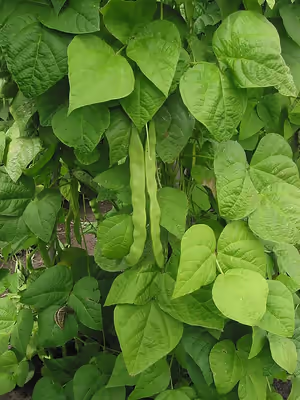
Bush varieties form erect bushes 20–60 centimetres (8–20 inches) tall, while pole, or running, varieties form vines 2–3 metres (7–10 feet) long. All wild members of the species have a climbing habit. All varieties bear alternate, green or purple leaves, which are divided into three oval, smooth-edged leaflets, each 6–15 cm (2–6 in) long and 3–11 cm (1–4 in) wide.
The white, pink, or purple flowers are about a centimetre long and have 10 stamens each. The flowers are self-pollinating, which facilitates the selection of stable cultivars. The flowers give way to pods 8–20 cm (3–8 in) long and 1–1.5 cm wide. These may be green, yellow, black, or purple, each containing 4–8 beans. Some varieties develop a string along the pod; these are generally cultivated for dry beans, as green stringy beans are not commercially desirable. The beans are smooth, plump, kidney-shaped, up to 1.5 cm long, range widely in color and are often mottled in two or more colors. The beans maintain their germination capacity for up to five years.
Like most Phaseolus species, the genome has 11 chromosomal pairs (2n = 22). The genome is one of the smallest in the legume family at 625 Mbp per haploid genome.
Raw or undercooked beans contain a toxic protein called phytohaemagglutinin.
Sign in to keep reading
7 more chapters are free with a Lably account.
Taxonomy
The common bean, like all Phaseolus species, is a member of the legume family, Fabaceae.
In Species Plantarum in 1753, Carl Linnaeus classified the beans known by him into genus Phaseolus and genus Dolichos, naming 11 species of Phaseolus, including 6 cultivated species and 5 "wild" species.
The beans cultivated in Europe prior to the Columbian Exchange were of Asian origin and are unrelated to New World Phaseolus species. The Eurasian species were transferred to other genera including Vigna, Vicia and Lablab, so members of the Phaseolus genus are now all from the Americas.
Etymology
Ancient Greeks used the word φάσηλος (phasēlos) to refer to the beans of Asian origins that were cultivated in Europe at the time. The Romans used both the Latinized phaseolus and their own faba to refer to different pre-Columbian species of beans, presumably using the word faseolus for smaller seeds like those belonging to the genus Vigna such as black-eyed peas and the word faba for larger seeds, such as the fava beans. This latter word, faba, was related to the Proto-Germanic bauno, from which the Old English word bean is derived and has the meaning of "bean, pea, legume". When Phaseolus vulgaris arrived in Europe in the 16th century, this species was yet another seed in a pod, thus there were already words in the European languages describing it.
In the Americas, P. vulgaris is also known as ayacotl in Nahuatl (Aztec language), búul in Mayan (Maya language) and purutu in Quechua (Inca language). In Argentina, Bolivia, Chile, Paraguay and Uruguay, the Spanish name poroto is used, being derived from its corresponding Quechua word. Additional names include the Castilian Spanish frijol, the Portuguese feijão, and the Catalan fesol.
Distribution
Wild P. vulgaris is native to the Americas. It was domesticated separately in Mesoamerica and in the southern Andes region some 8000years ago, giving the domesticated bean two gene pools.
Beans, squash, and maize (corn) are the three Mesoamerican crops that constitute the "Three Sisters", central to indigenous American agriculture.
The common bean arrived in Europe as part of the Columbian exchange. It is now grown on every continent except Antarctica.
Ecology
Like most members of Fabaceae, common beans acquire the nitrogen they require through an association with rhizobia, which are nitrogen-fixing bacteria.
Cultivation
Good commercial yield in favorable environments under irrigation is 5 to 7 tonnes per hectare (2 to 3 short ton/acre) fresh and 1.4 to 1.8 t/ha (0.6 to 0.8 short ton/acre) dry seed.
Cultivars and varieties
Archeologists found large-seeded varieties of the domesticated bean in the highlands of Peru, dating to 2300 BC, and spreading to the coastal regions by around 500 BC. Small-seeded varieties were found in sites in Mexico, dating to 300 BC, which then spread north and east of the Mississippi River by 1000 AD.
Many well-known bean cultivars and varieties belong to this species, and the list below is in no way exhaustive. Both bush and running (pole) cultivars/varieties exist. The colors and shapes of pods and seeds vary over a wide range.
Production
In 2022, world production of dry common beans was 28 million tonnes, led by India with 23% of the total. Brazil and Myanmar were secondary producers.
Toxicity
The toxic compound phytohaemagglutinin, a lectin, is present in many common bean varieties but is especially concentrated in red kidney beans. White kidney beans contain about a third as much phytohaemagglutinin as the red variety; broad beans (Vicia faba) contain 5–10% of the amount that red kidney beans contain.
Phytohaemagglutinin can be inactivated by a two-step process. The United States Food and Drug Administration recommends soaking the dry beans for at least five hours in water, which should then be discarded; this first step is largely for reducing indigestible carbohydrates. Then boiling the hydrated (wet, soft) beans for 30 minutes to ensure they reach a sufficient temperature for long enough to destroy the toxin completely.
Outbreaks of poisoning have been associated with cooking kidney beans in slow cookers at 80 °C/176 °F, which is insufficient to deactivate all toxins.
The primary symptoms of phytohaemagglutinin poisoning are nausea, vomiting, and diarrhea. Onset is from one to three hours after consumption of improperly prepared beans, and symptoms typically resolve within a few hours. Consumption of as few as four or five raw, soaked kidney beans can cause symptoms. Canned red kidney beans are safe to use immediately, as they have already been cooked.
Beans are high in purines, which are metabolized to uric acid. Uric acid is not a toxin but may promote the development or exacerbation of gout. However, more recent research has questioned this association, finding that moderate intake of purine-rich foods is not associated with an increased risk of gout.
Uses
Nutrition
Raw green beans are 90% water, 7% carbohydrates, and 1% protein and contain negligible fat. In a reference amount of 100 grams (3.5 oz), raw green beans supply about 36 calories and are a rich source (20% or more of the US Daily Value, DV) of vitamin K (41% DV) and a moderate source (10–19% DV) of vitamin C, vitamin B6, and manganese.
Dry white common beans, after boiling, are 63% water, 25% carbohydrates, and 10% protein and contain little fat. In a reference amount of 100 grams (3.5 oz), boiled white common beans supply about 139 calories and are a rich source of folate and manganese, with moderate amounts of thiamine and several dietary minerals.
Dry beans
Dry beans will keep indefinitely if stored in a cool, dry place, but as time passes, their nutritive value and flavor degrade, and cooking times lengthen. Dried beans are almost always cooked by boiling, often after being soaked in water for several hours. While the soaking is not strictly necessary, it shortens cooking time and results in more evenly textured beans. In addition, soaking beans removes 5 to 10% of the gas-producing sugars that can cause flatulence for some people. The methods include simple overnight soaking and the power-soak method, in which beans are boiled for three minutes and then set aside for 2–4 hours. Before cooking, the soaking water is drained off and discarded. Dry common beans take longer to cook than most pulses: Cooking times vary from one to four hours but are substantially reduced with pressure cooking.
In Mexico, Central America, and South America, the traditional spice used with beans is epazote, which is also said to aid digestion. In East Asia, a type of seaweed, kombu, is added to beans as they cook for the same purpose. Salt, sugar, and acidic foods such as tomatoes may harden uncooked beans, resulting in seasoned beans at the expense of slightly longer cooking times.
Dry beans may also be bought cooked and canned as refried beans, or whole with water, salt, and sometimes sugar.
Green beans and wax beans
The three commonly known types of green beans are string, or snap, beans, which may be round or have a flat pod; stringless or French beans, which lack a tough, fibrous string running along the length of the pod; and runner beans, which belong to a separate species, Phaseolus coccineus. Green beans may have a purple rather than green pod, which changes to green when cooked. Wax beans are P. vulgaris beans that have a yellow or white pod. Wax bean cultivars are commonly grown; the plants are often of the bush, or dwarf, form.
As the name implies, snap beans break easily when the pod is bent, giving off a distinct audible snapping sound. The pods of snap beans (green, yellow, and purple) are harvested when they are rapidly growing, fleshy, tender (not tough and stringy), and bright in color, and the seeds are small and underdeveloped (8 to 10 days after flowering).
Green beans and wax beans are often steamed, boiled, stir-fried, or baked in casseroles.
Shelling beans
Shell, shelled, or shelling beans are beans removed from their pods before being cooked or dried. Common beans can be used as shell beans, but the term also refers to other species of beans whose pods are not typically eaten, such as lima beans, soybeans, peas, and fava beans. Fresh shell beans are nutritionally similar to dry beans but are prepared more like vegetables, often steamed, fried, or made into soups.
Popping (nuña) beans
The nuña is an Andean subspecies, P. v. subsp. nunas (formerly P. vulgaris Nuñas group), with seeds that come in a variety of shapes, colors, and patterns. When cooked on high heat, the bean explodes, exposing the inner part in the manner of popcorn and other puffed grains. Notably, these beans do not require soaking or boiling before consumption, and the dried bean can be safely eaten after being popped.
Other uses
Bean leaves have been used to trap bedbugs in houses. Microscopic hairs (trichomes) on the bean leaves entrap the insects.
Beans have been used as devices in various methods of divination since ancient times. Fortune-telling using beans is called favomancy.
P. vulgaris has been found to bio-accumulate zinc, manganese, and iron and have some tolerance to their respective toxicities, suggesting suitability for natural bio-remediation of heavy-metal-contaminated soils.
In culture
In 1528, Pope Clemente VII received some white beans, which thrived. Five years later, he gave a bag of beans as a present to his niece, Catherine, on her wedding to Prince Henri of France, along with the county of the Lauragais, whose county town is Castelnaudary, now synonymous with the white bean dish of cassoulet.