


Related on Lably
Through South America, Fossil and Evolution
Taxonomy
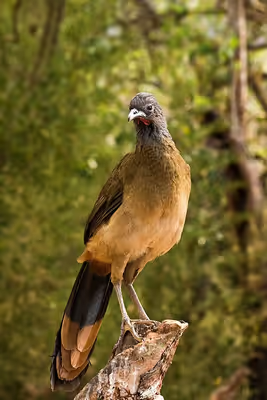
The genus Ortalis was introduced (as Ortalida) by the German naturalist Blasius Merrem in 1786 with the little chachalaca (Ortalis motmot) as the type species. The generic name is derived from the Ancient Greek word όρταλις, meaning "pullet" or "domestic hen." The common name derives from the Nahuatl verb chachalaca, meaning "to chatter." With a glottal stop at the end, chachalacah was an alternate name for the bird known as the chachalahtli. All these words likely arose as an onomatopoeia for the four-noted cackle of the plain chachalaca (O. vetula). The genus contains 16 species.
Mitochondrial and nuclear DNA sequence data tentatively suggest that the chachalacas emerged as a distinct lineage during the Oligocene, somewhere around 40–20 mya, possibly being the first lineage of modern cracids to evolve; this does agree with the known fossil record – including indeterminate, cracid-like birds – which very cautiously favors a north-to-south expansion of the family.
Sign in to keep reading
One more chapter is free with a Lably account.
Species
Prehistoric species
The cracids have a very poor fossil record, essentially being limited to a few chachalacas. The prehistoric species of the present genus, however, indicate that chachalacas most likely evolved in North or northern Central America:
- Ortalis tantala Wetmore 1933 (Early Miocene of Nebraska, USA)
- Ortalis pollicaris Miller 1944 (Flint Hill Middle Miocene of South Dakota, USA)
- Ortalis affinis Feduccia & Willis 1967 (Ogallala Early Pliocene of Trego County, Kansas, USA)
- Ortalis phengites Wetmore 1923 (Snake Creek Early Pliocene of Sioux County, Nebraska, USA)
The Early Miocene fossil Boreortalis from Florida is also a chachalaca; it may actually be referrable to the extant genus.