

Chrysaora fuscescens
Species of cnidarian
- 4 min read
- 5 chapters

Explore on Lably
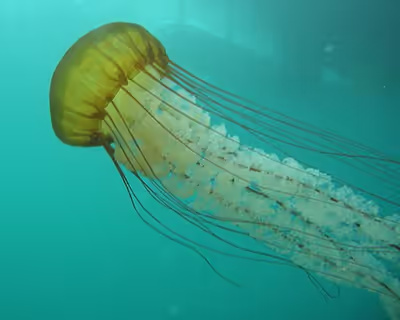
ToursExplore Lably’s 3D toursThe Pacific sea nettle has a distinctive, golden-brown bell with a reddish tint. The bell can grow to be larger than one meter (3’) in diameter in the wild; however, most are less than 50 cm across. The long and spiraling, whitish oral arms (and 24 undulating, maroon tentacles) may trail behind the nettle as far as 15 feet (4.6 m).
Since about the mid-20th century, C. fuscescens has proven to be a very popular cnidarian to feature at aquariums (and even some zoos with aquatic exhibits), mainly due to the public's fascination with their bright colors and extremely long tentacles. Additionally, the species is known for being quite low-maintenance in captivity, when provided with the appropriate water parameters and conditions. When these medusae are actively thriving under ideal conditions, they can even be easily bred via the culturing of polyps.
Taxonomy
Johann Friedrich von Brandt described this species in 1835. The origin of the genus name Chrysaora lies in Greek mythology, with Chrysaor, brother of Pegasus, the son of Poseidon and Medusa. Translated, Chrysaor is Greek for "he who has a golden armament", in reference to the goldenrod color of the nettle's bell. The species name, fuscescens, is Latin for "dark into light".
Sign in to keep reading
4 more chapters are free with a Lably account.
Distribution and habitat
Chrysaora fuscescens is commonly found along the coasts of southern British Columbia, Washington, Oregon and most of California to Baja California Sur, Mexico. Some sea nettles will range further north to the Gulf of Alaska, or west to Japan, and rarely into the Gulf of California. The populations reach their peak during the late summer. In recent years, C. fuscescens has become overly abundant off the coast of Oregon, which is thought to be an indicator of climate change. However, others suspect that the population is increasing because of human influences on coastal regions. Industrial runoff to the ocean, as well as agricultural waste and other forms of human pollution (such as fertilizer and chemical plants), add considerable amounts of nutrients to the water when dumped into the ocean. This then feeds microorganisms and helps to fuel algal blooms, which subsequently fuels the entire food chain and potentially provides the nettles with enough food to see a population increase.
Feeding and predators
In common with other cnidaria, Chrysaora fuscescens are carnivorous animals. They catch their prey via drift feeding by means of cnidocyst (or nematocyst) -laden tentacles that hang down in the water. The toxins in their nematocysts are effective against both their prey and humans, though it is typically nonlethal to the latter. Because C. fuscescens cannot chase after their prey, they must eat as they drift. By spreading out their tentacles like a large net, the sea nettle is able to catch food as it passes by. When prey come into contact with the tentacles, thousands of nematocysts discharge, launching barbed stingers that injects venom composed of various proteins, including proteases and pore forming toxins, which can disrupt cell membranes and tissues. The oral arms begin digestion as they transport the prey into the sea nettle's mouth.
C. fuscescens feeds on a wide variety of zooplankton, crustaceans, salps, pelagic snails, as well as small fish, their eggs, and larvae, and other jellyfish. Copepods often dominate gut contents, prey selection analyses indicate a preference for slow moving or non-motile prey such as fish eggs, while more motile prey are selected against. Due to the growing population of C. fuscescens, they seem to be reducing fish populations and have become nuisances to the fishermen of Oregon by clogging up fishing nets. Their dense swarms have also become problematic for scientific trawls and water intake.
Despite having a potent sting, some animals, apparently, are not bothered or affected by the defense mechanism at all; C. fuscescens often falls prey to many marine birds, large fish and some cetaceans, and are especially relished by leatherback turtles.
Physiology
Chrysaora fuscescens swim using jet propulsion by squeezing their bell and pushing water behind them, allowing them to swim against currents, although most of the time they simply float. Occasionally, they pick up hitchhikers, including small fish and crabs, which hide inside the sea nettle's bell and may feed on it.
The Chrysaora fuscescens use light sensing organs called ocelli to migrate from the deeper waters of the ocean to the surface.
Reproduction
Chrysaora fuscescens is capable of both sexual reproduction in the medusa stage and asexual reproduction in the polyp stage. The life cycle of C. fuscescens begins when females catch sperm released by the males to fertilize the eggs she has produced and is holding in her mouth. These fertilized eggs remain attached to her oral arms, and there they grow into flat bean-shaped planula, the free-swimming larval stage of cnidarians. After they grow into flower-shaped polyps, they are released into the ocean where they attach themselves to a solid surface and undergo asexual reproduction. The polyp makes identical copies of itself by means of budding, where the new polyp grows from its side. After the new polyp is fully formed, it too is released into the ocean and undergoes metamorphosis as it grows, developing a bell, arms, and tentacles until it is a fully formed medusa.