


Related on Lably
Through Species
Classification and evolution
Colobinae is split into two tribes: Colobini, in Africa, and Presbytini in Asia. Based on fossil records, the tribes split between 13 to 10 million years ago. The Colobini tribe contains three genera, black-and-white colobuses, red colobuses, and the olive colobus, all of whom are native to Africa. The Asian Presbytini comprises seven genera split into two clades, the odd-nosed group and the langur group. The discordant gene tree topologies and divergence age estimates suggest that hybridization, particularly involving female introgression from Piliocolobus/Procolobus into Colobus and male introgression from Semnopithecus into Trachypithecus, played a prominent role in shaping the phylogenetic relationships of African and Asian colobine monkeys during their evolutionary history.
The earliest remains of Colobinae are known from the Tugen Hills of Kenya, dating to 12.5 million years ago. The earliest fossils of the genus in Eurasia are those of Mesopithecus found in Greece, dating to around 8.2 million years ago.
- Family Cercopithecidae
- Subfamily Cercopithecinae
- Subfamily Colobinae
- Genus †Mesopithecus
- Genus †Lemucolobus
- Genus †Olotimcolobus
- Genus †Sawecolobus
- Tribe Colobini
- Genus Colobus - black-and-white colobus monkeys
- Genus Piliocolobus - red colobus monkeys
- Genus Procolobus - olive colobus
- †Genus Cercopithecoides
- Tribe Presbytini
- Langur (leaf monkey) group
- Genus Trachypithecus - lutungs
- Genus Presbytis - surilis
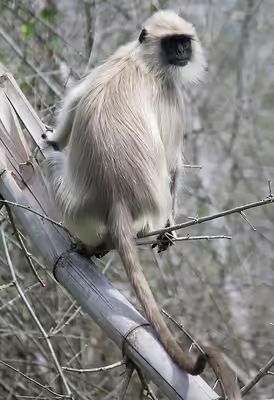
- Genus Semnopithecus - gray langurs
- Odd-nosed group
- Genus Pygathrix - doucs
- Genus Rhinopithecus - snub-nosed monkeys
- Genus Nasalis - proboscis monkey
- Genus Simias - pig-tailed langur
- Langur (leaf monkey) group
- Tribe Colobini
Sign in to keep reading
One more chapter is free with a Lably account.
Behaviour and ecology
Most colobine species are arboreal, although some live a more terrestrial life. They are found in many different habitats of different climate zones (rainforests, mangroves, mountain forests, and savannah), but not in deserts and other dry areas. They live in groups, but in social forms vary.
Colobines are folivorous, though their diet may be supplemented with flowers, fruits and the occasional insect. To aid in digestion, particularly of hard-to-digest leaves, they have multichambered, complex stomachs, making them the only primates with foregut fermentation. Foregut fermenters use bacteria to detoxify plant compounds before reaching the intestine, where toxins can be absorbed. Foregut fermentation is also associated with higher protein extraction and efficient digestion of fiber; it is the dominant form of digestions in diverse herbivore taxa, including most Artiodactyla (e.g., deer, cattle, antelope), sloths, and kangaroos. In contrast, lower diversity howler monkeys in the New World rely on hindgut fermentation – occurring lower in the colon or cecum – much like horses and elephants. Unlike the other subfamily of Old World monkeys, the Cercopithecinae, they do not possess cheek pouches.
Silvery lutung (Trachypithecus cristatus) and the Northern plains gray langur (Semnopithecus entellus) females begin reproducing after around 3 years of age.
Hybrids
Intergeneric hybrids are known to occur within the subfamily Colobinae. In India, gray langurs (Semnopithecus spp.) are known to hybridize with Nilgiri langurs (Trachypithecus johnii).