

Command and control
Military exercise of authority by a commanding officer over assigned forces
- 5 min read
- 4 chapters

Related on Lably
Versions of the United States Army Field Manual 3-0 circulated circa 1999 define C2 in a military organization as the exercise of authority and direction by a properly designated commanding officer over assigned and attached forces in the accomplishment of a mission.
A 1988 NATO definition is that command and control is the exercise of authority and direction by a properly designated individual over assigned resources in the accomplishment of a common goal. An Australian Defence Force definition, similar to that of NATO, emphasises that C2 is the system empowering designated personnel to exercise lawful authority and direction over assigned forces for the accomplishment of missions and tasks. The Australian doctrine goes on to state: "The use of agreed terminology and definitions is fundamental to any C2 system and the development of joint doctrine and procedures. The definitions in the following paragraphs have some agreement internationally, although not every potential ally will use the terms with exactly the same meaning."
Overview
US perspective
The US Department of Defense Dictionary of Military and Associated Terms defines command and control as: "The exercise of authority and direction by a properly designated commander over assigned and attached forces in the accomplishment of the mission. Also called C2. Source: JP 1".
The edition of the Dictionary "As Amended Through April 2010" elaborates, "Command and control functions are performed through an arrangement of personnel, equipment, communications, facilities, and procedures employed by a commander in planning, directing, coordinating, and controlling forces and operations in the accomplishment of the mission." However, this sentence is missing from the "command and control" entry for the edition "As Amended Through 15 August 2014."
Commanding officers are assisted in executing these tasks by specialized staff officers and enlisted personnel. These military staff are a group of officers and enlisted personnel that provides a bi-directional flow of information between a commanding officer and subordinate military units.
The purpose of a military staff is mainly that of providing accurate, timely information which by category represents information on which command decisions are based. The key application is that of decisions that effectively manage unit resources. While information flow toward the commander is a priority, information that is useful or contingent in nature is communicated to lower staffs and units.
Computer security industry
This term is also in common use within the computer security industry and in the context of cyberwarfare. Here the term refers to the influence an attacker has over a compromised computer system that they control. For example, a valid usage of the term is to say that attackers use "command and control infrastructure" to issue "command and control instructions" to their victims. Advanced analysis of command and control methodologies can be used to identify attackers, associate attacks, and disrupt ongoing malicious activity.
Sign in to keep reading
3 more chapters are free with a Lably account.
Derivative terms
There is a plethora of derivative terms that emphasize various aspects, uses, and sub-domains of C2. These terms are accompanied by numerous associated abbreviations. For example, in addition to C2, command and control is often abbreviated as C2 and sometimes as C&C.
"Command and control" have been coupled with:
- Collaboration
- Communication / communications
- Computers / computing
- Electronic warfare
- Interoperability
- Reconnaissance
- Surveillance
- Target acquisition
and others.
Some of the more common variations include:
- C2I – command, control & information
- C4, C4I, C4ISR, C4ISTAR, C4ISREW, C4ISTAREW – plus computers (technology focus) or computing (human activity focus)
- C6ISR – command, control, communications, computers, cyber-defense and combat systems and intelligence, surveillance, and reconnaissance
- NC2 − nuclear command and control
and others.
- Command: The exercise of authority based upon certain knowledge to attain an objective.
- Control: The process of verifying and correcting activity such that the objective or goal of command is accomplished.
- Communication: Ability to exercise the necessary liaison to exercise effective command between tactical or strategic units to command.
- Computers: The computer systems and compatibility of computer systems. Also includes data processing.
- Intelligence: Includes collection as well as analysis and distribution of information.
Command and control centers
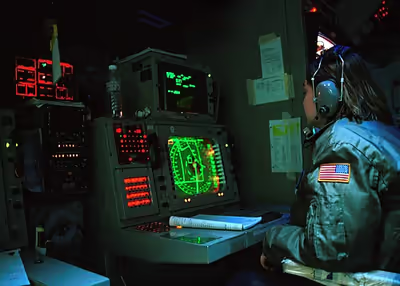
A command and control center is typically a secure room or building in a government, military or prison facility that operates as the agency's dispatch center, surveillance monitoring center, coordination office and alarm monitoring center all in one. Command and control centers are operated by a government or municipal agency.
Various branches of the US military such as the US Coast Guard and Navy have command and control centers. They are also common in many large correctional facilities.
A command and control center that is used by a military unit in a deployed location is usually called a "command post". A warship has a combat information center for tactical control of the ship's resources, but commanding a fleet or joint operation requires additional space for commanders and staff plus C4I facilities provided on a flagship (e.g., aircraft carriers), sometimes a command ship or upgraded logistics ship such as USS Coronado.
Command and control warfare
Command and control warfare encompasses all the military tactics that use communications technology. It can be abbreviated as C2W. An older name for these tactics is "signals warfare", derived from the name given to communications by the military. Newer names include information operations and information warfare.
The following techniques are combined:
with the physical destruction of enemy communications facilities. The objective is to deny information to the enemy and so disrupt its command and control capabilities. At the same time precautions are taken to protect friendly command and control capabilities against retaliation.
In addition to targeting the enemy's command and control, information warfare can be directed to the enemy's politicians and other civilian communications.
- Electronic warfare (EW)
- Military deception
- Operations security (OPSEC)
- Psychological operations (PSYOP)
- Psychological warfare