


Related on Lably
Historically, the dessert course consisted entirely of foods 'from the storeroom' (de l'office), including fresh, stewed, preserved, and dried fruits; nuts; cheese and other dairy dishes; dry biscuits (cookies) and wafers; and ices and ice creams. Sweet dishes from the kitchen, such as freshly prepared pastries, meringues, custards, puddings, and baked fruits, were served in the entremets course, not in the dessert course. By the 20th century, though, sweet entremets had come to be included among the desserts.
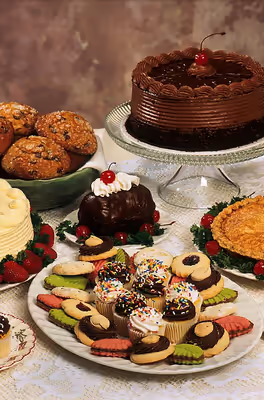
The modern term dessert can apply to many sweets, including fruit, custards, gelatins, puddings, biscuits, cookies, macaroons, pastries, pies, tarts, cakes, ice creams, and sweet soups.
Etymology
The term "dessert" originated from the French word desservir, meaning "to clear the table", and it referred to the final course of the meal, presented after the table was "cleared" (deservi).
One of the earliest uses of the term in a culinary context is in the Ménagier de Paris (1393), which includes a course of "desserte" in three of the menus, one of which includes sweet pastries and fruits, another of which includes savory frumenty and venison.
In later centuries, the term continued to refer to the last course of the meal. In the late 19th century, the word "desserts" also came to refer to the dishes served in the dessert course.
Sign in to keep reading
8 more chapters are free with a Lably account.
Other names
The word "dessert" is most commonly used for this course in Australia, Canada, Ireland, New Zealand, and the United States, while its use exists alongside several synonyms, including "pudding", "sweet" and "afters", in the United Kingdom and some other Commonwealth countries.
History
Sweets were fed to the gods in ancient Mesopotamia and ancient India and other ancient civilizations. Herodotus mentions that Persian meals featured many desserts, and were more varied in their sweet offerings than the main dishes. German army officer Helmuth von Moltke whilst serving in the Ottoman Empire noted the unusual presentation of courses with the sweet courses served between roasts and other savory dishes.
Dried fruit and honey were probably the first sweeteners used in most of the world, but the spread of sugarcane around the world was essential to the development of dessert. Sugarcane was grown and refined in India before 500 BC and was crystallized, making it easy to transport, by AD 500. Sugar and sugarcane were traded, making sugar available to Macedonia by 303 BC and China by AD 600. In the Indian subcontinent, the Middle East, and China, sugar has been a staple of cooking and desserts for over a thousand years.
Sugarcane and sugar were little known and rare in Europe until the twelfth century or later when the Crusades and then colonization spread its use. Europeans began to manufacture sugar in the Middle Ages, and more sweet desserts became available. Even then sugar was so expensive usually only the wealthy could indulge on special occasions. The first apple pie recipe was published in 1381; The earliest documentation of the term cupcake was in "Seventy-five Receipts for Pastry, Cakes, and Sweetmeats" in 1828 in Eliza Leslie's Receipts cookbook.
The Industrial Revolution in Europe and later America led to the mass-production of foodstuffs, including desserts, that could be processed, preserved, canned, and packaged. Frozen foods, including desserts, became very popular starting in the 1920s.
The broader amount of refined sugar and flour also helped with establishing elaborate desserts as a prominent feature in European court banquets in the 18th and 19th centuries. Tables could have creams, tarts, fruit, cakes, pastries, puddings, jellies, and meringues, usually shown to emphasize wealth and technicall skill.
Ingredients
Sweet desserts usually contain cane sugar, palm sugar, brown sugar, honey, or some types of syrup such as molasses, maple syrup, treacle, or corn syrup. Other common ingredients in Western-style desserts are flour or other starches, cooking fats such as butter or lard, dairy, eggs, salt, acidic ingredients such as lemon juice, and spices and other flavoring agents such as chocolate, coffee, peanut butter, fruits, and nuts. The proportions of these ingredients, along with the preparation methods, play a major part in the consistency, texture, and flavor of the end product.
Sugars contribute moisture and tenderness to baked goods. Flour or starch components serves as a protein and gives the dessert structure. Fats contribute moisture and can enable the development of flaky layers in pastries and pie crusts. The dairy products in baked goods keep the desserts moist. Many desserts also contain eggs, in order to form custard or to aid in the rising and thickening of a cake-like substance. Egg yolks specifically contribute to the richness of desserts. Egg whites can act as a leavening agent or provide structure. Further innovation in the healthy eating movement has led to more information being available about vegan and gluten-free substitutes for the standard ingredients, as well as replacements for refined sugar.
Desserts can contain many spices and extracts to add a variety of flavors. Salt and acids are added to desserts to balance sweet flavors and create a contrast in flavors. Some desserts are coffee-flavored, for example an iced coffee soufflé or coffee biscuits. Alcohols and liqueurs can also be used as an ingredient, to make alcoholic desserts.
Varieties and elements
Desserts consist of variations of tastes, textures, and appearances. Desserts can be defined as a usually sweeter course that concludes a meal. This definition includes a range of courses ranging from fruits or dried nuts to multi-ingredient cakes and pies. Many cultures have different variations of dessert. In modern times the variations of desserts have usually been passed down or come from geographical regions. This is one cause for the variation of desserts. These are some major categories in which desserts can be placed.
Cakes
Cakes are sweet tender breads made with sugar and delicate flour. Cakes can vary from light, airy sponge cakes to dense cakes with less flour. Common flavorings include dried, candied or fresh fruit, nuts, cocoa or extracts. They may be filled with fruit preserves or dessert sauces (like pastry cream), iced with buttercream or other icings, and decorated with marzipan, piped borders, or candied fruit. Cake is often served as a celebratory dish on ceremonial occasions, for example weddings, anniversaries, and birthdays. Small-sized cakes have become popular, in the form of cupcakes and petits fours, an example of which can be the Portuguese "bolo de arroz".
Puddings
Puddings are similar to custards in that their base is cream or milk. However, their primary difference is that puddings are thickened with starches such as corn starch or tapioca. On the other hand, custards are thickened using only eggs and are usually more firm.
Small cakes and pastries
Biscuits or cookies are small disks of sweetened dough, similar in composition to a cake. The term "biscuit" is a derivation of Latin for twice-baked, while the term "cookie" is a Dutch diminutive for koek, meaning cake. Some examples of this dessert include a ginger nut, shortbread biscuit and chocolate chip cookie. In Commonwealth English, the term "biscuit" refers to this type of dessert in general, with "cookie" reserved for a specific type of drop cookie; in North America, the term "cookie" typically refers to all forms of this dessert, with "biscuit" more commonly referring to a type of bread.
Other small cakes and pastries can also be counted as under these terms, due to their size and relative similarity to cookies and biscuits, such as jaffa cakes and Eccles cakes.
Confection
Confection, also called candy, sweets or lollies, features sugar or honey as a principal ingredient.
Many involve sugar heated into crystals with subtle differences. Dairy and sugar based include caramel, fudge and toffee or taffy. There are multiple forms of egg and sugar meringues and similar confections. Unheated sugar dissolves into icings, preservatives and sauces with other ingredients.
Before refined sugar became so available, honey was typically added to sweeten confections with fruit, nuts, herbs, and spices. Sugar based candy production later expanded in Europe, and these confectionary later became more and more mechanized from the late 18th century.
Chocolate
Theobroma cacao beans are commonly mixed with sugar to form chocolate. Pure, unsweetened dark chocolate contains primarily cocoa solids. Cocoa butter is also added in varying proportions. Much of the chocolate currently consumed is in the form of sweet chocolate, combining chocolate with sugar. Milk chocolate is sweet chocolate that additionally contains milk powder or condensed milk. White chocolate contains cocoa butter, sugar, and milk, but no cocoa solids. Dark chocolate is produced by adding fat and sugar to the cacao mixture, with no milk or much less than milk chocolate. Beyond consuming chocolate on its own, it is also an ingredient commonly used in many desserts such as brownies.
Mithai (sweets)
Mithai, derived from the Sanskrit word 'sharkara', represents the range of Indian desserts.
Custards
These kinds of desserts usually include a thickened dairy base. Custards are cooked and thickened with eggs. Baked custards include crème brûlée and flan. They are often used as ingredients in other desserts, for instance as a filling for pastries or pies.
Custards can also be served soft like found in crème anglaise, or can be served firmly by baking or chilling. Their texture depends on the controlled heating of eggs and diary, because expressive heat can cause the proteins to overcoagulate and create a curdled texture.
Deep-fried
Many cuisines include a dessert made of deep-fried starch-based batter or dough. In many countries, a doughnut is a flour-based batter that has been deep-fried. It is sometimes filled with custard or jelly. Fritters are fruit pieces in a thick batter that have been deep fried. Gulab jamun is an Indian dessert made of milk solids kneaded into a dough, deep-fried, and soaked in honey. Churros are a deep-fried and sugared dough that is eaten as dessert or a snack in many countries.
Deep-fried desserts differ in shape and preparation. It can range from ring shaped doughnuts to delicious sweets drizzled in syrup and filled pastries. Frying quickly creates a browned outer layer while keeping the interior soft. After, many desserts are finished with sugar, syrup, honey, or a sweet filling.
Frozen
Ice cream, gelato, sorbet and shaved-ice desserts fit into this category. Ice cream is a cream base that is churned as it is frozen to create a creamy consistency. Gelato uses a milk base and has less air whipped in than ice cream, making it denser. Sorbet is made from churned fruit and is not dairy based. Shaved-ice desserts are made by shaving a block of ice and adding flavored syrup or juice to the ice shavings.
Frozen desserts are different in their proportions of dairy, sugar, and incorporated air. Gelato is generally made with less milk fat and less air than the typical ice cream, which explains the denser texture. It is also served at a warmer temperature. Sherbet is a fruit-flavored frozen dessert that includes milk or cream, differentiating itself from dairy free sorbet.
Gelatin
Jellied desserts are made with a sweetened liquid thickened with gelatin or another gelling agent. They are traditional in many cultures. Yōkan is a Japanese jellied dessert. In English-speaking countries, many dessert recipes are based on gelatin with fruit or whipped cream added. The vegetarian substitute for gelatin is agar agar. Marshmallow is also most commonly made with gelatin.
Gelling agents let sweetened liquids to set into a range of textures, from soft and spoonable gels to firmer molded desserts. Agar, a gelling substance from seaweed, is typically used in Asian desserts and can be a vegetarian alternative to animal gelatin.
Pastries
Pastries are sweet baked pastry products. Pastries can either take the form of light and flaky bread with an airy texture, such as a croissant or unleavened dough with a high fat content and crispy texture, such as shortbread. Pastries are often flavored or filled with fruits, chocolate, nuts, and spices. Pastries are sometimes eaten with tea or coffee as a breakfast food.
Pies, cobblers, and clafoutis
Pies and cobblers consist of a filling enclosed by a crust, which can be made from either pastry or crumbs. The fillings of pies can vary from fruits to puddings, whereas cobbler fillings are mostly fruit-based. On the other hand, clafoutis is a dessert in which batter is poured over a fruit-based filling before being baked.
Sweet soups
Tong sui, literally translated as "sugar water" and also known as tim tong, is a collective term for any sweet, warm soup or custard served as a dessert at the end of a meal in Cantonese cuisine. Tong sui are a Cantonese specialty and are rarely found in other regional cuisines of China. Outside of Cantonese-speaking communities, soupy desserts generally are not recognized as a distinct category, and the term tong sui is not used.
Wines
Dessert wines are sweet wines typically served with dessert. There is no simple definition of a dessert wine. In the UK, a dessert wine is considered to be any sweet wine drunk with a meal, as opposed to the white fortified wines (fino and amontillado sherry) drunk before the meal, and the red fortified wines (port and madeira) drunk after it. Thus, most fortified wines are regarded as distinct from dessert wines, but some of the less strong fortified white wines, such as Pedro Ximénez sherry and Muscat de Beaumes-de-Venise, are regarded as honorary dessert wines. In the United States, by contrast, a dessert wine is legally defined as any wine over 14% alcohol by volume, which includes all fortified wines - and is taxed at higher rates as a result. Examples include Sauternes and Tokaji Aszú.
By region
Africa
Throughout much of central and western Africa, there is no tradition of a dessert course following a meal. Fruit or fruit salad would be eaten instead, which may be spiced, or sweetened with a sauce. In some former colonies in the region, the colonial power has influenced desserts – for example, the Angolan cocada amarela (yellow coconut) resembles baked desserts in Portugal.
Asia
In Asia, desserts are often eaten between meals as snacks rather than as a concluding course. There is widespread use of rice flour in East Asian desserts, which often include local ingredients such as coconut milk, palm sugar, and tropical fruit. In India, where sugarcane has been grown and refined since before 500 BC, desserts have been an important part of the diet for thousands of years; types of desserts include burfis, halvahs, jalebis, and laddus.
Ukraine and Russia
In Ukraine and Russia, breakfast foods such as nalysnyky or blintz or oladi (pancake), and syrniki are served with honey and jam as desserts.
The Netherlands
In the Netherlands vla is a popular dessert. It is a custard-like dessert that is served cold. Popular flavours are: vanilla, chocolate, caramel, and several fruit flavours. There is also hopjesvla which is flavoured like a Hopje, a Dutch coffee and caramel sweet.
France
Early use of the term
The word dessert as a culinary term appears as early as 1393 in the Ménagier de Paris, where "desserte" is included in three of the twenty-nine menus. The desserte comes near the end of the meal, but before the issue (departure) of hypocras and wafers, included in ten of the menus; and before the boute-hors (sendoff) of wines and spices, included in four of the menus. The desserte was the last cooked course of the meal, but the boute-hors was the true final course of the meal.
In the later printed book Petit traicté auquel verrez la maniere de faire cuisine (c. 1536), more widely known from the edition titled Livre fort excellent de cuisine (1542), the menus at the end of the book present the meal in four stages : the entree de table (entrance to the table), potaiges (foods boiled or simmered "in pots"), services de rost (meat or fowl "roasted" in dry heat), and issue de table (departure from the table). The issue de table includes fruit, nuts, pastries, jellies, cheese, and cream. The menus do not mention "dessert".
Dessert in the "Classical Order" of table service
Between the mid-16th and mid-17th century, the stages of the meal underwent several significant changes. Notably, potage became the first stage of the meal, the entrée became the second stage, entremets came to be served in their own distinct stage after the roast, and the last course of the meal came to be called "dessert".
In the 17th, 18th, and 19th centuries, the dessert stage of the meal consisted entirely of foods "from the storeroom" (de l'office), such as fresh, stewed, preserved, and dried fruits; fruit jellies; nuts; cheese and other dairy dishes; dry biscuits (cookies) and wafers; and, beginning in the mid-18th century, ices and petits fours.
On lean days out of Lent, the dishes in the dessert stage of the meal were the same as those served on meat days. In Lent, though, eggs were never served at any meal, and only dishes that did not include eggs were appropriate for the dessert stage.
Despite the significance of dessert in the structured meals of the time, the dessert course was often not included on the menus or bills of fare of the 17th and 18th centuries.
Changes in the 19th and 20th centuries
In the late 19th century, the word dessert, which properly referred to the last stage of the meal, came to refer also to the dishes that were served in that stage.
In the 20th century, cheeses came to be served in their own course just before the dessert course.
Also in the 20th century, sweet dishes from the kitchen, such as freshly prepared pastries, meringues, custards, puddings, and baked fruits, which had traditionally been served in the entremets course, came to be included among the desserts.
North America
Ice cream in the United States is popular. Pie and Cheesecake is also fairly popular in the US. Some of Mexico’s favorite desserts are flans, paletas, and Pastel de Tres Leches.
South America
Dulce de leche is a very common confection in Argentina. In Bolivia, sugarcane, honey and coconut are traditionally used in desserts. Tawa tawa is a Bolivian sweet fritter prepared using sugar cane, and helado de canela is a dessert that is similar to sherbet which is prepared with cane sugar and cinnamon. Coconut tarts, puddings cookies and candies are also consumed in Bolivia. Brazil has a variety of candies such as brigadeiros (chocolate fudge balls), cocada (a coconut sweet), beijinhos (coconut truffles and clove) and Romeu e Julieta (cheese with a guava jam known as goiabada). Peanuts are used to make paçoca, rapadura and pé-de-moleque. Local common fruits are turned in juices and used to make chocolates, ice pops and ice cream. In Chile, kuchen has been described as a "trademark dessert". Several desserts in Chile are prepared with manjar, (caramelized milk), including alfajor, flan, cuchufli and arroz con leche. Desserts consumed in Colombia include dulce de leche, waffle cookies, puddings, nougat, coconut with syrup and thickened milk with sugarcane syrup. Desserts in Ecuador tend to be simple, and desserts are a moderate part of the cuisine. Desserts consumed in Ecuador include tres leches cake, flan, candies and various sweets.
Oceania
In Australia, meals are often finished with dessert. This includes various fruits. More complex desserts include cakes, pies and cookies, which are sometimes served during special occasions.
New Zealand and Australia have a long-standing debate over which country invented the Pavlova. The pavlova is named after Anna Pavlova, who visited both countries in the 1920s.
Market
The market for desserts has grown over the last few decades, being greatly increased by the commercialization of baking desserts and the rise of food productions. Desserts are served in most restaurants as their popularity has increased. Many commercial stores have been established as solely dessert stores. Ice cream parlors have been around since before 1800. Many businesses have started advertising campaigns focusing solely on desserts. The tactics used to market desserts are very different depending on the audience; for example, desserts can be advertised with popular movie characters to target children. The rise of companies such as Food Network has produced many shows which feature desserts and their creation. Shows like these have displayed extreme desserts and made a game show atmosphere to make desserts a more competitive field.
Desserts are a standard staple in restaurant menus, with different degrees of variety. Pie and cheesecake were among the most popular dessert courses ordered in U.S. restaurants in 2012.
Nutrition
Dessert foods often contain relatively high amounts of sugar and fats and, as a result, higher calorie counts per gram than other foods. Fresh or cooked fruit with minimal added sugar or fat is an exception.