

Dhammapada
Collection of sayings of the Buddha in verse form
- 7 min read
- 6 chapters

Related on Lably
Through The Buddha, Buddhism and Dharma
The Buddhist scholar and commentator Buddhaghosa explains that each saying recorded in the collection was made on a different occasion in response to a unique situation that had arisen in the life of the Buddha and his monastic community. His translation of the commentary, the Dhammapada Aṭṭhakatha, presents the details of these events and is a rich source of legend for the life and times of the Buddha.
Etymology
The title "Dhammapada" is a compound term composed of dhamma and pada, each word having a number of denotations and connotations. Generally, dhamma can refer to the Buddha's "doctrine" or an "eternal truth" or "righteousness" or all "phenomena"; at its root, pada means "foot" and thus by extension, especially in this context, means either "path" or "verse" (cf. prosodic foot) or both. English translations of this text's title have used various combinations of these and related words.
Sign in to keep reading
5 more chapters are free with a Lably account.
History
According to tradition, the Dhammapada's verses were spoken by the Buddha on various occasions. Glenn Wallis states: "By distilling the complex models, theories, rhetorical style and sheer volume of the Buddha's teachings into concise, crystalline verses, the Dhammapada makes the Buddhist way of life available to anyone...In fact, it is possible that the very source of the Dhammapada in the third century B.C.E. is traceable to the need of the early Buddhist communities in India to laicize the ascetic impetus of the Buddha's original words." The text is part of the Khuddaka Nikāya of the Sutta Piṭaka, although over half of the verses exist in other parts of the Pāli Canon. A 4th or 5th century CE commentary attributed to Buddhaghosa includes 305 stories which give context to the verses.
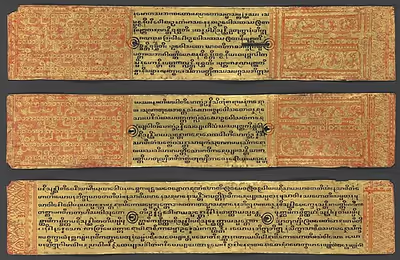
The Pāli Dhammapada is one of the most popular pieces of Theravāda literature. Its oldest available manuscripts date to 1500 CE. A compiler is not named. A critical edition of the Dhammapada in Latin was produced by Danish scholar Viggo Fausbøll in 1855, becoming the first Pāli text to receive this kind of examination by the European academic community.
Parallels
Although the Pāli edition is the best-known, a number of other versions are known:
- "Gāndhārī Dharmapada" – a version possibly of Dharmaguptaka or Kāśyapīya origin in Gāndhārī written in Kharosthi script
- "Patna Dharmapada" – a version in Buddhist Hybrid Sanskrit, most likely of the Sāmatiya sect
- "Udānavarga" – a seemingly related Mula-Sarvāstivāda or Sarvāstivāda text in
- 3 Sanskrit versions
- a Tibetan translation, which is popular in traditional Tibetan Buddhism
- "Mahāvastu" – a Lokottaravāda text with parallels to verses in the Pāli Dhammapada's Sahassa Vagga and Bhikkhu Vagga.
- "Fajujing 法句经" – 4 Chinese works; one of these appears to be an expanded translation of the Pāli version; this has not traditionally been very popular.
- The Faju jing – translated and compiled by Weizhinan in 224 CE
- The Faju piyu jing – compiled by Faju and Fali between 290-306 CE
- The Chuyao jing – translated by Zhu Fonian in 383 CE
- The Faju yaosong jing – translated by Tianxizai between 980-999 CE
Comparing the Pāli Dhammapada, the Gāndhārī Dharmapada and the Udānavarga, Brough (2001) identifies that the texts have in common 330 to 340 verses, 16 chapter headings and an underlying structure. He suggests that the three texts have a "common ancestor" but underlines that there is no evidence that any one of these three texts might have been the "primitive Dharmapada" from which the other two evolved.
Organization
The Pāli Dhammapada contains 423 verses in 26 chapters (listed in Pāli and English):
Many of the themes within the Dhammapada are dichotomous. For example, contrasts between joy and suffering, virtuous action and misconduct, and truth and deceit recur throughout the text.
Excerpts
The following Pāli verses and corresponding English translations are from Ānandajoti (2017), which also contains explanatory footnotes.
English translations
See also online translations listed in External links.
- Daniel Gogerly, printed the first English translation of Dhammapada, comprising verses 1–255 in 1840 in Ceylon.
- Tr F. Max Müller, from Pali, 1870; reprinted in Sacred Books of the East, volume X, Clarendon/Oxford, 1881; reprinted in Buddhism, by Clarence Hamilton; reprinted separately by Watkins, 2006; reprinted 2008 by Red and Black Publishers, St Petersburg, Florida, ISBN 978-1-934941-03-4; the first complete English translation; (there was a Latin translation by V. Fausböll in 1855).
- Tr J. Gray, American Mission Press, Rangoon, 1881
- Tr J. P. Cooke & O. G. Pettis, Boston (Massachusetts?), 1898
- Hymns of Faith, tr Albert J. Edmunds, Open Court, Chicago, & Kegan Paul, Trench, Trübner & Co., London, 1902
- Tr Norton T. W. Hazeldine, Denver, Colorado, 1902
- The Buddha's Way of Virtue, tr W. D. C. Wagiswara & K. J. Saunders, John Murray, London, 1912
- Tr Silacara, Buddhist Society, London, 1915
- Tr Suriyagoda Sumangala, in Ceylon Antiquary, 1915
- Tr A. P. Buddhadatta, Colombo Apothecaries, 1920?
- The Buddha's Path of Virtue, tr F. L. Woodward, Theosophical Publishing House, London & Madras, 1921
- In Buddhist Legends, tr E. W. Burlinghame, Harvard Oriental Series, 1921, 3 volumes; reprinted by Pali Text Society , Bristol; translation of the stories from the commentary, with the Dhammapada verses embedded
- Tr R. D. Shrikhande and/or P. L. Vaidya (according to different bibliographies; or did one publisher issue two translations in the same year?), Oriental Book Agency, Poona, 1923; includes Pali text
- "Verses on Dhamma", in Minor Anthologies of the Pali Canon, volume I, tr C. A. F. Rhys Davids, 1931, Pali Text Society, Bristol; verse translation; includes Pali text
- Tr N. K. Bhag(w?)at, Buddha Society, Bombay, 1931/5; includes Pali text
- The Way of Truth, tr S. W. Wijayatilake, Madras, 1934
- Tr Irving Babbitt, Oxford University Press, New York & London, 1936; revision of Max Müller
- Tr K. Gunaratana, Penang, Malaya, 1937
- The Path of the Eternal Law, tr Swami Premananda, Self-Realization Fellowship, Washington DC, 1942
- Tr Dhammajoti, Maha Bodhi Society, Benares, 1944
- Comp. Jack Austin, Buddhist Society, London, 1945
- Stories of Buddhist India, tr Piyadassi, 2 volumes, Moratuwa, Ceylon, 1949 & 1953; includes stories from the commentary
- (see article) Tr Sarvepalli Radhakrishnan, Oxford University Press, London, 1950; includes Pali text
- Collection of Verses on the Doctrine of the Buddha, comp Bhadragaka, Bangkok, 1952
- Tr T. Latter, Moulmein, Burma, 1950?
- Tr W. Somalokatissa, Colombo, 1953
- Tr Narada, John Murray, London, 1954
- Tr E. W. Adikaram, Colombo, 1954
- Tr A. P. Buddhadatta, Colombo, 1954; includes Pali text
- Tr Siri Sivali, Colombo, 1954
- Tr ?, Cunningham Press, Alhambra, California, 1955
- Tr C. Kunhan Raja, Theosophical Publishing House, Adyar/Madras, 1956; includes Pali text
- Free rendering and interpretation by Wesley La Violette, Los Angeles, 1956
- Tr Buddharakkhita, Maha Bodhi Society, Bangalore, 1959; 4th edn, Buddhist Publication Society, Kandy, Sri Lanka, 1996; includes Pali text
- Tr Suzanne Karpelès, serialized in Advent (Pondicherry, India), 1960–65; reprinted in Questions and Answers, Collected Works of the Mother, 3, Pondicherry, 1977
- Growing the Bodhi Tree in the Garden of the Heart, tr Khantipalo, Buddhist Association of Thailand, Bangkok, 1966; reprinted as The Path of Truth, Bangkok, 1977
- Tr P. Lal, New York, 1967/70
- Tr Juan Mascaró, Penguin Classics, 1973
- Tr Thomas Byrom, Shambhala, Boston, Massachusetts, & Wildwood House, London, 1976 (ISBN 0-87773-966-8)
- Tr Ananda Maitreya, serialized in Pali Buddhist Review, 1 & 2, 1976/7; offprinted under the title Law Verses, Colombo, 1978; revised by Rose Kramer (under the Pali title), originally published by Lotsawa Publications in 1988, reprinted by Parallax Press in 1995
- The Buddha's Words, tr Sathienpong Wannapok, Bangkok, 1979
- Wisdom of the Buddha, tr Harischandra Kaviratna, Pasadena, 1980; includes Pali text
- The Eternal Message of Lord Buddha, tr Silananda, Calcutta, 1982; includes Pali text
- Tr Chhi Med Rig Dzin Lama, Institute of Higher Tibetan Studies, Sarnath, India, 1982; tr from the modern Tibetan translation by dGe-'dun Chos-'phel; includes Pali & Tibetan texts
- Tr & pub Dharma Publishing, Berkeley, California, 1985; tr from the modern Tibetan translation by dGe-'dun Chos-'phel
- Commentary, with text embedded, tr Department of Pali, University of Rangoon, published by Union Buddha Sasana Council, Rangoon (date uncertain; 1980s)
- Tr Daw Mya Tin, Burma Pitaka Association, Rangoon, 1986; probably currently published by the Department for the Promotion and Propagation of the Sasana, Rangoon, and/or Sri Satguru, Delhi
- Path of Righteousness, tr David J. Kalupahana, Universities Press of America, Lanham, Maryland, c. 1986
- Tr Raghavan Iyer, Santa Barbara, 1986; includes Pali text
- (see article) Tr Eknath Easwaran, Arkana, London, 1986/7(ISBN 978-1-58638-019-9); reissued with new material Nilgiri Press 2007, Tomales, CA (ISBN 9781586380205)
- Tr John Ross Carter & Mahinda Palihawadana, Oxford University Press, New York, 1987; the original hardback edition also includes the Pali text and the commentary's explanations of the verses; the paperback reprint in the World's Classics Series omits these
- Tr U. D. Jayasekera, Colombo, 1992
- Treasury of Truth, tr Weragoda Sarada, Taipei, 1993
- Tr Thomas Cleary, Thorsons, London, 1995
- The Word of the Doctrine, tr K. R. Norman, 1997, Pali Text Society, Bristol; the PTS's preferred translation
- Intro/Ed. Anne Bancroft (Tr Byrom), Element Books, Shaftesbury, Dorset, & Richport, Massachusetts, 1997
- The Dhammapada: The Buddha's Path of Wisdom, tr Buddharakkhita, Buddhist Publication Society, 1998. (ISBN 9-55240-131-3)
- The Way of Truth, tr Sangharakshita, Windhorse Publications, Birmingham, 2001
- Tr F. Max Müller (see above), revised Jack Maguire, SkyLight Pubns, Woodstock, Vermont, 2002
- Tr Glenn Wallis, Modern Library, New York, 2004 (ISBN 978-0-8129-7727-1); The Dhammapada: Verses on the Way
- Tr Gil Fronsdal, Shambhala, Boston, Massachusetts, 2005 (ISBN 1-59030-380-6)
- Tr Bhikkhu Varado, Inward Path, Malaysia, 2007; Dhammapada in English Verse
Musical settings
- Ronald Corp's 2010 a cappella choral setting of Francis Booth's translation, released on Stone Records
- "Dhammapada - Sacred Teachings of the Buddha." Hariprasad Chaurasia & Rajesh Dubey. 2018 - Freespirit Records