


Related on Lably
Through Insect, Bird and Insectivore
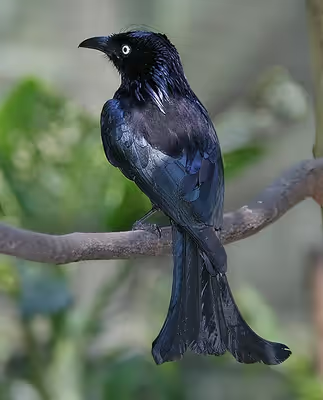
Drongos are mostly black or dark grey, short-legged birds, with an upright stance when perched. They have forked tails and some have elaborate tail decorations. They feed on insects and small birds, which they catch in flight or on the ground. Some species are accomplished mimics and have a variety of alarm calls, to which other birds and animals often respond. They are known to utter fake alarm calls that scare other animals off food, which the drongo then claims.
Taxonomy
The genus Dicrurus was introduced by French ornithologist Louis Pierre Vieillot for the drongos in 1816. The type species was subsequently designated as the balicassiao (Dicrurus balicassius) by English zoologist George Robert Gray in 1841. The name of the genus combines the Ancient Greek words dikros "forked" and oura "tail". "Drongo" is originally from the indigenous language of Madagascar, where it refers to the crested drongo; it is now used for all members of the family.
This family now includes only the genus Dicrurus, although Christidis and Boles (2007) expanded the family to include the subfamilies Rhipidurinae (Australasian fantails), Monarchinae (monarch and paradise flycatchers), and Grallininae (magpie larks).
The family was formerly treated as having two genera, Chaetorhynchus and Dicrurus. The genus Chaetorhynchus contains a single species, the New Guinea–endemic C. papuensis. On the basis of both morphological and genetic differences, it is now placed with the fantails (Rhipiduridae) and renamed from the pygmy drongo to the drongo fantail.
The genus Dicrurus contains 28 species:
The family Dicruridae is most likely of Indo-Malayan origin, with a colonization of Africa about 15 million years ago (Mya). Dispersal across the Wallace Line into Australasia is estimated to have been more recent, around 6 Mya.
Sign in to keep reading
2 more chapters are free with a Lably account.
Characteristics
These insectivorous birds are usually found in open forests or bush. Most are black or dark grey in colour, sometimes with metallic tints. They have long, forked tails; some Asian species have elaborate tail decorations. They have short legs and sit very upright whilst perched, like a shrike. They flycatch or take prey from the ground. Some drongos, especially the greater racket-tailed drongo, are noted for their ability to mimic other birds and even mammals.
Two to four eggs are laid in a nest high in a tree. Despite their small size, they are aggressive and fearless, and will attack much larger species if their nests or young are threatened.
Several species of animals and birds respond to drongos' alarm calls, which often warn of the presence of a predator. Fork-tailed drongos in the Kalahari Desert use alarm calls in the absence of a predator to cause animals to flee and abandon food, which they eat, getting up to 23% of their food this way. They not only use their own alarm calls, but also imitate those of many species, either their victim's or that of another species to which the victim responds. If the call of one species is not effective, perhaps because of habituation, the drongo may try another; 51 different calls are known to be imitated. In one test on pied babblers, the babbler ignored an alarm call repeated three times when no danger was present, but continued to respond to different calls. Researchers have considered the possibility that these drongos possess theory of mind, not fully shown in any animal other than humans.
Culture
The word "drongo" is used in Australian English as a mild form of insult meaning "idiot" or "stupid fellow". This usage derives from an Australian racehorse of the same name (Drongo) (apparently after the spangled drongo, D. bracteatus) in the 1920s that never won despite many places. The word also has been frequently used among friends and can be used in a casual or serious tone.