

Dsungaripterus
Genus of dsungaripterid pterosaur from the Early Cretaceous
- 2 min read
- 3 chapters

Related on Lably
Through China, South Korea and Phylogenetics
Description
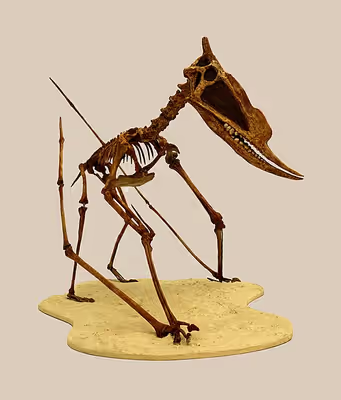
Dsungaripterus weii had a wingspan of 3–3.5 metres (9.8–11.5 ft). Like most dsungaripteroids it had a rather robust skeleton with thick walls and stouty bodily proportions, suggesting a mostly terrestrial lifestyle. The flight style of these animals is unclear, but it was probably punctuated by abrupt landings and extensive flapping.
The skull of Dsungaripterus, measuring over 46 centimeters (18 in) long, bore a low bone crest that ran down from the base of the skull to halfway to the beak. Dsungaripterus's head and neck were together almost 1 meter (3.3 ft) long. Its most notable feature are its long, narrow, upcurved jaws with a pointed tip. It had no teeth in the front part of its jaws, which were probably used to remove prey from cracks in rocks and/or the sandy, muddy inland environments it inhabited. It had knobbly flat teeth more to the back of the jaw that were well suited for crushing the armor of shellfish or other hard objects. Thus, it is commonly interpreted that dsungaripterids were durophagous and possibly piscivorous pterosaurs. Additionally, Dsungaripterus also had a palate similar to that of azhdarchoids.
Sign in to keep reading
2 more chapters are free with a Lably account.
History of discovery
Dsungaripterus was described in 1964 named by Yang Zhongjian. The genus name combines a reference to the Junggar Basin with a Latinized Greek pteron, "wing". The type species is Dsungaripterus weii, the specific name honoring paleontologist C.M. Wei of the Palaeontological Division, Institute of Science, Bureau of Petroleum of Xinjiang. The holotype is IVPP V-2776, a partial skull and skeleton from the Lianmuqin Formation. In 1973, more material has been found within the Shengjinkou Formation, which includes almost complete skulls.
In 1980 Peter Galton renamed Pterodactylus brancai (Reck 1931) from the Tendaguru Formation into Dsungaripterus brancai, but the identification is now commonly rejected. In 1982 Natasha Bakhurina named a new species, Dsungaripterus parvus, based on a smaller skeleton from Mongolia. Later, this was renamed into "Phobetor", a preoccupied name, and in 2009 concluded to be identical to Noripterus. A dsungaripterid wing finger phalanx was reported in 2002 from the Hasandong Formation of South Korea, and was identified in 2015 and 2018 as Dsungaripterus? cf. D. weii.
Classification
Dsungaripterus was classified by Yang as a member of the Dsungaripteridae. Below is a cladogram showing the results of a phylogenetic analysis presented by Andres and colleagues in 2014. They recovered Dsungaripterus within the clade Dsungaripteromorpha (a subgroup within the Azhdarchoidea), more specifically within the Dsungaripteridae, sister taxon to Domeykodactylus. Their cladogram is shown below.
In 2019, a different topology, this time by Kellner and colleagues, was published. In this study, Dsungaripterus was recovered outside the Azhdarchoidea, within the larger group Tapejaroidea, sister taxon to Noripterus. The cladogram of the analysis is shown below.