

Extraction (chemistry)
Separation of a desired substance from other substances in the sample
- 2 min read
- 3 chapters
- 4 labs on Lably

Learn it on Lably
Types of extraction
- Liquid–liquid extraction
- Acid-base extraction
- Supercritical fluid extraction
- Solid-liquid extraction
- Solid-phase extraction
- Maceration (grinding)
- Ultrasound-assisted extraction
- Microwave-assisted extraction
- Heat reflux extraction
- Instant controlled pressure drop extraction (Détente instantanée contrôlée)
- Supercritical fluid extraction
- Pressurized liquid extraction
- Perstraction
Sign in to keep reading
2 more chapters are free with a Lably account.
Laboratory applications and examples
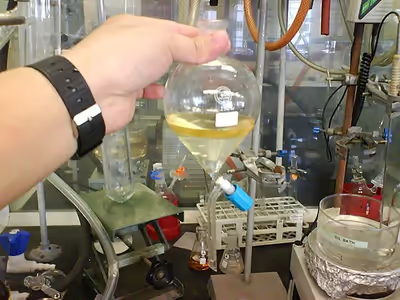
Liquid-liquid extractions in the laboratory usually make use of a separatory funnel, where two immiscible phases are combined to separate a solute from one phase into the other, according to the relative solubility in each of the phases. Typically, this will be to extract organic compounds out of an aqueous phase and into an organic phase, but may also include extracting water-soluble impurities from an organic phase into an aqueous phase.
Common extractants may be arranged in increasing order of polarity according to the Hildebrand solubility parameter:
- ethyl acetate < acetone < ethanol < methanol < acetone:water (7:3) < ethanol:water (8:2) < methanol:water (8:2) < water
Solid-liquid extractions at laboratory scales can use Soxhlet extractors. A solid sample containing the desired compound along with impurities is placed in the thimble. An extracting solvent is chosen in which the impurities are insoluble and the desired compound has at least limited solubility. The solvent is refluxed and condensed solvent falls into the thimble and dissolves the desired compound which then passes back through the filter into the flask. After extraction is complete the solvent can be removed and the desired product collected.
Everyday applications and examples
Boiling tea leaves in water extracts the tannins, theobromine, and caffeine out of the leaves and into the water, as an example of a solid-liquid extraction. A microwave-assisted approach is common among Americans.
Brewing of coffee can make use of many more advanced solid-liquid extraction techniques, especially pressurized fluid (espresso machine) and heat reflux (coffee percolator).
Chefs commonly use oil, both cold and hot, to extract aroma-bearing compounds from herbs and spices.
Decaffeination of tea and coffee is also an example of an extraction, where the caffeine molecules are removed from the tea leaves or coffee beans, often utilising supercritical fluid extraction with CO2 or standard solid-liquid extraction techniques.