

Flame test
Process in chemistry to detect certain elements
- 3 min read
- 4 chapters

Related on Lably
Through Flame, Photoelectric effect and Photon
History
Robert Bunsen invented the now-famous Bunsen burner in 1855, which was useful in flame tests due to its non-luminous flame that did not disrupt the colors emitted by the test materials. The Bunsen burner, combined with a prism (filtering the color interference of contaminants), led to the creation of the spectroscope, capable of emitting the spectral emission of various elements. In 1860, the unexpected appearance of sky-blue and dark red was observed in spectral emissions by Bunsen and Gustav Kirchhoff, leading to the discovery of two alkali metals, caesium (sky blue) and rubidium (dark red). Today, this low-cost method is used in secondary education to teach students to detect metals in samples qualitatively.
Sign in to keep reading
3 more chapters are free with a Lably account.
Process
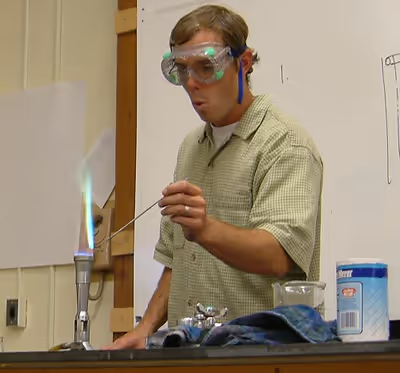
A flame test involves introducing a sample of the element or compound to a hot, non-luminous flame and observing the color of the flame that results. The compound can be made into a paste with concentrated hydrochloric acid, as metal halides, being volatile, give better results. Different flames can be tried to verify the accuracy of the color. Wooden splints, Nichrome wires, platinum wires, magnesia rods, cotton swabs, and melamine foam are suggested for support. Safety precautions are crucial due to the flammability and toxicity of some substances involved. When using a splint, one must be careful to wave the splint through the flame rather than holding it in the flame for extended periods, to avoid setting the splint itself on fire. The use of a cotton swab or melamine foam (used in "eraser" cleaning sponges) as a support has also been suggested. Sodium is a common component or contaminant in many samples, and its spectrum tends to dominate many other flame tests. The test flame is often viewed through cobalt blue glass to filter out the yellow of sodium and allow for easier viewing of other metal ions.
The color of the flames also generally depends on temperature and oxygen fed; see flame colors. The procedure uses different solvents and flames to view the test flame through a cobalt blue glass or didymium glass to filter the interfering light of contaminants such as sodium.
Flame tests are subject of a number of limitations. The range of elements positively detectable under standard conditions is small. Some elements emit weakly and others (Na) very strongly. Gold, silver, platinum, palladium, and a number of other elements do not produce a characteristic flame color, although some may produce sparks (as do metallic titanium and iron); salts of beryllium and gold reportedly deposit pure metal on cooling. The test is highly subjective.
Principle
In flame tests, ions are excited thermally. These excited states then relax to the ground state with emission of a photon. The energy of the excited state(s) and associated emitted photon is characteristic of the element. The nature of the excited and ground states depends only on the element. Ordinarily, there are no bonds to be broken, and molecular orbital theory is not applicable. The emission spectrum observed in flame test is also the basis of flame emission spectroscopy, atomic emission spectroscopy, and flame photometry.
Common elements
Some common elements and their corresponding colors are: