


Related on Lably
Through Thermodynamics, Molecule and Expression (mathematics)
The theory is named after Paul Flory and Maurice Loyal Huggins who developed it independently in 1941.
Theory
The thermodynamic equation for the Gibbs energy change accompanying mixing at constant temperature and (external) pressure is
A change, denoted by , is the value of a variable for a solution or mixture minus the values for the pure components considered separately. The objective is to find explicit formulas for and , the enthalpy and entropy increments associated with the mixing process.
The result obtained by Flory and Huggins is
The right-hand side is a function of the number of moles and volume fraction of solvent (component ), the number of moles and volume fraction of polymer (component ), with the introduction of a parameter to take account of the energy of interdispersing polymer and solvent molecules. is the gas constant and is the absolute temperature. The volume fraction is analogous to the mole fraction, but is weighted to take account of the relative sizes of the molecules. For a small solute, the mole fractions would appear instead, and this modification is the innovation due to Flory and Huggins. In the most general case the mixing parameter, , is a free energy parameter, thus including an entropic component.
Sign in to keep reading
4 more chapters are free with a Lably account.
Derivation
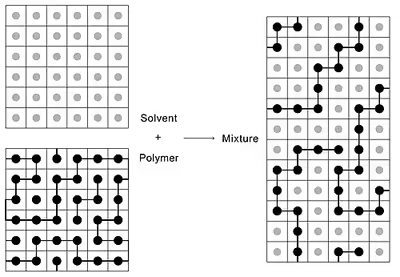
We first calculate the entropy of mixing, the increase in the uncertainty about the locations of the molecules when they are interspersed. In the pure condensed phases – solvent and polymer – a molecule exists for any arbitrarily small volume element. The expression for the entropy of mixing of small molecules in terms of mole fractions is no longer reasonable when the solute is a macromolecular chain. We take account of this dissymmetry in molecular sizes by assuming that individual polymer segments and individual solvent molecules occupy sites on a lattice. Each site is occupied by exactly one molecule of the solvent or by one monomer of the polymer chain, so the total number of sites is
where is the number of solvent molecules and is the number of polymer molecules, each of which has segments.
For a random walk on a lattice we can calculate the entropy change (the increase in spatial uncertainty) as a result of mixing solute and solvent.
where is the Boltzmann constant. Define the lattice volume fractions and
These are also the probabilities that a given lattice site, chosen at random, is occupied by a solvent molecule or a polymer segment, respectively. Thus
For a small solute whose molecules occupy just one lattice site, equals one, the volume fractions reduce to molecular or mole fractions, and we recover the usual entropy of mixing.
In addition to the entropic effect, we can expect an enthalpy change. There are three molecular interactions to consider: solvent-solvent , monomer-monomer (not the covalent bonding, but between different chain sections), and monomer-solvent . Each of the last occurs at the expense of the average of the other two, so the energy increment per monomer-solvent contact is
The total number of such contacts is
where is the coordination number, the number of nearest neighbors for a lattice site, each one occupied either by one chain segment or a solvent molecule. That is, is the total number of polymer segments (monomers) in the solution, so is the number of nearest-neighbor sites to all the polymer segments. Multiplying by the probability that any such site is occupied by a solvent molecule, we obtain the total number of polymer-solvent molecular interactions. An approximation following mean field theory is made by following this procedure, thereby reducing the complex problem of many interactions to a simpler problem of one interaction.
The enthalpy change is equal to the energy change per polymer monomer-solvent interaction multiplied by the number of such interactions
The polymer-solvent interaction parameter chi is defined as
It depends on the nature of both the solvent and the solute, and is the only material-specific parameter in the model. The enthalpy change becomes
Assembling terms, the total free energy change is
where we have converted the expression from molecules and to moles and by transferring the Avogadro constant to the gas constant .
The value of the interaction parameter can be estimated from the Hildebrand solubility parameters and
where is the actual volume of a polymer segment.
In the most general case the interaction and the ensuing mixing parameter, , is a free energy parameter, thus including an entropic component. The Flory–Huggins interaction parameter χ represents the energetic interaction between polymer segments and solvent molecules. It reflects the difference between polymer–solvent interactions and the average interactions of polymer–polymer and solvent–solvent pairs. Larger positive values of χ indicate unfavorable mixing and may lead to phase separation, whereas smaller values correspond to better miscibility. In many polymer–solvent systems the parameter is temperature dependent and often decreases as temperature increases. This means that aside to the regular mixing entropy there is another entropic contribution from the interaction between solvent and monomer. This contribution is sometimes very important in order to make quantitative predictions of thermodynamic properties.
More advanced solution theories exist, such as the Flory–Krigbaum theory.
Liquid-liquid phase separation
Polymers can separate out from the solvent, and do so in a characteristic way. The Flory–Huggins free energy per unit volume, for a polymer with monomers, can be written in a simple dimensionless form
for the volume fraction of monomers, and . The osmotic pressure (in reduced units) is
- .
The polymer solution is stable with respect to small fluctuations when the second derivative of this free energy is positive. This second derivative is
and the solution first becomes unstable when this and the third derivative
are both equal to zero. A little algebra then shows that the polymer solution first becomes unstable at a critical point at
This means that for all values of the monomer-solvent effective interaction is weakly repulsive, but this is too weak to cause liquid/liquid separation. However, when , there is separation into two coexisting phases, one richer in polymer but poorer in solvent, than the other.
The unusual feature of the liquid/liquid phase separation is that it is highly asymmetric: the volume fraction of monomers at the critical point is approximately , which is very small for large polymers. The amount of polymer in the solvent-rich/polymer-poor coexisting phase is extremely small for long polymers. The solvent-rich phase is close to pure solvent. This is peculiar to polymers, a mixture of small molecules can be approximated using the Flory–Huggins expression with , and then and both coexisting phases are far from pure.
Polymer blends
Synthetic polymers rarely consist of chains of uniform length in solvent. The Flory–Huggins free energy density can be generalized to an N-component mixture of polymers with lengths by
For a binary polymer blend, where one species consists of monomers and the other monomers this simplifies to
As in the case for dilute polymer solutions, the first two terms on the right-hand side represent the entropy of mixing. For large polymers of and these terms are negligibly small. This implies that for a stable mixture to exist , so for polymers A and B to blend their segments must attract one another.
Limitations
Flory–Huggins theory tends to agree well with experiments in the semi-dilute concentration regime and can be used to fit data for even more complicated blends with higher concentrations. The theory qualitatively predicts phase separation, the tendency for high molecular weight species to be immiscible, the interaction-temperature dependence and other features commonly observed in polymer mixtures. However, unmodified Flory–Huggins theory fails to predict the lower critical solution temperature observed in some polymer blends and the lack of dependence of the critical temperature on chain length . Additionally, it can be shown that for a binary blend of polymer species with equal chain lengths the critical concentration should be ; however, polymers blends have been observed where this parameter is highly asymmetric. In certain blends, mixing entropy can dominate over monomer interaction. By adopting the mean-field approximation, parameter complex dependence on temperature, blend composition, and chain length was discarded. Specifically, interactions beyond the nearest neighbor may be highly relevant to the behavior of the blend and the distribution of polymer segments is not necessarily uniform, so certain lattice sites may experience interaction energies disparate from that approximated by the mean-field theory.
One well-studied effect on interaction energies neglected by unmodified Flory–Huggins theory is chain correlation. In dilute polymer mixtures, where chains are well separated, intramolecular forces between monomers of the polymer chain dominate and drive demixing leading to regions where polymer concentration is high. As the polymer concentration increases, chains tend to overlap and the effect becomes less important. In fact, the demarcation between dilute and semi-dilute solutions is commonly defined by the concentration where polymers begin to overlap which can be estimated as
Here, m is the mass of a single polymer chain, and is the chain's radius of gyration.