

G7
Intergovernmental political and economic forum
- 15 min read
- 7 chapters

Related on Lably
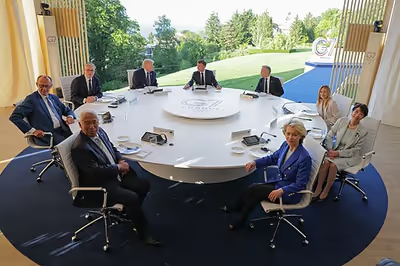
Originating from an ad hoc gathering of finance ministers in 1973, the G7 has since become a formal, high-profile venue for discussing and coordinating solutions to major global issues, especially in the areas of trade, security, economics, and climate change. Each member's head of government or state, along with the EU's Commission president and European Council president, meet annually at the G7 Summit; other high-ranking officials of the G7 and the EU meet throughout the year. Representatives of other states and international organizations are often invited as guests, with Russia having been a formal member (as part of the G8) from 1997 until its expulsion in 2014.
The G7 is not based on a treaty and has no permanent secretariat or office. It is organized through a presidency that rotates annually among the member states, with the presiding state setting the group's priorities and hosting the summit; France presides for 2026. While lacking a legal or institutional basis, the G7 is widely considered to wield significant international influence; it has catalyzed or spearheaded several major global initiatives, including efforts to combat the HIV/AIDS pandemic, provide financial aid to developing countries, and address climate change through the 2015 Paris Agreement. The group has been criticized by observers for its allegedly outdated and limited membership, narrow global representation, and inefficacy.
The G7 countries have together a population of about 780 million people (or almost 10% of the world population) and account for around half of worldwide nominal net wealth and as of 2026 about 44% of world nominal GDP and about 28% of world GDP by purchasing power parity.
History
Origins
The concept of a forum for the capitalist world's major industrialized countries emerged before the 1973 oil crisis. On 25 March 1973, the United States secretary of the treasury, George Shultz, convened an informal gathering of finance ministers from West Germany (Helmut Schmidt), France (Valéry Giscard d'Estaing), and the United Kingdom (Anthony Barber) before an upcoming meeting in Washington, DC. United States president Richard Nixon offered the White House as a venue, and the meeting was subsequently held in its library on the ground floor; the original group of four consequently became known as the "Library Group". In mid-1973, at the Spring Meetings of the International Monetary Fund and the World Bank, Shultz proposed the addition of Japan, which all members accepted. The informal gathering of senior financial officials from the United States, United Kingdom, West Germany, Japan, and France became known as the "Group of Five".
In 1974, all five members endured sudden and often troubled changes in leadership. French president Georges Pompidou abruptly died, leading to a fresh presidential election that was closely won by Valéry Giscard d'Estaing. West German chancellor Willy Brandt, American president Richard Nixon, and Japanese prime minister Kakuei Tanaka all resigned due to scandals. In the United Kingdom, a hung election led to a minority government whose subsequent instability prompted another election the same year. Consequently, Nixon's successor, Gerald Ford, proposed a retreat the following year for the group's new leaders to learn about one another.
First summit and expansion
At the initiative of Giscard d'Estaing and his German counterpart, Helmut Schmidt, France hosted a three-day summit in November 1975, inviting the Group of Five plus Italy, forming the "Group of Six" (G6). Taking place at the Château de Rambouillet, the meeting focused on several major economic issues, including the oil crisis, the collapse of the Bretton Woods system, and the ongoing global recession. The result was the 15-point "Declaration of Rambouillet", which, among other positions, announced the group's united commitment to promoting free trade, multilateralism, cooperation with the developing world, and rapprochement with the Eastern Bloc. The members also established plans for future gatherings to take place regularly every year.
In 1976, British prime minister Harold Wilson, who had participated in the first G6 summit, resigned from office; Schmidt and Ford believed the group needed an English speaker with more political experience, and advocated for inviting Pierre Trudeau, who had been Prime Minister of Canada for eight years – significantly longer than any G6 leader. Canada was also the next largest advanced economy after the G6 members. The summit in Dorado, Puerto Rico later that year became the first of the current Group of Seven (G7).
In 1977, the United Kingdom, which hosted that year's summit, invited the European Economic Community to join all G7 summits; beginning in 1981, it has attended every gathering through the president of the European Commission and the leader of the country holding the presidency of the Council of the European Union. Since 2009, the then-newly established position of the president of the European Council, who serves as the Union's principal foreign representative, also regularly attends the summits.
Rising profile
Until the 1985 Plaza Accord, meetings between the seven governments' finance ministers were not public knowledge. The Accord, which involved only the original Group of Five, was announced the day before it was finalized, with a communiqué issued afterward. The 1980s also marked the G7's expanded concerns beyond macroeconomic issues, namely with respect to international security and conflict; for example, it sought to address the ongoing conflicts between Iran and Iraq and between the Soviet Union and Afghanistan (Afghan conflict).
Following the 1994 summit in Naples, Russian officials held separate meetings with leaders of the G7. This informal arrangement was dubbed the "Political 8" (P8), colloquially the G7+1. At the invitation of the G7 leaders, Russian president Boris Yeltsin was invited first as a guest observer, and later as a full participant. After the 1997 meeting, Russia was formally invited to the next meeting and formally joined the group in 1998, resulting in the Group of Eight (G8). Russia was an outlier in the group, as it lacked the national wealth and financial weight of other members, and had never been an established liberal democracy. Its invitation, made during a difficult transition to a post-communist economy, is believed to have been motivated by a desire to encourage its political and economic reforms and international engagement.
At the end of 1999, Vladimir Putin became Yeltsin's successor. In February 2007, Putin delivered a speech at the 43rd Munich Security Conference.
Russia's membership was suspended in March 2014 in response to its annexation of Crimea. Members stopped short of permanently ejecting the country, and in subsequent years expressed an openness or express desire to reinstate Russian participation. In January 2017, Russia announced it would permanently leave the G8, which came into effect June 2018. In 2018, U.S. president Donald Trump first advocated for Russia's return at the 2018 G7 Charlevoix summit, backed by Italian prime minister Giuseppe Conte, but all other members rejected the proposal. Trump again renewed his push in 2020, though Russia expressed no interest in returning.
Sign in to keep reading
6 more chapters are free with a Lably account.
Renewed calls for expanded membership
There have been various proposals to expand the G7. The U.S.-based Atlantic Council has held the D-10 Strategy Forum since 2014 with representatives from what it calls "leading democracies" which support a "rules-based democratic order", consisting of all members of the G7 (including the European Union) plus Australia and South Korea. Several democratic countries – including India, Indonesia, Poland, and Spain – participate as observers. Centered around a similar mandate as the G7, the D-10 has been considered by some analysts to be an alternative to the group; This is also favored by various think tanks and former British prime minister, Boris Johnson.
In 2019 under Russian President Vladimir Putin, Russia had signaled support for the inclusion of China, India, and Turkey if the G7 had reinstated Russian membership.
In 2020 under US President Donald Trump, the U.S. had signaled support for the inclusion of Australia, Brazil, India, and South Korea, plus the reincorporation of Russia. The leaders of the other six G7 members unanimously rejected this proposal.
Also in November 2020, Jared Cohen and Richard Fontaine, writing in Foreign Affairs, suggested that the G7 might be expanded to a "T-12" of "Techno Democracies". Earlier, in June of that same year, the Global Partnership on Artificial Intelligence (GPAI) was announced. Something of a spin-out of the G7, founded by members Canada and France, GPAI's initial membership was 15, including both the EU and India, as well as Australia, Mexico, New Zealand, Singapore, Slovenia, and the Republic of Korea.
Boris Johnson invited representatives of Australia and the Republic of Korea to the June 2021 G7 summit. India was also invited to the 2021 summit, with an aim to "deepen the expertise and experience around the table" along with the other guests, according to a U.K. government statement.
In 2021, French jurist and consultant Eric Gardner de Béville, a member of the Cercle Montesquieu, proposed Spain's membership to the G7. American Chargé d'Affaires in Spain, Conrad Tribble, stated that the United States "enthusiastically supports" a "greater" role of Spanish leadership at the international level.
In April 2022, Germany confirmed that India would be invited to the G7 summit, dispelling earlier rumours that the invitation would not be extended.
In March 2023, Japan's prime minister Fumio Kishida invited South Korea, Australia, India, Indonesia, Brazil, Vietnam, the Comoros (African Union president from February 2023 to February 2024), the Cook Islands (Pacific Islands Forum president from February 2021 to May 2024) and Ukraine to the 49th summit hosted in Hiroshima.
Ronald A. Klain writing for the Carnegie Endowment, proposed creating the G9 by adding South Korea and Australia due to the Eurocentrism of the current alliance and rising challenges posed by China in Asia.
In March 2025, Prime Minister of Canada Mark Carney invited President of Ukraine Volodymyr Zelenskyy to attend the 51st G7 summit in Kananaskis, Alberta, followed by invitations for Prime Minister of Australia Anthony Albanese to attend in May and Prime Minister of India Narendra Modi to attend in June.
Activities and initiatives
The G7 was founded primarily to facilitate shared macroeconomic initiatives in response to contemporary economic problems; the first gathering was centered around the Nixon shock, the 1970s energy crisis, and the ensuing global recession. Since 1975, the group has met annually at summits organized and hosted by whichever country occupies the annually-rotating presidency; since 1987, the G7 Finance Ministers have met at least semi-annually, and up to four times a year at stand-alone meetings.
Beginning in the 1980s, the G7 broadened its areas of concern to include issues of international security, human rights, and global security; for example, during this period, the G7 concerned itself with the ongoing Iran–Iraq War and Soviet occupation of Afghanistan. In the 1990s, it launched a debt-relief program for the 42 heavily indebted poor countries (HIPC); provided $300 million to help build the Shelter Structure over the damaged reactor at Chernobyl; and established the Financial Stability Forum to help in "managing the international monetary system".
At the turn of the 21st century, the G7 began emphasizing engagement with the developing world. At the 1999 summit, the group helped launch the G20, a similar forum made up of the G7 and the next 13 largest economies (including the European Union), in order to "promote dialogue between major industrial and emerging market countries"; the G20 has been touted by some of its members as a replacement for the G7. Having previously announced a plan to cancel 90% of bilateral debt for the HIPC, totaling $100 billion, in 2005 the G7 announced debt reductions of "up to 100%" to be negotiated on a "case by case" basis.
After the 2008 financial crisis, the G7 met twice in Washington, D.C. in 2008 and in Rome in February 2009. G7 finance ministers pledged to take "all necessary steps" to stem the crisis, devising an "aggressive action plan" that included providing publicly funded capital infusions to banks in danger of failing. Some analysts criticized the group for seemingly advocating that individual governments develop individual responses to the recession, rather than cohere around a united effort.
In subsequent years, the G7 has faced several geopolitical challenges that have led some international analysts to question its credibility, or propose its replacement by the G20. On 2 March 2014, the G7 condemned the Russian Federation for its "violation of the sovereignty and territorial integrity of Ukraine" through its military intervention. The group also announced its commitment to "mobilize rapid technical assistance to support Ukraine in addressing its macroeconomic, regulatory and anti-corruption challenges", while adding that the International Monetary Fund (IMF) was best suited to stabilizing the country's finances and economy.
In response to Russia's subsequent annexation of Crimea, on 24 March the G7 convened an emergency meeting at the official residence of the prime minister of the Netherlands, the Catshuis in The Hague; this location was chosen because all G7 leaders were already present to attend the 2014 Nuclear Security Summit hosted by the Netherlands. This was the first G7 meeting neither taking place in a member state nor having the host leader participating in the meeting. The upcoming G8 summit in Sochi, Russia was moved to Brussels, where the EU was the host. On 5 June 2014 the G7 condemned Moscow for its "continuing violation" of Ukraine's sovereignty and stated they were prepared to impose further sanctions on Russia. This meeting was the first since Russia was suspended from the G8, and subsequently it has not been involved in any G7 summit.
The G7 has continued to take a strong stance against Russia's "destabilising behaviour and malign activities" in Ukraine and elsewhere around the world, following the joint communique from the June 2021 summit in the U.K. The group also called on Russia to address international cybercrime attacks launched from within its borders, and to investigate the use of chemical weapons on Russian opposition leader Alexei Navalny. The June 2021 summit also saw the G7 commit to helping the world recover from the global COVID-19 pandemic (including plans to help vaccinate the entire world); encourage further action against climate change and biodiversity loss; and promote "shared values" of pluralism and democracy.
In 2022, G7 leaders were invited to attend an extraordinary summit of NATO called in response to the 2022 Russian invasion of Ukraine.
In April 2024, the G7 energy ministers agreed to phase out unabated coal-fired power generation between 2030 and 2035, or on a timeline that is consistent with limiting global warming to 1.5 °C.
2019 Amazon rainforest fires and Brazil
The G7 nations pledged US$20 million to help Brazil and other countries in South America fight the wildfires. This money was welcomed, although it was widely seen as a "relatively small amount" given the scale of the problem. Macron threatened to block a major trade deal between the European Union and Brazil (Mercosur) that would benefit the agricultural interests accused of driving deforestation. Soon after, Germany and the United Kingdom criticized the threat.
Summit organization
The annual G7 summit is attended by each member's head of government. The member country holding the G7 presidency is responsible for organizing and hosting the year's summit. The serial annual summits can be parsed chronologically in arguably distinct ways, including as the sequence of host countries for the summits has recurred over time and series. Generally every country hosts the summit once every seven years.
Besides a main meeting in June or July, a number of other meetings may take place throughout the year; in 2021 for example, seven tracks existed for finance (4–5 June 2021), environmental (20 and 21 May 2021), health (3–4 June 2021), trade (27–28 May 2021), interior (7–9 September 2021) digital and technology (28–29 April 2021), development (3–5 May 2021) and foreign ministers.
Friction with the United States
The 2018 meeting in Charlevoix, Canada, was marred by fractious negotiations concerning tariffs and Donald Trump's position that Russia should be reinstated to the G7. The Trump administration had just imposed steel and aluminium tariffs on many countries, including European countries that are fellow members of the G7, and Canada, the host country for the 2018 meeting. Trump expressed dismay at Canadian Prime Minister Justin Trudeau for holding a press conference in which Canada restated its position on tariffs (a public criticism of Trump's economic policy), and directed his representatives at the meeting not to sign the economic section of the joint communiqué that is typically issued at the conclusion of the meeting. German Chancellor Angela Merkel described Trump's behaviour as a "depressing withdrawal", while French President Emmanuel Macron invited him "to be serious". In the final statement signed by all members except the US, the G7 announced its intention to recall sanctions and to be ready to take further restrictive measures within the next months against the Russian Federation for its failure to completely implement the Minsk Agreement.
Twelve-Day War
The G7 countries expressed support for Israel in the Twelve-Day War. On 16 June 2025, G7 leaders said in a statement: "We affirm that Israel has a right to defend itself. We reiterate our support for Israel's security. Iran is the principal source of regional instability and terror." On 22 March 2026, the foreign ministers of G7 condemned Iran's "unjustifiable" and "reckless" attacks on sites in the Gulf region.
List of summits
Current leaders
Member country data
The G7 is composed of the seven wealthiest advanced countries. The People's Republic of China, according to its data, would be the second-largest with 17.90% of the world net wealth, but is excluded because of its relatively low net wealth per adult and Human Development Index. As of 2021, Crédit Suisse reports the G7 (without the European Union) represents around 53% of the global net wealth; including the EU, the G7 accounts for over 60% of the global net wealth. The combined population of the G7 countries is about 10% of world population.
Reception
According to the group hegemony theory, the G7 has helped stabilise and perpetuate an inequitable world economic order.
2003 protests
The 2003 G8 summit held in Évian-les-Bains, France, also sparked violent protests in Geneva, accompanied by widespread looting of stores and tens of millions of euros in damage.
2015 protests
About 7,500 protesters led by the group 'Stop-G7' demonstrated during the 2015 summit in Bavaria, Germany. About 300 of those reached the 3 m high and 7 km long security fence surrounding the summit location. The protesters questioned the legitimacy of the G7 to make decisions that could affect the whole world. Authorities had banned demonstrations in the area closest to the summit location and 20,000 police were on duty in Southern Bavaria to keep activists and protesters from interfering with the summit.
China
In June 2024, the G7 issued a statement criticizing the People's Republic of China for "enabling" the Russian invasion of Ukraine and threatening sanctions. China's foreign ministry criticized the G7 statement. In March 2025, the People's Republic of China's foreign ministry criticized the G7 for a statement that raised concerns about the PRC's nuclear buildup, maritime actions in the South China Sea, and market policies.