

Grain size
Diameter of individual grains of sediment, or of lithified particles in clastic rocks
- 2 min read
- 3 chapters
- 6 labs on Lably

Learn it on Lably
Krumbein phi scale
Size ranges define limits of classes that are given names in the Wentworth scale (or Udden–Wentworth scale named after geologists Chester K. Wentworth and Johan A. Udden) used in the United States. The Krumbein phi (φ) scale, a modification of the Wentworth scale created by W. C. Krumbein in 1934, is a logarithmic scale computed by the equation
where
- is the Krumbein phi scale,
- is the diameter of the particle or grain in millimeters (Krumbein and Monk's equation) and
- is a reference diameter, equal to 1 mm (to make the equation dimensionally consistent).
This equation can be rearranged to find diameter using φ:
In some schemes, gravel is anything larger than sand (comprising granule, pebble, cobble, and boulder in the table above).
Sign in to keep reading
2 more chapters are free with a Lably account.
International scale
ISO 14688-1:2017 establishes the basic principles for identifying and classifying soils based on those material and mass characteristics most commonly used for soils for engineering purposes. ISO 14688-1 applies to natural soils in situ, similar man-made materials in situ and soils redeposited by people.
Sorting
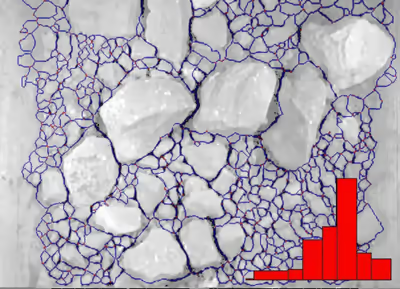
An accumulation of sediment can also be characterized by the grain size distribution. A sediment deposit can undergo sorting when a particle size range is removed by an agency such as a river or the wind. The sorting can be quantified using the Inclusive Graphic Standard Deviation:
where
- is the Inclusive Graphic Standard Deviation in phi units
- is the 84th percentile of the grain size distribution in phi units, etc.
The result of this can be described using the following terms: