


Explore on Lably
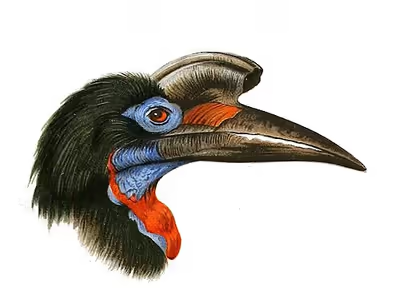
ToursExplore Lably’s 3D toursGround hornbills are large, with adults around a metre tall. Both species are ground-dwelling, unlike other hornbills. They are carnivorous and feed on insects, snakes, other birds, amphibians and even tortoises.
Taxonomy
The genus Bucorvus was introduced in 1830, originally as a subgenus, by the French naturalist René Lesson to accommodate a single species, Buceros abyssinicus Boddaert, the Abyssinian ground hornbill. This is the type species. The generic name is a portmanteau of the genus Buceros introduced by Carl Linnaeus in 1758 for the Asian hornbills and corvus, the Latin word for a "raven".
A molecular phylogenetic study published in 2013 found that the genus Bucorvus was sister to the rest of the hornbills. The ground hornbills are estimated to have diverged from the other hornbills in the early Miocene, around 22 million years ago. The ground hornbills in the genus Bucorvus have sometimes been placed in a separate family, Bucorvidae.
The genus contains two species: