

Gyanvapi Mosque
Mosque and former Hindu temple in Varanasi, Uttar Pradesh, India
- 18 min read
- 5 chapters

Related on Lably
Through Mosque, Common Era and Muslims
A comprehensive ASI survey found that the mosque was constructed on the remains of a pre-existing large Hindu temple. The present structure incorporates architectural components of the previous temple, with visible Hindu motifs and sculptures on its pillars. However, both Hindus and the Muslims claim the right to the land, and ownership is currently disputed.
Vishweshwar temple
The site originally had a Vishweshwar temple devoted to the Hindu deity Shiva. It was built by Todar Mal, a premier courtier and minister of Akbar, in conjunction with Narayana Bhatta, a pre-eminent Brahmin scholar of Banaras from Maharashtra, during the late 16th century.
The temple contributed to the establishment of Banaras as a vaunted center of Brahminic assembly, drawing scholars across the subcontinent esp. Maharashtra, for adjudicating a spectrum of disputes concerned with Hindu religious law. Architectural historian Madhuri Desai hypothesizes that the temple was a system of intersecting iwans —a borrowing from Mughal architecture— with prominent pointed arches; it had a carved stone exterior.
Pre-temple history
What was on the site prior to the temple is debated by scholars and has been extensively contested by the local Hindu and Muslim populations. Desai said these multiple histories of the original temple and tensions arising out of the location of Gyanvapi fundamentally shaped the sacred topography of the city.
Popular claims
21st-century accounts of the history of the mosque, as purveyed by Hindus, centre around a litany of repeated destruction and re-construction of the original temple which is situated in contrast to the timelessness of the lingam. The original temple was allegedly uprooted by Ghurids in 1193/1194 CE, upon the defeat of Jayachandra of Kannauj; the Razia Mosque was constructed in its place, a few years later. The temple would be rebuilt by a Gujarati merchant during the reign of Iltutmish (1211–1266 CE) at today's site — in what used to be Avimukteshwara's precincts — only to be demolished by Hussain Shah Sharqi (1447–1458) of the Jaunpur Sultanate or Sikandar Lodi (1489–1517) of the Delhi Sultanate.
Historicity
The earliest manuscripts of Skanda Purana (c. 810 CE) describe Banaras to be the kshetra of Avimukteshwar; there is no mention of Vishweshwar. The slightly later Matsya Purana, too, attests the supremacy of Avimukteshwar and does not mention Vishweshwar; however, certain corrupt manuscripts include it, suggesting a late interpolation. Krtyakalpataru, an encyclopedia of traditional Hindu law, written during the reign of Govindachandra (c. early 12th century) quoted a detailed description of Banaras — including an enumeration of all religious sanctuaries — from the Linga Purana; Kedareshwur was the only linga that was recorded to have been housed in a temple, Avimukteshwara was mentioned to be in the north of a sacred well, and of the two references to Vishweshwar, one is a literal reference to Shiva being the "Lord of the Universe" while the other is a linga. None of the extant Gahadavala inscriptions refer to a Vishveshwar shrine. Seals, excavated from Rajghat, mention Vishveshwar for the first time only in the first decade of the twelfth century; however, they soon become extremely abundant esp. as the Avimukteshwara seals, prevalent for centuries, die out.
Desai said it appears unlikely that there existed any prominent-enough Vishweshwar temple in Banaras, during the Ghurid raids (c. late-12th century) — or even during Razia Sultana's reign (fl. 1236) —, to have attracted particular attention in conflicts. She said that Hindu traditions were not timeless but fluid in time and space — they shared a dialogical relationship with popular practice as well as patronage. The Vishweshwar lingam received prominence only between the twelfth and fourteenth centuries with the Kashikhand being the first text to attempt establishing Vishweshwar as the guardian deity of the city.
In contrast, Hans T. Bakker largely agrees with the popular narrative; he said the pre-history of the site is one of "[Muslim] bigotry and [Hindu] stubbornness". Bakker said that a temple, located at the current-day Gyanvapi precincts and devoted to Avimukteshwara, was indeed destroyed in 1194 CE; he cites Hasan Nizami's chronicling of wanton temple-demolition during Qutb ud-Din Aibak's raid on Banaras in support. At that time, Vishweshwar only occupied the adjacent hill-top that still bears an eponymous name. Soon Razia Sultana had a mosque constructed atop the hill-top forcing the Hindus to reclaim the vacant Gyanvapi site for a temple of Vishweshwar. This new temple of Vishweshwar was destroyed by the Jaunpur Sultanate to supply building materials for mosques at their new capital. Diana L. Eck agreed; other scholars have critiqued Eck's non-contextual usage of medieval sources.
Beginning around the late-thirteenth century, a temple for Vishweshwar/Vishvanath finds mentions in both literary and inscriptional records — an inscription issued by Narasimha III in 1279 CE endowed the revenue of a village for payment toward taxes by the inhabitants of Banaras and for services at the Visvesvar Temple; an inscription from 1296, used as spolia in the Lal Darwaza Mosque, refers to a temple for Vishweshwar; and, Bhatta's Tristhalisetu (c. mid-16th century) mentions about how at times, "though there may be no Vishweshwar lingam due to mlechhas or other evil kings", yet pilgrimage must go on. Richard G. Salomon and others read this as a proof of the existence of a desecrated temple of unknown antiquity, before Todar Mal's construction.
For centuries, the Vishweshwar was one among the many sacred sites in the town; it would become the principal shrine of the city only after sustained patronage of Mughals, beginning from the late sixteenth century.
Sign in to keep reading
4 more chapters are free with a Lably account.
Establishment
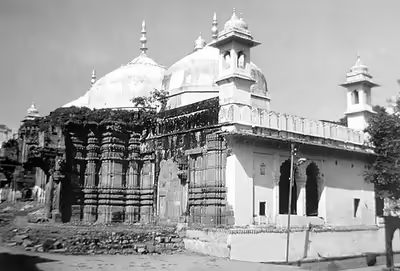
In September 1669, Aurangzeb ordered the demolition of the temple; a mosque was constructed in place, perhaps by Aurangzeb, in c. 1678 CE. The façade was modeled partially on the Taj Mahal's entrance; the plinth of the temple was left largely untouched to serve as the courtyard of the mosque, and the southern wall — along with its cusped arches, exterior moldings and toranas — was turned into the qibla wall. Other buildings in the precinct were spared.
Oral accounts indicate that notwithstanding the desecration, Brahmin priests were allowed to reside in the premises of the mosque and exert their privileges on issues of Hindu pilgrimage. The remnants of the temple, especially the plinth, continued to remain a popular hub for Hindu pilgrims. The mosque came to be known as the Alamgiri Mosque — after the name of Aurangzeb — but with time, the current name was adopted in common parlance, deriving from an adjoining sacred waterbody — Gyan Vapi ("Well of Knowledge") — which, in all likelihood, even predated the temple.
Motives
Scholars attribute political reasons rather than religious zealotry to be the primary motivation for Aurangzeb's demolition. Catherine Asher, a historian of Indo-Muslim architecture, notes that not only did the zamindars of Banaras frequently rebel against Aurangzeb but also the local Brahmins were oft accused of interfering with Islamic teaching. Consequently, she said that the demolition was a political message in that it served as a warning for the Zamindars and Hindu religious leaders, who wielded great influence in the city; Cynthia Talbot, Richard M. Eaton, Satish Chandra and Audrey Truschke agree on similar grounds. O' Hanlon highlights that the temple was demolished at a time when the conflict with Marathas was at its zenith.
In general, scholars emphasize upon how Aurangzeb granted protection and patronage to several temples, ghats, and maths, including in Banaras, both before and after the demolition. Ian Copland and others support Iqtidar Alam Khan who said Aurangzeb built more temples than he destroyed; they said that the religious politics of the Mughal emperors ought not to be viewed in light of their personal piety but in the sociopolitical contingencies of their times. The Oxford World History of Empire said that while the demolition of Gyanvapi might be interpreted as a sign of Aurangzeb's "orthodox inclinations", local politics played an influencing role and his policies towards Hindus and their places of worship were "varied and contradictory, rather than consistently agnostic."
Muslim counter-claims
Writing in 1993, Mary Searle Chatterjee said most local Muslims rejected the idea that Aurangzeb had the temple demolished out of religious zealotry. Theories included:
- The original building was a structure of the Din-i Ilahi faith which collapsed by itself or was destroyed by Aurangzeb, out of his hostility to Akbar's heretical thought-school.
- The original building was a temple but destroyed by a Hindu merchant from Jaunpur called Jnan Chand, as a consequence of the priests having looted, violated, and murdered one of his female relatives.
- A slight variant where it was Aurangzeb who destroyed the temple after the female relative of an accompanying officer suffered such fate.
- The original building was a temple but destroyed in a communal riot, triggered by local Hindus
- Ganj-e-Arsadi — a collection of the sayings of Arsad Badr-al-Haqq of Banaras, compiled in 1721 — notes Makhdum Shah Yasin to have demolished the "big temple" (assumed to be the Vishweshwar) in late 1669 in a communal melee as retribution against local Hindus who had engaged in the repetitive demolition of an under-construction mosque. Though opposed by the local administration in light of the associated imperial patronage, Aurangzeb did not condemn Yasin and expressed relief at the act.
- The original building was a temple and was destroyed by Aurangzeb but only because it had served as a hub of political rebellion.
More fringe claims include from the likes of Abdus Salam Nomani (d. 1987), the erstwhile Imam of the Gyanvapi mosque, who posited that the mosque was constructed much before Aurangzeb's reign; Shah Jahan had allegedly started a madrasah at the mosque in 1638–1639 CE. The mosque management committee, Anjuman Intezamia Masjid (AIM) supports Nomani and maintains that both the (new) Kashi Vishwanath Temple and the Gyanvapi mosque were constructed by Akbar, true to his spirit of religious tolerance.
Local Muslims emphatically reject that Aurangzeb had demolished any temple to commission the mosque. Nonetheless, there has been little engagement with these claims in historical scholarship; Desai said Nomani's arguments were a strategic "rewriting of history" arising out of the Hindu-hegemonic nature of discourse in postcolonial Benaras.
Late-Mughal India
In 1678 the chief minister of the Malla ruler of Lalitpur constructed the Bhaideval temple for Vishveshwara in the Patan Durbar Square — the inscription claims him to have transported Shiva from Banaras to Lalitpur since "he [Shiva] was dejected by terrible yavanas [Muslims]." In 1698, Bishan Singh, the Kachhwaha ruler of Amber, had his agents survey the town — rather its ritual landscape — and gather details about the land-use patterns; their maps ('tarah') were explicit in holding the Gyanvapi mosque to lay at the site of the dismantled Vishweshwar temple. The temple-plinth and the Gyan Vapi well (pond) were demarcated separately from the mosque. The Amber court went on to purchase significant land around the Gyanvapi precincts, including from Muslim inhabitants, with an aim to rebuild the temple — but without demolishing the mosque — yet failed. Eventually, an "Adi-Vishweshwar Temple" was constructed at the initiative of Bishan Singh's successor Sawai Jai Singh II, about 150 yards anterior to the mosque; the construction was borrowed from contemporary Mughal architecture — with Desai finding the typology to be more reminiscent of a Mughal tomb than temple — in what was a pointer to imperial patronage.
By the early 18th century, Banaras was under the effective control of the Nawabs of Lucknow; simultaneously, with the advent of the East India Company and their increasingly severe annexation policies, multiple rulers from across the country — and even administrative elites — started investing in Brahminising the cityscapes of Banaras, to claim cultural authority back in their homelands. The Marathas, in particular, became highly vocal about religious injustice at the hands of Aurangzeb and Nana Fadnavis proposed demolishing the mosque and reconstructing a Vishweshwar temple. In 1742, Malhar Rao Holkar proposed a similar course of action. Despite such consistent efforts, these plans did not materialize due to a multitude of interventions — the Nawabs who were their political rivals, local Brahmins who feared the wrath of the Mughal court, and British authorities who feared an outbreak of communal tensions.
In the late eighteenth century, as East India Company gained direct control of Banaras ousting the Nawabs, Malhar Rao's successor Ahilyabai Holkar constructed the present Kashi Vishwanath Temple to the immediate south of the mosque — this, however, had a markedly different spatial configuration and was ritually inconsistent. Compounded with the belief that the original lingam was hidden by the priests inside the Gyan Vapi during Aurangzeb's raid, the plinth would attract greater devotion than the temple for well over a century.
British Raj
Under British Raj, the Gyanvapi, which was once the subject of whimsical Mughal politics, got transformed into a site of perennial contestation between local Hindus and Muslims spawning numerous legal suits and even, riots. A new generation of aristocrats and well-to-do traders took over the role exclusively played by petty rulers in late-Mughal India in controlling the ritual life of the city, most often under the guise of urbanization. Desai said the construction of mosque had sought to air an "explicitly political and visual" assertion about the Mughal command over the city's religious sphere but instead, "transmuted Vishweshwur into the undisputed fulcrum of the city's ritual landscape".
In October 1809, a riot broke between the Hindus and the Muslims out of a disputed construction at the Laat Bhairav site on the outskirts of the city. The day after, the riot spread across the city proper — a Muslim mob destroyed the Laat and proceeded to attempt demolishing the Kashi Vishwanath Temple; in turn, a Hindu mob, composed mostly of Gosains, burnt the Gyanvapi Mosque, massacred the Muslims sheltering within, and then, attempted to demolish it. Several deaths, mostly of Muslims, were reported and property damage ran into lacs, before the British administration quelled the riot. Widely believed to be first significant riot in N. India under Company rule, this hastened the growth of competitive communalism in Banaras. In memorials submitted to the government, about a year after the riot, the Hindus had accused Aurangzeb of being a bigoted ruler who had wrested Vishweshwar — among other temples — from them and pleaded for its restoration; the Muslims, in turn, accused the Hindus of having a perennial habit of claiming random mosques as Hindu shrines and asserted that the Gyan Vapi pond had only began to be worshipped from around twenty years before.
Visiting in September 1824, Reginald Heber found the plinth to be more revered than Ahilyabai's temple and filled with priests and devotees; the "well", fed by a subterranean channel of the Ganges, featured a stair for the devotees to descent and take a bath. Four years later, Baiza Bai, widow of the Maratha ruler Daulat Rao Scindhia, constructed a pavilion around the well — reducing it in size —, and erected a colonnade to support a roof, pursuant to a proposal raised by member of a Peshwa family. The colonnade was based on the Gyan Mandapa, mentioned in Kashikhand but the architectural style was borrowed from contemporary Mughal Baradaris. To its east, was installed a statue of Nandi, which had been gifted by the Rana of Nepal. To further east, a temple of Mahadeva was constructed by the Rani of Hyderabad. In the south, two small shrines —one of marble, and the other of stone— existed.
The first legal dispute seem to have arose in 1843, when the priest of the Gyan Vapi well approached the local court about two attendants of the mosque who had been constructing a house in the temple precincts in violation of longstanding government orders that disallowed any unilateral modification of the site; the Court ordered in her favor and had the house demolished. Soon, legal disputes became frequent — in 1852, a dispute arose concerning the rights of cutting of a tree in a compound; two years later, a plea to install a new Nandi idol in the complex was rejected; etc. — and hostilities grew. In 1854, a Bengali pilgrim noted that Muslim guards were to be "either bribed or hoodwinked" to access the precincts.
M. A. Sherring, writing in 1868, said the Hindus had claimed the plinth as well as the southern wall; the Muslims were allowed to exert control over the mosque but quite reluctantly, and permitted to only use the side entrance. A peepal tree overhanging the gateway was also venerated, and Muslims were not allowed to "pluck a single leaf from it." In 1886, adjudicating on a dispute about illegal constructions, the District Magistrate held that unlike the mosque proper, which had belonged to the Muslims exclusively, the enclosure was a common space thereby precluding any unilateral and innovative use. This principle would continue to decide multiple cases in the next few decades. Edwin Greaves, visiting the site in 1909, found that the mosque was "not greatly used", and remained an "eyesore" to the Hindus. His description of the pavilion paralleled Sherring's; the well commanded significant devotion too — however, pilgrims were not allowed direct access and instead, had to received its sacred water from a priest, who sat on an adjoining stone-screen. In the meanwhile, legal disputes continued unabated.
In 1929 and 1930, the cleric of Gyanvapi was cautioned into not letting the crowd overflow into the enclosure on the occasion of Jumu'atul-Wida, lest Hindu pilgrims face inconvenience. Subsequently, in January 1935, upon such an occurrence, the city magistrate came down with his men and ordered the worshippers to vacate the site; days later, the mosque committee unsuccessfully demanded before the District Magistrate that the restriction on crowd-overflow be waived. It was also demanded, unsuccessfully, that Muslims be allowed to offer prayers anywhere in the complex. In December 1935, local Muslims attacked the Police after being prevented from offering prayers outside of the mosque proper, injuring several officials. This gave way to a lawsuit urging that the entire complex be treated as an integral part of the mosque — a waqf property — by customary rights, if not by legal rights; the contention was rejected by the lower Court in August 1937 and an appeal was dismissed by the Allahabad High Court with costs, in 1941.
Independent India
In March 1959, Hindu Mahasabha conducted a Rudrabhishek ceremony at the mosque pavilion on the occasion of Maha Shivaratri. Two of their workers were subsequently sentenced to six months of imprisonment for violating law and order. This spurred fellow Mahasabha-ites to mount routine agitations at the mosque pavilion across the next few months, demanding the restoration of the temple; by July, two hundred and ninety one "satyagrahis" spread across twenty three batches had courted arrest and served imprisonments of varying duration. In November, the annual meeting of RSS adopted a resolution to similar effects.
The site continues to remain volatile — Dumper finds it to be the "focus of religious tension" in the town. Access to the mosque remains prohibited for non-Muslims, photography is prohibited, the approaching alleys have light police-pickets (alongside RAF units), the walls are fenced with barbed wire, and a watchtower exists too. The mosque is neither well-used nor embedded enough in the cultural life of the city. On the eve of the 2004 Indian general election, a BBC report noted over a thousand policemen to have been deployed around the site.
Litigation
From 1984, the Vishva Hindu Parishad (VHP) and other elements of the Hindu nationalist Sangh Parivar engaged in a nation-wide campaign to reclaim mosques which were constructed by demolishing Hindu temples. The Gyanvapi mosque was prominently included among them. In 1991, a title-dispute suit was filed by three local Hindus in the Varanasi Civil Court on behalf of three Hindu deities — Shiva, Shringar Gauri, and Ganesha — for handing over the entire site to Hindu community to facilitate the reconstruction of temple; AIM, acting as one of the defendants, said that the petition contravened the Places of Worship (Special Provisions) Act (henceforth PoW), which had expressly prohibited courts from entertaining any litigation that sought to convert places of worship. Nonetheless, AIM contested the idea that Aurangzeb had demolished any temple to construct the mosque. In the meanwhile, tensions increased in the wake of the demolition of the Babri mosque in December 1992, even though the Bharatiya Janata Party leaders, including those who had supported the demand for reclaiming Babri mosque, opposed the VHP's demand for the Gyanvapi Mosque since it was actively used. Further, VHP leaders issued multiple calls across the mid-90s for Hindus to congregate in large numbers on the occasion of Maha Shivaratri and worship the Shringar Gauri image at the southern wall; public response was poor and no fracas occurred due to a proactive state administration.
Hearings began in the civil court in June 1997. Four months later, the suit was held to be summarily barred by the PoW act. Three revision petitions were filed before the district court, by both the plaintiff and the defendants on disparate grounds, which were merged and the civil court was ordered to adjudicate the dispute, afresh, after considering all evidence. The mosque management committee successfully challenged this allowance in the Allahabad High Court, who passed an order in October 1998, staying the proceedings. After a limbo of 22 years, the Civil court recommenced proceedings after petitioners cited a SCI judgement from 2018 which had held judicial stays to have a lifetime of six months unless explicitly extended; accordingly, the petitioners requested for an ASI survey to discover evidence in their favor. AIM petitioned against the very recommencement of trial before the High Court, who granted a fresh stay and reserved judgement on the merits of whether holding such a trial would be barred by the PoW Act. Nonetheless, the request for survey was granted in April 2021 and a five-member committee of archaeologists — with two members from the Muslim community — was constituted to determine whether any temple existed at the site, prior to the mosque. AIM opposed such a survey and moved before the High Court, who, in September, criticized the judgement for wanton breach of judicial decorum and issued an indefinite stay on the survey.
However, on 12 May 2022, the Civil court — adjudicating on a fresh plea by five Hindu women to worship the Shringar Gauri image at the southern wall — allowed a video-survey of the site. The survey went ahead notwithstanding local Muslim protests and accusations of bias by AIM. An object was discovered on draining the ablution pool which was alleged to be a shivling by the petitioners and the Court not only sealed-off the area but also restrained congregations of more than twenty mosque-goers at a time. AIM, claiming the object to be a medieval stone fountain, petitioned the Supreme Court of India for an indefinite stay of the survey and for vacating of all restrictions. However, the Court declined to grant full relief and only restored unfettered access to the mosque, before transferring the onus of deciding on merits to the District Court.
On 25 January 2024, the Archeological Survey of India presented its survey report to the court. It was determined that there existed a multi-chambered Hindu temple at the site prior to the construction of the mosque; most of the temple pillars were reused and they still had multiple votive inscriptions — in Devanagri, Kannada and Telugu scripts — featuring various names of Shiva. In addition, several sculptures of Hindu gods were found buried in the cellars. On 31 January 2024, the Civil Court allowed a Hindu petitioner to take possession of the cellar and initiate worship.