


Related on Lably
Through Electrochemistry, Electrode and Electrolyte
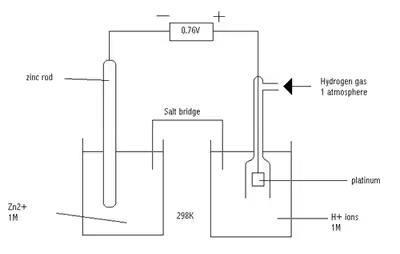
A standard half-cell consists of a metal electrode in an aqueous solution where the concentration of the metal ions is 1 molar (1 mol/L) at 298 kelvins (25 °C). In the case of the standard hydrogen electrode (SHE), a platinum electrode is used and is immersed in an acidic solution where the concentration of hydrogen ions is 1M, with hydrogen gas at 1atm being bubbled through solution. The electrochemical series, which consists of standard electrode potentials and is closely related to the reactivity series, was generated by measuring the difference in potential between the metal half-cell in a circuit with a standard hydrogen half-cell, connected by a salt bridge.
The standard hydrogen half-cell:
- 2H+(aq) + 2e− → H2(g)
The half-cells of a Daniell cell: