

Harappa
Archaeological site in Punjab, Pakistan
- 8 min read
- 6 chapters

Related on Lably
Through Clay, Indus Valley Civilisation and British Raj
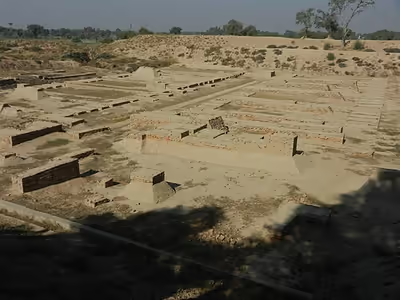
The city of Harappa is believed to have had as many as 23,500 residents and occupied about 150 hectares (370 acres) with clay brick houses, at its greatest extent during the Mature Harappan phase (2600 BC – 1900 BC), which is considered large for its time.
The ancient city of Harappa was heavily damaged under British rule when bricks from the ruins were used as track ballast to construct the Lahore–Multan Railway. The current village of Harappa is less than one kilometre (5⁄8 mi) from the ancient site. Although modern Harappa has a legacy railway station from the Raj period, it is a small crossroads town of 15,000 people today. In 2004, the site was added to the tentative list for UNESCO World Heritage Sites. In 2005, a controversial amusement park scheme at the site was abandoned when builders unearthed many archaeological artefacts during the early stages of building work.
History
The Harappan Civilization has its earliest roots in cultures such as that of Mehrgarh, around 5200 BC. The two greatest cities, Mohenjo-daro and Harappa, emerged along the Indus River valley in Punjab and Sindh. The civilization, with a possible writing system, urban centres, drainage infrastructure and diversified social and economic system, was rediscovered in the 1920s also after excavations at Mohenjo-daro in Sindh near Larkana, and Harappan cities, in west Punjab south of Lahore. A number of other sites stretching from the Himalayan foothills in the East Punjab, to Gujarat in the southeast, and Balochistan, Pakistan in the southwest, have also been discovered and studied. Although the archaeological site at Harappa was damaged in 1857 when engineers constructing the Lahore-Multan railway used bricks from the ruins for track ballast, an abundance of artefacts has nevertheless been recovered.
Due to falling sea-levels, certain regions were abandoned during the late Harappan period. In its later stages, the Harappan civilization lost features such as writing and hydraulic engineering. As a result, the Ganges Valley settlement gained prominence and Ganges' cities developed.
The earliest recognisably Harappan sites date to around 3300 BC. This early phase lasts till around 2600 BC. The civilization's mature phase lasted from 2600 BC to 2000 BC. This is when the great cities were at their height. Then, from around 2000 BC, there was a steady disintegration that lasted till 1300 BC – what is usually called Late Harappan. There is no sign that the Harappan cities were laid waste by invaders. The evidence strongly points to natural causes. A number of studies show that the area which is today the Thar Desert was once far wetter and that the climate gradually became drier.
Sign in to keep reading
5 more chapters are free with a Lably account.
Culture and economy
The Indus Valley civilization was basically an urban culture sustained by surplus agricultural production and commerce, the latter including trade with Elam and Sumer. Both Mohenjo-daro and Harappa are generally characterised as having "differentiated living quarters, flat-roofed brick houses, and fortified administrative or religious centers." Although such similarities have given rise to arguments for the existence of a standardised system of urban layout and planning, the similarities are largely due to the presence of a semi-orthogonal type of civic layout, and a comparison of the layouts of Mohenjo-Daro and Harappa shows that they are in fact, arranged in a quite dissimilar fashion.
The weights and measures of the Indus Valley Civilisation, on the other hand, were highly standardised, and conformed to a set scale of gradations. Distinctive seals were used, among other applications, perhaps for the identification of property and shipment of goods. Although copper and bronze were in use, iron was not yet employed. "Cotton was woven and dyed for clothing; wheat, rice, and a variety of vegetables and fruits were cultivated; and a number of animals, including the humped bull, was domesticated," as well as "fowl for fighting". Wheel-made pottery—some of it adorned with animal and geometric motifs—has been found in profusion at all the major Indus sites. A centralised administration for each city, though not the whole civilisation, has been inferred from the revealed cultural uniformity; however, it remains uncertain whether authority lay with a commercial oligarchy. Harappans had many trade routes along the Indus River that went as far as the Persian Gulf, Mesopotamia, and Egypt. Some of the most valuable things traded were carnelian and lapis lazuli.
Evidence from Harappan skeletal remains shows elevated rates of injury (15.5%), particularly in contexts associated with the later phases of the civilization. Examinations of Harappan skeletons have often found wounds that are likely to have been inflicted in battle. Paleopathological analysis demonstrated that leprosy and tuberculosis were present at Harappa, with the highest prevalence of both disease and trauma present in the skeletons from Area G (an ossuary located south-east of the city walls). The increase in craniofacial trauma and infection appears to coincide with the period of societal decline, suggesting that these signs of violence and disease largely emerged after the onset of collapse, potentially reflecting post-collapse social stress, resource scarcity, and exclusion from access to basic health and safety resources.
Trade
The Harappans had traded with ancient Mesopotamia and Elam, among other areas. Cotton textiles and agricultural products were the primary trading objects. The Harappan merchants also had procurement colonies in Mesopotamia as well, which served as trading centres. They also traded extensively with people living in southern India, near modern-day Karnataka, to procure gold and copper from them.
The trade routes of Indus valley covered vast routes extending from India to Egypt. The trade relations are assumed to be much older and followed till very late. Trade and Trade Routes
Archaeology
Significance
Harappa is the type site of the Bronze Age Indus Valley Civilisation ("IVC"), as it was the first IVC site to be excavated by the Archaeological Survey of India during the British Raj, although its significance did not become manifest until the discovery of Mohenjo-daro in Sindh, Pakistan, some years later. For this reason, IVC is sometimes called the "Harappan civilisation," a term more commonly used by the Archaeological Survey of India after decolonization in 1947. The discovery of Harappa and, soon afterwards, Mohenjo-Daro, two major urban IVC settlements, was the culmination of work that had begun after the founding of the Archaeological Survey of India in 1861.
Chronology
The excavators of the site have proposed the following chronology of Harappa's occupation:
- Ravi Aspect of the Hakra phase, c. 3300 – c. 2800 BC
- Kot Dijian (Early Harappan) phase, c. 2800 – c. 2600 BC
- Harappan Phase, c. 2600 – c. 1900 BC
- Transitional Phase, c. 1900 – c. 1800 BC
- Late Harappan Phase, c. 1800 – c. 1300 BC
Period 1 occupation was thought to be around 7 to 10 hectares, but following excavations and findings of pottery in Mound E, along with previously found Mound AB pottery, suggest Ravi/Hakra phase would have been extended, together in both mounds, to 25 hectares.
Period 2, Kot Diji phase, was extended in the same two mounds, AB and E, covering over 27 hectares.
In Period 3, Harappa phase, the settlement reached 150 hectares.
By far the most exquisite and obscure artefacts unearthed to date are the small, square steatite (soapstone) seals engraved with human or animal motifs. A large number of seals have been found at such sites as Mohenjo-Daro and Harappa. Many bear pictographic inscriptions generally thought to be a form of writing or script. Despite the efforts of philologists from all parts of the world and the use of modern cryptographic analysis, the signs remain undeciphered. It is also unknown if they reflect proto-Dravidian or other non-Vedic language(s). The ascribing of Indus Valley Civilisation iconography and epigraphy to historically known cultures is extremely problematic, in part due to the rather tenuous archaeological evidence for such claims, as well as the projection of modern South Asian political concerns onto the archaeological record of the area.
The area of the late Harappan period consisted of the areas of the Daimabad, Maharashtra, and Badakshan regions of Afghanistan. The area covered by this civilisation would have been very large with a distance of around 2,400 kilometres (1,500 mi).
Symbols similar to the Indus script
Clay and stone tablets unearthed at Harappa, which were carbon-dated 3300–3200 BC, contain trident-shaped and plant-like markings. "It is a big question as to if we can call what we have found true writing, but we have found symbols that have similarities to what became Indus script", said Dr. Richard Meadow of Harvard University, Director of the Harappa Archeological Research Project. These primitive symbols are placed slightly earlier than the primitive writing of the Sumerians of Mesopotamia, dated c.3100 BC. These markings have similarities to what later became Indus Script which has not been completely deciphered yet.
In February 2006, a school teacher in the village of Sembian-Kandiyur in Tamil Nadu, discovered a stone celt (tool) with an inscription estimated to be up to 3,500 years old. Indian epigraphist Iravatham Mahadevan postulated that the four signs were in the Indus script and called the find "the greatest archaeological discovery of a century in Tamil Nadu". Based on this evidence, he went on to suggest that the language used in the Indus Valley was of Dravidian origin. However, the absence of a Bronze Age in South India, contrasted with the knowledge of bronze making techniques in the Indus Valley cultures, calls into question the validity of this hypothesis.
Dating
- The earliest radiocarbon dating mentioned on the web is 2725±185 BC (uncalibrated) or 3338, 3213, 3203 BC calibrated, giving a midpoint of 3251 BC. Kenoyer, Jonathan Mark (1991) Urban process in the Indus Tradition: A preliminary report. In Harappa Excavations, 1986–1990: A multidisciplinary approach to Second Millennium urbanism, edited by Richard H. Meadow: 29–59. Monographs in World Archaeology No.3. Prehistory Press, Madison Wisconsin.
- Periods 4 and 5 are not dated at Harappa. The termination of the Harappan tradition at Harappa falls between 1900 and 1500 BC.
- Mohenjo-daro is another major city of the same period, located in Sindh province of Pakistan. One of its most well-known structures is the Great Bath of Mohenjo-Daro.