

Lapis lazuli
Metamorphic rock containing lazurite, prized for its intense blue color
- 6 min read
- 3 chapters

Related on Lably
Through Metamorphic rock, Ancient history and Blue
By the end of the Middle Ages, Europe began importing lapis lazuli to grind it into powder and make ultramarine pigment. Ultramarine was used by some of the most important artists of the Renaissance and Baroque, including Masaccio, Perugino, Titian and Vermeer; it was often reserved for the clothing of the central figures of their paintings, especially the Virgin Mary. Ultramarine has also been found in dental tartar of medieval nuns and scribes, perhaps as a result of licking their painting brushes while producing medieval texts and manuscripts.
History
Excavations from Tepe Gawra show that lapis lazuli was introduced to Mesopotamia approximately in the late Ubaid period, c. 4900–4000 BCE. It became there the chief material for magic stones. A traditional understanding was that the Lapis lazuli was mined some 1,500 miles to the east – in Badakhshan. Indeed, the Persian لاژورد lāžavard/lāževard, also written لاجورد lājevard, is commonly interpreted as having an origin in a local place name.
From the Persian, the Arabic لازورد lāzaward is the etymological source of both the English word azure (via Old French azur) and Medieval Latin lazulum, which came to mean 'heaven' or 'sky'. To disambiguate, lapis lazulī ("stone of lazulum") was used to refer to the stone itself, and is the term ultimately imported into Middle English. Lazulum is used as a root for the word for blue in several languages, including Spanish and Portuguese azul.
Mines in northeast Afghanistan continue to be a major source of lapis lazuli. Important amounts are also produced from mines west of Lake Baikal in Russia, and in the Andes mountains in Chile which is the source that the Inca used to carve artifacts and jewelry. Smaller quantities are mined in Pakistan, Italy, Mongolia, the United States, and Canada.
Sign in to keep reading
2 more chapters are free with a Lably account.
Science and uses
Composition
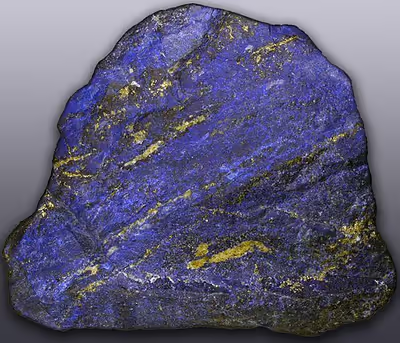
The most important mineral component of lapis lazuli is lazurite (typically 30% to 40%), a blue feldspathoid silicate mineral of the sodalite family, with the formula Na7Ca(Al6Si6O24)(SO4)(S3) ·H2O . Most lapis lazuli also contains calcite (white), and pyrite (metallic yellow). Some samples of lapis lazuli contain augite, diopside, enstatite, mica, hauynite, hornblende, nosean, and sulfur-rich löllingite geyerite.
Lapis lazuli usually occurs in crystalline marble as a result of contact metamorphism.
Color
The intense blue color is due to the presence of the trisulfur radical anion (S•−
3) in the crystal. The presence of disulfur (S•−
2) and tetrasulfur (S•−
4) radicals can shift the color towards yellow or red, respectively. These radical anions substitute for the chloride anions within the sodalite structure. The S•−
3 radical anion exhibits a visible absorption band in the range 595–620 nm with high molar absorptivity, leading to its bright blue color.
Uses and substitutes
Lapis takes an excellent polish and can be made into jewellery, carvings, boxes, mosaics, ornaments, small statues, and vases. Interior items and finishing of buildings can be also made with lapis. During the Renaissance, lapis was ground and processed to make the pigment ultramarine for use in frescoes and oil painting. Its usage as a pigment in oil paint largely ended during the early 19th century, when a chemically identical synthetic variety became available.
Lapis lazuli is commercially synthesized or simulated by the Gillson process, which is used to make artificial ultramarine and hydrous zinc phosphates. Spinel or sodalite, or dyed jasper or howlite, can be substituted for lapis.
History and art
In the ancient world
Lapis lazuli has been mined in Afghanistan and exported to the Mediterranean world and South Asia since the Neolithic age, along the ancient trade route between Afghanistan and the Indus Valley dating to the 7th millennium BC. Quantities of these beads have also been found at 4th millennium BC settlements in Northern Mesopotamia, and at the Bronze Age site of Shahr-e Sukhteh in southeast Iran (3rd millennium BC). A dagger with a lapis handle, a bowl inlaid with lapis, amulets, beads, and inlays representing eyebrows and beards, were found in the Royal Tombs of the Sumerian city-state of Ur from the 3rd millennium BC.
Lapis was also used in ancient Persia, Mesopotamia by the Akkadians, Assyrians, and Babylonians for seals and jewelry. It is mentioned several times in the Mesopotamian poem, the Epic of Gilgamesh (17th–18th century BC), one of the oldest known works of literature. The Statue of Ebih-Il, a 3rd millennium BC statue found in the ancient city-state of Mari in modern-day Syria, now in the Louvre, uses lapis lazuli inlays for the irises of the eyes.
In ancient Egypt, lapis lazuli was a favorite stone for amulets and ornaments such as scarabs. Lapis jewellery has been found at excavations of the Predynastic Egyptian site Naqada (3300–3100 BC). At Karnak, the relief carvings of Thutmose III (1479–1429 BC) show fragments and barrel-shaped pieces of lapis lazuli being delivered to him as tribute. Powdered lapis was used as eyeshadow by Cleopatra.
Jewelry made of lapis lazuli has also been found at Mycenae attesting to relations between the Myceneans and the developed civilizations of Egypt and the East.
Pliny the Elder wrote that lapis lazuli is "opaque and sprinkled with specks of gold". Because the stone combines the blue of the heavens and golden glitter of the sun, it was emblematic of success in the old Jewish tradition. In the early Christian tradition lapis lazuli was regarded as the stone of Virgin Mary.
In late classical times and as late as the Middle Ages, lapis lazuli was often called sapphire (sapphirus in Latin, sappir in Hebrew), though it had little to do with the stone today known as the blue corundum variety sapphire. In his book on stones, the Greek scientist Theophrastus described "the sapphirus, which is speckled with gold," a description which matches lapis lazuli.
There are many references to "sapphire" in the Old Testament, but most scholars agree that, since sapphire was not known before the Roman Empire, they most likely are references to lapis lazuli. For instance, Exodus 24:10: "And they saw the God of Israel, and there was under his feet as it were a paved work of a sapphire stone..." (KJV). The words used in the Latin Vulgate Bible in this citation are "quasi opus lapidis sapphirini", the terms for lapis lazuli. Modern translations of the Bible, such as the New Living Translation Second Edition, refer to lapis lazuli in most instances instead of sapphire.
Vermeer
Johannes Vermeer used lapis lazuli paint in the Girl with a Pearl Earring painting.
Yeats
The poet, William Butler Yeats, describes a figurine of sculpted lapis lazuli in a poem entitled "Lapis Lazuli". The sculpture of three men from China, a bird, and a musical instrument serves in the poem as a reminder of "gaiety" in the face of tragedy.
Present day
Usage by the Taliban
In 2014, a militia under Haji Abdul Malek, a former commander during the Afghan Civil War, gained control of the Kuran wa Munjan district, where major lapis mines were located. Under control of Malek, armed groups received ~$20 million from the mines in 2014, an estimated $1 million of those profits going to the Taliban. The former Afghan government itself only declared about $20 million received across the whole of the country's lapis mines in 2013. The Taliban were reported to have taken around $4 million in profits from the mines in 2014. The working conditions in the mines are highly unethical.