


Related on Lably
Through Iron, Sulfur and Relative density
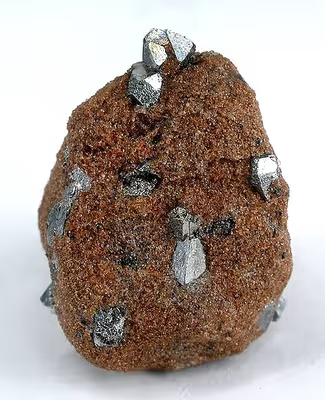
It forms opaque silvery white orthorhombic prismatic crystals often exhibiting crystal twinning. It also occurs in anhedral masses and tarnishes on exposure to air. It has a Mohs hardness of 5.5 to 6 and a quite high specific gravity of 7.1 to 7.5. It becomes magnetic after heating.
Loellingite was first described in 1845 at the Lölling district in Carinthia, Austria, for which it was named.
It occurs in mesothermal ore deposits associated with skutterudite, native bismuth, nickeline, nickel-skutterudite, siderite and calcite. It has also been reported from pegmatites.