

Lazurite
Alumino-silicate mineral whose blue colour is due to a sulfide species and not copper
- 2 min read
- 3 chapters

Related on Lably
Mineral
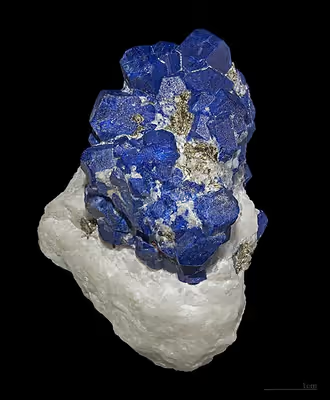
Lazurite is a deep‐blue to greenish‐blue. The colour is due to the presence of S−
3 anions. It has a Mohs hardness of 5.0 to 5.5 and a specific gravity of 2.4. It is translucent with a refractive index of 1.50. It is fusible at 3.5 on Wolfgang Franz von Kobell's fusibility scale, and soluble in HCl. It commonly contains or is associated with grains of pyrite.
Lazurite is a product of contact metamorphism of limestone and is typically associated with calcite, pyrite, diopside, humite, forsterite, hauyne and muscovite.
Other blue minerals, such as the carbonate mineral, azurite, and the phosphate mineral, lazulite, may be confused with lazurite, but are easily distinguished with careful examination. At one time, lazurite was a synonym for azurite.
Lazurite was first described in 1890 for an occurrence in the Sar-e-Sang District, Koksha Valley, Badakhshan Province, Afghanistan. It has been mined for more than 6,000 years in the lapis lazuli district of Badakhshan. It has been used as a pigment in painting and cloth dyeing since at least the 6th or 7th century. It is also mined at Lake Baikal in Siberia; Mount Vesuvius; Burma; Canada; and the United States. The name is from the Persian lajvard for blue.
The most important mineral component of lapis lazuli is lazurite. (25% to 40%)
Sign in to keep reading
2 more chapters are free with a Lably account.
Redefinition
Most lapis lazuli gets its blue color from Hauyne and almost none contain "true lazurite". This was changed in 2021, as lazurite was redefined so that it is enough for a quarter (instead of half) of the cages to contain sulfide.
Structure
Lazurite and hauyne seem to have the same structure and both are sulfate-dominant minerals. Lazurite is a pigment (opalescent) and has a bright blue streak (especially as a component of the semiprecious stone lapis lazuli). Many hauynes have a white or pale blue streak and are translucent. The difference might be a consequence of the redox state (sulfate to sulfide ratio).