

Middle English
English language during the Middle Ages
- 20 min read
- 5 chapters

Related on Lably
Through Vocabulary, Grammar and Orthography
During the Middle English period, many Old English grammatical features either became simplified or disappeared altogether. Noun, adjective, and verb inflections were simplified by the reduction (and eventual elimination) of most grammatical case distinctions. Middle English also saw considerable adoption of Anglo-Norman vocabulary, especially in the areas of politics, law, the arts, and religion, as well as poetic and emotive diction. Conventional English vocabulary remained primarily Germanic in its sources, with Old Norse influences becoming more apparent. Significant changes in pronunciation took place, particularly involving long vowels and diphthongs, which in the later Middle English period began to undergo the Great Vowel Shift.
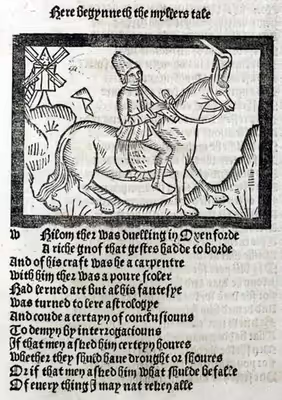
Little survives of early Middle English literature, due in part to Norman domination and the prestige that came with writing in French rather than English. During the 14th century, a new style of literature emerged with the works of writers including John Wycliffe and Geoffrey Chaucer, whose Canterbury Tales remains the most studied and read work of the period.
By the end of the period (about 1470), and aided by the invention of the printing press by Johannes Gutenberg in 1439, a standard based on the London dialects (Chancery Standard) had become established. This largely formed the basis for Modern English spelling, although pronunciation has changed considerably since that time. In England, Middle English was succeeded by Early Modern English, which lasted until about 1650. In Scotland, Early Scots developed concurrently from a variant of the Northumbrian Old English (prevalent in Northern England and spoken in southeast Scotland).
History
Transition from Old English
The transition from Late Old English to Early Middle English had taken place by the 1150s to 1180s, the period when the Augustinian canon Orrm wrote the Ormulum, one of the oldest surviving texts in Middle English.
Contact with Old Norse aided the development of English from a synthetic language with relatively free word order to a more analytic language with a stricter word order, as both Old English and Old Norse were synthetic languages with complicated inflections. Communication between Vikings in the Danelaw and their Anglo-Saxon neighbours resulted in the erosion of inflection in both languages; this effect was characterized as being of a "substantive, pervasive, and of a democratic" manner. Old Norse and Old English closely resembled each other, and with a lot of vocabulary and grammatical structures in common, speakers of each language roughly understood each other, but according to the historian Simeon Potler, the main difference lay in their inflectional endings, which led to much confusion within the mixed population that existed in the Danelaw, thus endings tended gradually to become obscured and finally lost, "simplifying English grammar" in the process, leading to the emergence of the analytic pattern. The dramatic changes that happened in English contribute to the acceptance of the hypothesis that Old Norse had a more profound impact on the development of Middle and Modern English than any other language.
Viking influence on Old English is most apparent in pronouns, modals, comparatives, pronominal adverbs (like hence and together), conjunctions, and prepositions show the most marked Danish influence. The best evidence of Scandinavian influence appears in extensive word borrowings; however, texts from the period in Scandinavia and Northern England do not provide certain evidence of an influence on syntax.
While the Old Norse influence was strongest in the dialects under Danish control, which approximately covered Yorkshire, the central and eastern Midlands, and the East of England, words in the spoken language emerged in the 10th and 11th centuries near the transition from Old to Middle English. Influence on the written languages only appeared from the beginning of the 13th century onwards; this delay in Scandinavian lexical influence in English has been attributed to the lack of written evidence from the areas of Danish control, as the majority of written sources from Old English were produced in the West Saxon dialect spoken in Wessex, the heart of Anglo-Saxon political power at the time.
The Norman Conquest of England in 1066 saw the replacement of the top levels of the English-speaking political and ecclesiastical hierarchies by Norman rulers who spoke a dialect of Old French, now known as Old Norman, which developed in England into Anglo-Norman. The use of Norman as the preferred language of literature and polite discourse fundamentally altered the role of Old English in education and administration, even though many Normans of this period were illiterate and depended on the clergy for written communication and record-keeping. A significant number of Norman words were borrowed into English and used alongside native Germanic words with similar meanings. Examples of Germanic/Norman pairs in Modern English include pig and pork, calf and veal, wood and forest, and freedom and liberty. The role of Anglo-Norman as the language of government and law can be seen in the abundance of Modern English words for the mechanisms of government that are derived from Anglo-Norman, such as court, judge, jury, appeal, and parliament. There are also many Norman-derived terms relating to the chivalric cultures that arose in the 12th century, an era of feudalism, seigneurialism, and crusading.
Words were often taken from Latin, usually through French transmission. This gave rise to various synonyms, including kingly (inherited from Old English), royal (from French, inherited from Vulgar Latin), and regal (from French, which borrowed it from Classical Latin). Later French appropriations were derived from standard, rather than Norman, French. Examples of the resulting doublet pairs include warden (from Norman) and guardian (from later French; both share a common ancestor loaned from Germanic).
The end of Anglo-Saxon rule did not result in immediate changes to the language. The general population would have spoken the same dialects as they had before the Conquest. Once the writing of Old English came to an end, Middle English had no standard language, only dialects that evolved individually from Old English.
Ralph d'Escures' Homily on the Virgin Mary, a French work translated into Latin and then English in the first half of the 12th Century, was either one of "the very latest compositions in Old English, or, as some scholars would have it, the very earliest in Middle English," having an Old English vocabulary co-existing with simplified inflexion.
Early Middle English
Early Middle English (1150–1350) has a largely Anglo-Saxon vocabulary (with many Norse borrowings in the northern parts of the country) but a greatly simplified inflectional system. The grammatical relations that were expressed in Old English by the dative and instrumental cases were replaced in Early Middle English with prepositional constructions. The Old English genitive -es survives in the -'s of the modern English possessive, but most of the other case endings disappeared in the Early Middle English period, including most of the roughly one dozen forms of the definite article ("the"). The dual personal pronouns (denoting exactly two) also disappeared from English during this period.
The loss of case endings was part of a general trend from inflections to fixed word order that also occurred in other Germanic languages (though more slowly and to a lesser extent). Therefore, it cannot be attributed simply to the influence of French-speaking sections of the population; English did, after all, remain the vernacular. It is also argued that Norse immigrants to England had a great impact on the loss of inflectional endings in Middle English. One argument is that, although Norse and English speakers were somewhat comprehensible to each other due to similar morphology, the Norse speakers' inability to reproduce the ending sounds of English words influenced Middle English's loss of inflectional endings.
Important texts for the reconstruction of the evolution of Middle English out of Old English are the Peterborough Chronicle, which continued to be compiled up to 1154; the Ormulum, a biblical commentary probably composed in Lincolnshire in the second half of the 12th century, incorporating a unique phonetic spelling system; and the Ancrene Wisse and the Katherine Group, religious texts written for anchoresses, apparently in the West Midlands in the early 13th century. The language found in the last two works is sometimes called the AB language, one of a range of regional dialects: East Midlands (London), South West (Kentish), Western (AB) and Northern. Additional literary sources of the 12th and 13th centuries include Layamon's Brut and The Owl and the Nightingale.
Some scholars have defined "Early Middle English" as encompassing English texts up to 1350. This longer time frame would extend the corpus to include many Middle English Romances (especially those of the Auchinleck manuscript c. 1330).
Late Middle English
Gradually, the wealthy and the government Anglicised again, although Norman (and subsequently French) remained the dominant language of literature and law until the 14th century, even after the loss of the majority of the continental possessions of the English monarchy.
The writing of this period, however, continues to reflect a variety of regional forms of English. The Ayenbite of Inwyt, a translation of a French confessional prose work, completed in 1340, is written in the Kentish dialect, represented in a rather consistent phonetic orthography. The best known writer of Middle English, Geoffrey Chaucer, wrote in the second half of the 14th century in the emerging London dialect, although he also portrays some of his characters as speaking in northern dialects, as in "The Reeve's Tale".
In the English-speaking areas of lowland Scotland, an independent standard was developing, based on the Northumbrian Old English. This would develop into what came to be known as the Early Scots.
A large number of terms for abstract concepts were adopted directly from scholastic philosophical Latin (rather than via French). Examples are "absolute", "act", "demonstration", and "probable".
Transition to Early Modern English
Emerging around 1430, the Chancery Standard was an official written English dialect firmly rooted in the East Midlands-influenced speech of London. This administrative script was pioneered in August 1417 when King Henry V began issuing his Signet letters to government officials in English, establishing a uniform style that directly influenced modern spelling. Multilingual clerks, proficient in French and Latin, shaped this blueprint by blending local London speech with Central East Midland Lollard texts. Although the Church and courts initially resisted by maintaining Latin and Law French, this national standard was slowly adopted by royal bureaucrats for most official purposes.
The Chancery Standard's influence on later forms of written English is disputed, but it did undoubtedly provide the core around which Early Modern English formed. Early Modern English emerged with the help of William Caxton's printing press, developed during the 1470s. The press stabilized English through a push towards standardization, led by Chancery Standard enthusiast and writer Richard Pynson. Early Modern English began in the 1540s after the printing and wide distribution of the English Bible and Prayer Book, which made the new standard of English publicly recognisable and lasted until about 1650.
Sign in to keep reading
4 more chapters are free with a Lably account.
Phonology
The main changes between the Old English sound system and that of Middle English include:
- The emergence of the voiced fricatives , , and as separate phonemes, rather than mere allophones of the corresponding voiceless fricatives;
- The reduction of Old English diphthongs to monophthongs and the emergence of new diphthongs, with reasons including vowel breaking in certain positions, the change of Old English post-vocalic and (sometimes resulting from the allophone of ) to offglides, and borrowing from French;
- The merger of Old English and into a single vowel ;
- The raising of the long vowel to ;
- The rounding of to in the southern dialects;
- The unrounding of the front rounded vowels (, , , and ) to , , , and in most dialects;
- The 13th-century lengthening of vowels in open syllables (and in certain other positions); the resultant long vowels (and other preexisting long vowels) subsequently underwent changes of quality in the Great Vowel Shift, which began during the late Middle English period;
- The loss of gemination (double consonants came to be pronounced as single ones);
- And the loss of weak final vowels (schwa, written ⟨e⟩). By Chaucer's time, this vowel was silent in normal speech, although it was normally pronounced in verse as the meter required (much as occurs in Modern French). Also, nonfinal unstressed ⟨e⟩ was dropped when adjacent to only a single consonant on either side if there was another short ⟨e⟩ in an adjoining syllable. Thus, every began to be pronounced as evry, and palmeres as palmers.
The combination of the last three processes listed above led to the spelling conventions associated with silent ⟨e⟩ and doubled consonants (see § Orthography below).
Morphology
Nouns
Middle English retains only two distinct noun-ending patterns from the more complex system of inflection in Old English:
Nouns of the weak declension are primarily inherited from Old English n-stem nouns but also from ō-stem, wō-stem, and u-stem nouns, which did not inflect in the same way as n-stem nouns in Old English, but joined the weak declension in Middle English. Nouns of the strong declension are inherited from the other Old English noun stem classes.
Some nouns of the strong type have an -e in the nominative/accusative singular, like the weak declension, but otherwise strong endings. Often, these are the same nouns that had an -e in the nominative/accusative singular of Old English (they, in turn, were inherited from Proto-Germanic ja-stem and i-stem nouns).
The distinct dative case was lost in early Middle English, and although the genitive survived, by the end of the Middle English period only the strong -'s ending (variously spelled) was in use. Some formerly feminine nouns, as well as some weak nouns, continued to make their genitive forms with -e or no ending (e.g., fole hoves, horses' hooves), and nouns of relationship ending in -er frequently have no genitive ending (e.g., fader bone, "father's bane").
The strong -(e)s plural form has survived into Modern English. The weak -(e)n form is now rare and used only in oxen and as part of a double plural, in children and brethren. Some dialects still have forms such as eyen (for eyes), shoon (for shoes), hosen (for hose(s)), kine (for cows), and been (for bees).
Grammatical gender survived to a limited extent in early Middle English before being replaced by natural gender in the course of the Middle English period. Grammatical gender was indicated by agreement of articles and pronouns (e.g., þo ule "the feminine owl") or using the pronoun he to refer to masculine nouns such as helm ("helmet"), or phrases such as scaft stærcne (strong shaft), with the masculine accusative adjective ending -ne.
Adjectives
Single-syllable adjectives added -e when modifying a noun in the plural and when used after the definite article (þe), after a demonstrative (þis, þat), after a possessive pronoun (e.g., hir, our), or with a name or in a form of address. This derives from the Old English "weak" declension of adjectives. This inflexion continued to be used in writing even after final -e had ceased to be pronounced. In earlier texts, multisyllable adjectives also receive a final -e in these situations, but this occurs less regularly in later Middle English texts. Otherwise, adjectives have no ending and adjectives already ending in -e etymologically receive no ending as well.
Earlier texts sometimes inflect adjectives for case as well. Layamon's Brut inflects adjectives for the masculine accusative, genitive, and dative, the feminine dative, and the plural genitive. The Owl and the Nightingale adds a final -e to all adjectives not in the nominative, here only inflecting adjectives in the weak declension (as described above).
Comparatives and superlatives were usually formed by adding -er and -est. Adjectives with long vowels sometimes shortened these vowels in the comparative and superlative (e.g., greet, great; gretter, greater). Adjectives ending in -ly or -lich formed comparatives either with -lier, -liest or -loker, -lokest. A few adjectives also displayed Germanic umlaut in their comparatives and superlatives, such as long, lenger. Other irregular forms were mostly the same as in modern English.
Pronouns
Middle English personal pronouns were mostly developed from those of Old English, with the exception of the third person plural, a borrowing from Old Norse. (The original Old English form clashed with the third person singular and was eventually dropped.) Also, the nominative form of the feminine third person singular was replaced by a form of the demonstrative that developed into sche (modern she), but the alternative heyr remained in some areas for a long time.
As with nouns, there was some inflectional simplification (the distinct Old English dual forms were lost), but pronouns, unlike nouns, retained distinct nominative and accusative forms. Third person pronouns also retained a distinction between accusative and dative forms, but that was gradually lost: The masculine hine was replaced by him south of the River Thames by the early 14th century, and the neuter dative him was ousted by it in most dialects by the 15th.
The following table shows some of the various Middle English pronouns. Many other variations are noted in Middle English sources because of differences in spellings and pronunciations at different times and in different dialects.
Verbs
As a general rule, the indicative first person singular of verbs in the present tense ended in -e (e.g., ich here, "I hear"), the second person singular in -(e)st (e.g., þou spekest, "thou speakest"), and the third person singular in -eþ (e.g., he comeþ, "he cometh/he comes"). (þ (the letter "thorn") is pronounced like the unvoiced th in "think", but under certain circumstances, it may be like the voiced th in "that"). The following table illustrates a typical conjugation pattern:
Plural forms vary strongly by dialect, with Southern dialects preserving the Old English -eþ, Midland dialects showing -en from about 1200, and Northern forms using -es in the third person singular as well as the plural.
The past tense of weak verbs was formed by adding an -ed(e), -d(e), or -t(e) ending. The past-tense forms, without their personal endings, also served as past participles with past-participle prefixes derived from Old English: i-, y-, and sometimes bi-.
Strong verbs, by contrast, formed their past tense by changing their stem vowel (e.g., binden became bound, a process called apophony), as in Modern English.
Orthography
With the discontinuation of the Late West Saxon standard used for the writing of Old English in the period prior to the Norman Conquest, Middle English came to be written in a wide variety of scribal forms, reflecting different regional dialects and orthographic conventions. Later in the Middle English period, however, and particularly with the development of the Chancery Standard in the 15th century, orthography became relatively standardised in a form based on the East Midlands-influenced speech of London. Spelling at the time was mostly quite regular. (There was a fairly consistent correspondence between letters and sounds.) The irregularity of present-day English orthography is largely due to pronunciation changes that have taken place over the Early Modern English and Modern English eras.
Middle English generally did not have silent letters. For example, knight was pronounced (with both the ⟨k⟩ and the ⟨gh⟩ pronounced, the latter sounding as the ⟨ch⟩ in German Ich). The major exception was the silent ⟨e⟩ – originally pronounced but lost in normal speech by Chaucer's time. This letter, however, came to indicate a lengthened – and later also modified – pronunciation of a preceding vowel. For example, in name, originally pronounced as two syllables, the /a/ in the first syllable (originally an open syllable) lengthened, the final weak vowel was later dropped, and the remaining long vowel was modified in the Great Vowel Shift (for these sound changes, see Phonology, above). The final ⟨e⟩, now silent, thus became the indicator of the longer and changed pronunciation of ⟨a⟩. In fact, vowels could have this lengthened and modified pronunciation in various positions, particularly before a single consonant letter and another vowel or before certain pairs of consonants.
A related convention involved the doubling of consonant letters to show that the preceding vowel was not to be lengthened. In some cases, the double consonant represented a sound that was (or had previously been) geminated (i.e., had genuinely been "doubled" and would thus have regularly blocked the lengthening of the preceding vowel). In other cases, by analogy, the consonant was written double merely to indicate the lack of lengthening.
Alphabet
The basic Old English Latin alphabet consisted of 20 standard letters plus four additional letters: ash ⟨æ⟩, eth ⟨ð⟩, thorn ⟨þ⟩, and wynn ⟨ƿ⟩. There was not yet a distinct j, v, or w, and Old English scribes did not generally use k, q, or z.
Ash was no longer required in Middle English, as the Old English vowel that it represented had merged into /a/. The symbol nonetheless came to be used as a ligature for the digraph ⟨ae⟩ in many words of Greek or Latin origin, as did ⟨œ⟩ for ⟨oe⟩.
Eth and thorn both represented or its allophone in Old English. Eth fell out of use during the 13th century and was replaced by thorn. Thorn mostly fell out of use during the 14th century and was replaced by ⟨th⟩. Anachronistic usage of the scribal abbreviation yͤ (þe, "the") has led to the modern mispronunciation of thorn as ⟨y⟩ in this context; see ye olde.
Wynn, which represented the phoneme , was replaced by ⟨w⟩ during the 13th century. Due to its similarity to the letter ⟨p⟩, it is mostly represented by ⟨w⟩ in modern editions of Old and Middle English texts even when the manuscript has wynn.
Under Norman influence, the continental Carolingian minuscule replaced the insular script that had been used for Old English. However, because of the significant difference in appearance between the old insular g and the Carolingian g (modern g), the former continued in use as a separate letter, known as yogh, written ⟨ȝ⟩. This was adopted for use to represent a variety of sounds: , while the Carolingian g was normally used for [g]. Instances of yogh were eventually replaced by ⟨j⟩ or ⟨y⟩ and by ⟨gh⟩ in words like night and laugh. In Early Scots, yogh became indistinguishable from cursive z, and printers tended to use ⟨z⟩ when yogh was not available in their fonts; this led to new spellings (often giving rise to new pronunciations), as in McKenzie, where the ⟨z⟩ replaced a yogh, which had the pronunciation .
Under continental influence, the letters ⟨k⟩, ⟨q⟩, and ⟨z⟩, which had not normally been used by Old English scribes, came to be commonly used in the writing of Middle English. Also, the newer Latin letter ⟨w⟩ was introduced (replacing wynn). The distinct letter forms ⟨v⟩ and ⟨u⟩ came into use but were still used interchangeably; the same applies to ⟨j⟩ and ⟨i⟩. (For example, spellings such as wijf and paradijs for "wife" and "paradise" can be found in Middle English.)
The consonantal ⟨j⟩/⟨i⟩ was sometimes used to transliterate the Hebrew letter yodh, representing the palatal approximant sound (and transliterated in Greek by iota and in Latin by ⟨i⟩); words like Jerusalem, Joseph, etc. would have originally followed the Latin pronunciation beginning with , that is, the sound of ⟨y⟩ in yes. In some words, however, notably from Old French, ⟨j⟩/⟨i⟩ was used for the affricate consonant , as in joie (modern "joy"), used in Wycliffe's Bible. This was similar to the geminate sound , which had been represented as ⟨cg⟩ in Old English. By the time of Modern English, the sound came to be written as ⟨j⟩/⟨i⟩ at the start of words (like "joy"), and usually as ⟨dg⟩ elsewhere (as in "bridge"). It could also be written, mainly in French loanwords, as ⟨g⟩, with the adoption of the soft G convention (age, page, etc.)
Other symbols
Many scribal abbreviations were also used. It was common for the Lollards to abbreviate the name of Jesus (as in Latin manuscripts) to ihc. The letters ⟨n⟩ and ⟨m⟩ were often omitted and indicated by a macron above an adjacent letter, so for example, in could be written as ī. A thorn with a superscript ⟨t⟩ or ⟨e⟩ could be used for that and the; the thorn here resembled a ⟨Y⟩, giving rise to the ye of "Ye Olde". Various forms of the ampersand replaced the word and.
Numbers were still always written using Roman numerals, except for some rare occurrences of Arabic numerals during the 15th century.
Letter-to-sound correspondences
Although Middle English spelling was never fully standardised, the following table shows the pronunciations most usually represented by particular letters and digraphs towards the end of the Middle English period, using the notation given in the article on Middle English phonology. As explained above, single vowel letters had alternative pronunciations depending on whether they were in a position where their sounds had been subject to lengthening. Long vowel pronunciations were in flux due to the beginnings of the Great Vowel Shift.
Sample texts
Most of the following Modern English translations are poetic sense-for-sense translations, not word-for-word translations.
Ormulum, 12th century
This passage explains the background to the Nativity (3494–501):
Epitaph of John the smyth, died 1371
An epitaph from a monumental brass in an Oxfordshire parish church:
Pre-Wycliffite Bibles
Wycliffite Bibles
From the Wycliffe's Bible:
Chaucer, 1390s
The following is the very beginning of the General Prologue from The Canterbury Tales by Geoffrey Chaucer. The text was written in a dialect associated with London and spellings associated with the then-emergent Chancery Standard.
Gower, 1390
The following is the beginning of the Prologue from Confessio Amantis by John Gower.
Translation in Modern English: (by J. Dow)
Of those who wrote before we were born, books survive,
So we are taught what was written by them when they were alive. So it's good that we, in our times here on earth, write of new matters – Following the example of our forefathers – So that, in such a way, we may leave our knowledge to the world after we are dead and gone. But it's said, and it is true, that if one only reads of wisdom all day long It often dulls one's brains. So, if it's alright with you, I'll take the middle route and write a book between the two – Somewhat of amusement, and somewhat of fact.
In that way, somebody might, more or less, like that.