

Ibn Yunus
Egyptian mathematician (c. 950–1009)
- 3 min read
- 4 chapters

Related on Lably
Life
Information regarding his early life and education is uncertain. He was born in Egypt between 950 and 952 and came from a respected family in Fustat belonging to the Yemeni Arab tribe of Sadaf, a branch traditionally traced to Ḥimyar. His father was a historian, biographer, and scholar of hadith who wrote two volumes about the history of Egypt, one about the Egyptians and one based on traveller commentary on Egypt. A prolific writer, ibn Yunus' father has been described as "Egypt's most celebrated early historian and first known compiler of a biographical dictionary devoted exclusively to Egyptians". His grandfather was also a scholar who specialized in astronomy, and Ibn Yunus enjoyed great prestige among the Fatimid caliphs, who encouraged him to pursue his astronomical and mathematical research. They built an observatory for him near Fustat (Cairo), and equipped it with all the necessary machinery and tools. Sarton says of him that he was perhaps the greatest Muslim astronomer. His great-grandfather had been an associate of the noted legal scholar al-Shafi'i.
Early in the life of ibn Yunus, the Fatimid dynasty came to power and the new city of Cairo was founded. In Cairo, he worked as an astronomer for the Fatimid dynasty for twenty-six years, first for the Caliph Al-Aziz Billah and then for al-Hakim. Ibn Yunus dedicated his most famous astronomical work, al-Zij al-Kabir al-Hakimi, to the latter.
As well as for his mathematics, Ibn Yunus was also known as an eccentric and a poet.
Sign in to keep reading
3 more chapters are free with a Lably account.
Ibn Yunus's philosophy
In his scientific studies, he only believed in what his mind was convinced of, and he did not care what people said about him. His philosophy was summarized in three points:
- Adopting the scientific principle based on observation and measurement, and taking the universe and everything in it as a teacher, from which facts are deduced and to which they are returned.
- Strengthening faith by touching the signs of the Creator emanating in the universe.
- Practicing legitimate pleasures. (Ibn Khallikan mentions about one of the astrologers that he once went with him to Mount Mokattam, and he stopped to observe the planet Venus, so he took off his turban and dress and put on a red shirt and a red mask to cover himself with. He took out a stick and struck it with incense in his hands, and his situation was bizarre).
Narration of Hadith
Ibn Yunus narrated hadiths and reports from his father, Abi al-Sa'id, but the scholars rejected his narration due to his preoccupation with astrology and magic.
Books
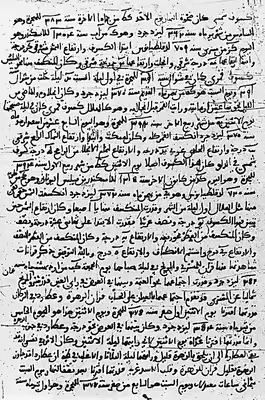
Ibn Yunus had many works, and his most important book is Al-Zij Al-Kabir Al-Hakimi, which is the book he began writing, by order of the Fatimid Caliph Al-Aziz in the year 380 AH/990 AD, and completed it in 1007 AD during the reign of Caliph Al-Hakim Ould Al-Aziz, and he called it Al-Zij Al-Hakimi, after the caliph.
The word Zij is a Persian word (Zik), and its meaning in our modern sense is mathematical astronomical tables. He had another book called Zij Ibn Yunus, and the numbers he included in his two zij books are correct up to the seventh decimal number, which indicates unparalleled mathematical accuracy in calculations, and many astronomers have been transmitted from him, especially after his zij moved to the East, and the Egyptians relied on their calendars on Ibn Yunus’ zij for a long period of time.