

Independence
Condition of a nation with self-governance
- 3 min read
- 5 chapters
- 5 labs on Lably

Learn it on Lably
- Independence and Partition of IndiaClass 10 · History & Civics
- India’s Long Road to IndependenceClass 8 · Social Science
- Towards Independence and Partition (1939–1947)Class 12 · History
- India’s Struggle for FreedomClass 8 · History & Civics
- The First War of Independence, 1857Class 10 · History & Civics
- The Growth of NationalismClass 8 · History & Civics
Definition
Whether the attainment of independence is different from revolution has long been contested, and has often been debated over the question of violence as legitimate means to achieving sovereignty. In general, revolutions aim only to redistribute power with or without an element of emancipation, such as in democratization within a state, which as such may remain unaltered. For example, the Mexican Revolution (1910) chiefly refers to a multi-factional conflict that eventually led to a new constitution; it has rarely been used to refer to the armed struggle (1821) against Spain. However, some wars of independence have been described as revolutions, such as the ones in the United States (1783) and Indonesia (1949), while some revolutions that were specifically about a change in the political structure have resulted in breakaway states. Mongolia and Finland, for example, gained their independence during the revolutions occurring in China (1911) and Russia (1917) respectively. Causes for a country or province wishing to seek independence are many, but most can be summed up as a feeling of inequality compared to the dominant power. The means can extend from intended peaceful demonstrations as in the case of India (1947), to a violent war as in the case of Algeria (1962). In some cases, a country may also have declared independence, but may only be partially recognized by other countries; such as Kosovo (2008), whose independence Serbia, from which Kosovo has seceded, has not formally recognized.
Distinction between independence and autonomy
Autonomy refers to a kind of independence which has been granted by an overseeing authority that itself still retains ultimate authority over that territory (see Devolution). A protectorate refers to an autonomous region that depends upon a larger government for its protection as an autonomous region.
Sign in to keep reading
4 more chapters are free with a Lably account.
Right to independence
During the 20th century wave of decolonization colonies gained rights to independence through documents such as the 1960 Declaration on the Granting of Independence to Colonial Countries and Peoples, but this right remained mostly applicable only to unfree territorial entities, such as colonies. How much these rights apply to all people has been a crucial point of discussion. The rights to nationality and self-determination allow clarification. The right of self-determination allows self-governance, as for example in the case of indigenous peoples, but is not a right of secession, except in extreme cases of oppression as a remedy from the oppression. Therefore, the right to secession is generally determined by the legislation of sovereign states and independence by the capacity to be a state.
Declarations of independence
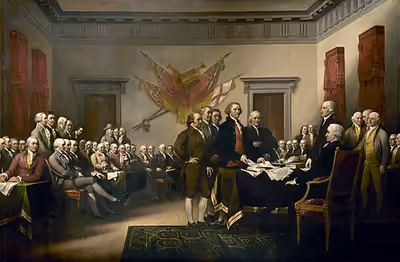
Sometimes, a state wishing to achieve independence from a dominating power will issue a declaration of independence; the earliest surviving example is Scotland's Declaration of Arbroath in 1320, with the most recent examples being Azawad's declaration of independence in 2012 and Catalan declaration of independence in 2017. Declaring independence and attaining it, however, are quite different. A well-known successful example is the U.S. Declaration of Independence issued in 1776. The dates of established independence (or, less commonly, the commencement of revolution), are typically celebrated as a national holiday known as an independence Day.
Historical overview
Historically, there have been four major periods of declaring independence:
- from the 1770s, beginning with the American Revolutionary War through the 1830s, when the last royalist bastions fell at the close of the Spanish American wars of independence;
- the immediate aftermath of the First World War following the breakup of the Ottoman, Austro-Hungarian, Russian, German empires;
- 1945 to c. 1979, when seventy newly independent states emerged from the European colonial empires like India, Algeria etc. and the collapse of the Nazi German Reich and the Empire of Japan;
- and the early 1990s, following the breakup of the Soviet Union, Czechoslovakia and Yugoslavia.