

Iranian Intermezzo
821-1055 Resurgence of Iranian self-rule after the Arab conquests
- 5 min read
- 2 chapters

Related on Lably
Through Muslims, Abbasid Caliphate and Islam
According to the historian Alison Vacca: "The Iranian Intermezzo in fact includes a number of other Iranian, mostly Kurdish, minor dynasties in the former caliphal provinces of Armenia, Albania, and Azerbaijan". Likewise, in the second edition of the Encyclopaedia of Islam, the historian Clifford Edmund Bosworth states that the Russian historian Vladimir Minorsky considers the Rawadids to be flourishing during this period.
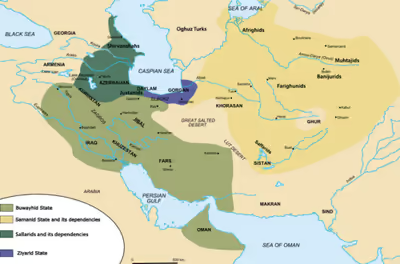
List of Intermezzo dynasties
Tahirid (821–873)
The Tahirid dynasty (Persian: سلسله طاهریان) was an Iranian dynasty that ruled over the northeastern part of Greater Iran, in the region of Khorasan (made up of parts of Iran, present-day Afghanistan, Tajikistan, Turkmenistan, and Uzbekistan). The Tahirid capital was located in Nishapur.
Saffarid (861–1003)
The Saffarid dynasty (Persian: سلسله صفاریان) was an Iranian empire which ruled in Sistan (861–1003), a historical region in southeastern Iran and southwestern Afghanistan. Their capital was Zaranj.
Samanid (819/875–999)
The Samanid dynasty (Persian: سلسلهٔ سامانیان), also known as the Samanid Empire or simply Samanids (819–999), (Persian: سامانیان Sāmāniyān) were an Iranian empire in Central Asia and Greater Khorasan, named after its founder Saman Khuda who converted to Sunni Islam despite being from Zoroastrian theocratic nobility.
With their roots stemming from the city of Balkh (in present-day Afghanistan), the Samanids promoted the arts, giving rise to the advancement of science and literature, and thus attracted scholars such as Rudaki and Avicenna. While under Samanid control, Bukhara was a rival to Baghdad in its glory. Scholars note that the Samanids revived Persian more than the Buyids and the Saffarids, while continuing to patronize Arabic to a significant degree. Nevertheless, in a famous edict, Samanid authorities declared that "here, in this region, the language is Persian, and the kings of this realm are Persian kings."
Sajid (889–929)
The Sajid dynasty (Persian: ساجیان) was an Islamic dynasty that ruled from 889–890 until 929. The Sajids ruled Azerbaijan and parts of Armenia first from Maragha and Barda and then from Ardabil. The Sajids originated from the Central Asian province of Ushrusana and were of Iranian (Sogdian) heritage.
Ziyarid (930–1090)
The Ziyarid dynasty (Persian: زیاریان) was an Iranian dynasty of Gilaki origin that ruled Tabaristan from 930 to 1090. At its greatest extent, it ruled much of western and northern Iran.
Banu Ilyas (932–968)
The Banu Ilyas were an Iranian dynasty of Sogdian origin which ruled Kerman from 932 until 968. Their capital was Bardasir.
Buyid (934–1062)
Buyid dynasty, also known as the Buyid Empire or the Buyids (Persian: بوییان Buyiān, Caspian: Bowyiyün), also known as Buwaihids or Buyyids, were a Shia Iranian dynasty that originated from Daylaman. They founded a confederation that controlled most of Iran and Iraq in the 10th and 11th centuries. Indeed, as Dailamite Iranians the Būyids consciously revived symbols and practices of Persia's Sassānid dynasty. In fact, beginning with 'Adud al-Daula they used the ancient Sassānid title Shāhanshāh (Persian: شاهنشاه), literally meaning king of kings.
Sallarid (942–979)
The Sallarid dynasty (also referred to as the Musafirids or Langarids) was an Islamic Persian dynasty principally known for its rule of Iranian Azerbaijan, Shirvan, and a part of Armenia from 942 until 979.
Shaddadid (951–1199)
The Shaddadids were a Kurdish Sunni Muslim dynasty. who ruled in various parts of Armenia and Arran from 951 to 1199 AD. They were established in Dvin. Through their long tenure in Armenia, they often intermarried with the Bagratuni royal family of Armenia.
Rawadid (955–1070/1116)
Rawwadid dynasty was a Sunni Muslim Kurdish dynasty, centered in the northwestern region of Adharbayjan (Azerbaijan) between the late 8th and early 13th centuries.
Hasanwayhid (959–1015)
Hasanwayhids was a powerful Shia Kurdish dynasty reigning the western parts of Iran such as Iranian Azerbaijan and Zagros Mountains between Shahrizor and Khuzestan from c. 959 to 1015. The last Hasanwayhid ruler died in 1015 in Sarmadj, south of Bisotun, as the Seljuks began entering the region.
Ghaznavid (977–1186)
The Ghaznavids were an Persianate Muslim dynasty and empire of Turkic mamluk origin, ruling at its greatest extent, large parts of Iran, Khorasan, and the northwest Indian subcontinent from 977 to 1186.
Marwanid (983/990–1084)
The Marwanids were a Kurdish Sunni Muslim dynasty in the Diyar Bakr region of Upper Mesopotamia (present day northern Iraq/southeastern Turkey) and Armenia, centered on the city of Amid (Diyarbakır).
Annazid (990/991–1117)
The Annazids was a Kurdish Sunni Muslim dynasty which ruled an oscillating territory on the frontier between Iran and present-day Iraq for about 130 years. The Annazids were related by marriage to the Hasanwayhids who they were in fierce rivalry with. The legitimacy of the Annazid rulers stemmed from the Buyid amir Bahāʾ al-Dawla and the dynasty relied on the Shadhanjan Kurds.
Kakuyid (1008–1141)
The Kakuyids (Persian: آل کاکویه) were a Shia Muslim dynasty of Daylamite origin that held power in western Iran, Jibal and Kurdistan (c. 1008–c. 1051). They later became atabegs (governors) of Yazd, Isfahan and Abarkuh from c. 1051 to 1141. They were related to the Buyids.
Sign in to keep reading
One more chapter is free with a Lably account.
In media
The Iranian Intermezzo features prominently in the video game Crusader Kings III, where it is a featured region in the 867 A.D. start date.