


Related on Lably
Through Mesopotamia and Iraq
Khuzestan comprises much of what historians refer to as ancient Elam, whose capital was at Susa. It was once one of the most important regions in the Ancient Near East. In modern Iran, there has been episodic conflict between the province's Arab population and the central government. Iraq invaded Khuzestan in 1980, and the invasion was reversed at the Battle of Khorramshahr in 1982. Containing Iran's largest oil field, it is a key strategic province.
Etymology
In Greek and Roman sources, from the Achaemenid period until the early centuries AD, the land now called Khuzestan was known as Susiana, a name derived from the city of Susa (modern Shush), which served for a time as a capital of ancient Elam and, under the Achaemenids, as one of the imperial capitals. According to the Achaemenid royal inscriptions, however, the Achaemenids themselves (c. 520–330 BC) called this satrapy Ūja or Uvja, a name that also appears in historical texts as Hūjiya. With the rise of later dynasties such as the Parthians and Sasanians, the name Susiana gradually fell out of use, and in the Middle Persian period it was replaced by names derived from the root hūz. Arab authors of later periods recorded this as Khūzī.
The word Hūjī occurs twenty-four times in the inscriptions of Darius the Great and once in an inscription of Xerxes I. This same word Ūja was rendered by the Greeks as Uza and Uzi, and was later written Uxi and pronounced "Uxi". Strabo and Pliny refer to the inhabitants of the region as the Uxii.
The Hūzī or Hūjī were a non-Semitic people who lived in southwestern Iran from well before the Christian era, with their capital at Susa. The word Khuzestan, which until the Safavid period took the form Hūzestān, consists of the elements hūz and -stān and means "land of the Hūz". The suffix -stān means "land", and older maps and documents indicate that the form Khūzī is an altered form of Hūzī.
According to Richard N. Frye, following the large-scale migration of Arabs into Iran from the west, in particular the migration of the Banu Ka'b and Bani Lam into southwestern Khuzestan, the province's name changed semi-officially from Hūzestān to Arabistan in the Safavid period onwards, that is from the 16th to the 19th century, until under Reza Shah it was officially named Khuzestan.
Uzistan or Huzistan, meaning the land of the Uz or Huz people, appears in Middle Persian (Sasanian Pahlavi) as well as in Parthian as hūjestān or hūžestān. In Syriac the region was called Beth Huzaye. A passage in a Parthian text on the Manichaean manuscript M 5569, which describes the time and place of Mani's death and was written in the third century AD, reads:
pad čafār saxt šahrewar māh, šahrewar rōž, dōšambat, ud ēwandas žamān, andar awestām ī hūžistān, ud šahrestān če bēlābād, kaδ ahrāmād hō pidar rōšn
English translation:
Four days into the month of Shahrewar, on the day of Shahrewar, on Monday, at the eleventh hour, in the province of Huzistan and in the city of Beth Lapat [that is, Gundeshapur], the Father of Light [that is, Mani] ascended…
The Arabic-speaking people who settled in this land after the Muslim conquest of Persia preserved the pronunciation of the people's name as Hūzī, and referred to the Hūzīs using the Arabic broken plural on the pattern afʿāl, that is, Ahvāz. They knew the city of Ahvaz as the "market of the Hūzīs" (Sūq al-Ahvāz).
Medieval Muslim geographers treated the name as covering a wide territory. Ibn Khordadbeh applied the name Ahvāz to the whole of what is now Khuzestan, describing it as an extensive land made up of seven kuras or districts, which he called Akwār al-Ahwāz. Richard N. Frye likewise describes the province as a wealthy lowland region divided into at least seven kuras, the largest of them Hormizd-Ardashir, which the Arabs called Sūq al-Ahvāz. Al-Istakhri placed Khuzestan between Fars, Isfahan, the Karkheh and Lorestan, and Khwarizmi mentioned both the province and the Hūzī language in his Mafatih al-Ulum in the second half of the tenth century.
According to Frye, following substantial Arab migration into Iran from the west, in particular the settlement of the Banu Ka'b and Bani Lam in southwestern Khuzestan — the province came to be known semi-officially as Arabistan rather than Hūzestān from the beginning of the Safavid period onward, that is from the 16th to the 19th century. The name Khuzestan was restored in official usage under Reza Shah. The older form of the name also appears in Ferdowsi's Shahnameh, where the inhabitants of the region are called Khuziyān.
Sign in to keep reading
9 more chapters are free with a Lably account.
History
Antiquity
The province of Khuzestan is one of the centres of ancient civilization, and one of the most important regions of the Ancient Near East, based around Susa. Human settlement in the region goes back to at least the late fourth millennium BC, and the Elamite civilization took shape here in the third millennium BC.
Archaeological remains show the province to have been home to the Elamite civilization, a kingdom speaking a language that was neither Semitic nor Indo-European, and the earliest civilization within the borders of what would later be called Persia.
In antiquity, and particularly under the Achaemenids, the region was divided into two parts: the northern and northeastern districts, known as Anshan, which were mountainous and heavily wooded, and the southern lowlands, with a hot and humid climate and fertile alluvial plains. The southern part, known as Elam, was strongly influenced by the culture of Mesopotamia.
In the words of Elton L. Daniel, the Elamites were "the founders of the first 'Iranian' empire in the geographic sense." Hence the central geopolitical significance of Khuzestan, the seat of Iran's first empire.
In 640 BC, the Elamites were defeated by Ashurbanipal, coming under the rule of the Assyrian Empire who brought destruction upon Susa and Chogha Zanbil. After the death of Ashurbanipal, the Assyrian Empire began to experience internal conflict, which was quietly taken advantage of by the Medes who had hitherto been subjects of Assyria. During the reign of the Median Cyaxares (625–585 BC), Elam was incorporated into the Median Empire, but in 538 BC, the Persian Cyrus the Great who established the Achaemenid Empire, was able to conquer the Elamite lands from the Medes. The Persians regarded Elam highly and the city of Susa was proclaimed as one of the Achaemenid capitals. Darius I then erected a grand palace known as Apadana there in 521 BC.
The geographer Strabo described the plain of Khuzestan as among the most fertile in the world, irrigated by numerous rivers that made agriculture and settlement possible across the region.
In 331 BC, following Achaemenid defeat at the Battle of the Uxian Defile, Susa was conquered by Alexander the Great, and a year later in 330 BC after suffering defeat at the Battle of the Persian Gate, Persia (the Achaemenid Empire) was conquered by the Macedonian Empire. The Susa weddings were arranged by Alexander in 324 BC in Susa, where mass weddings took place between the Persians and the Macedonians. After Alexander, the Seleucid dynasty came to rule the area.
As the Seleucid dynasty weakened, Mehrdad I the Parthian (171–137 BC) gained ascendency over the region.
Over centuries, Elamite culture and peoples were eventually absorbed into these later Indo-European-speaking populations. Speakers of Elamite may have persisted in isolated regions of Khuzestan into the 10th century, on the basis of interpretations of a Xūzī language reported in Arab sources. Elamite is now extinct.
Sassanid period
In 224, after the Parthians suffered defeat at the Battle of Hormozdgan, fought in what is now Khuzestan, the Sassanids established control over the area, bringing the 471-year rule of the Arsacids to an end. The Sassanids were responsible for the many constructions that were erected in Ahvaz, Shushtar, and the north of Andimeshk. During the early years of the reign of the Sassanian Shapur II (AD 309 or 310–379), Arabs crossed the Persian Gulf from Bahrain to "Ardashir-Khora" of Fars and raided the city. In retaliation, Shapur II led an expedition through Bahrain, defeated the combined forces of the Arab tribes of Taghleb, Bakr bin Wael, and Abd Al-Qays and advanced temporarily into Yamama in central Najd. The Sassanids nonetheless resettled the aforementioned tribes in Kerman and Ahvaz. Arabs named Shapur II "Shabur Dhul-aktāf" after this battle.
The existence of prominent scientific and cultural centers such as the Academy of Gundishapur, which gathered distinguished medical scientists from Egypt, Greece, India and Rome, shows the importance and prosperity of this region during this era. The medical school at Gundishapur was founded by the order of Shapur I. It was repaired and restored by Shapur II (also known as Zu'l-Aktaf, "the Possessor of Shoulder Blades") and was completed and expanded during the reign of Anushirvan.
Muslim conquest of Khuzestan
Rashidun period
The governor of Basra first sent Mughira ibn Shu'ba to take the towns of Khuzestan, and the Iranian landholders of Ahvaz submitted and accepted the payment of jizya. Mughira was subsequently removed from office and replaced by Abu Musa al-Ash'ari.
In 639, the Muslim Rashidun Caliphate forces under the command of Abu Musa al-Ash'ari defeated the Sassanids in Ahvaz and drove the Persian satrap Hormuzan out of the city. Susa later fell, so Hormuzan fled to Shushtar. The Muslims led by Abu Musa thereafter imposed a siege on the Sassanid forces in Shushtar that lasted for 18 months. Shushtar finally fell in 642 and the Muslims subsequently established full control over the area. The Khuzistan Chronicle records that an unknown Arab, living in the city, befriended a man in the army, and dug tunnels through the wall in return for a third of the spoil. The Arabs purged the Nestorians—the Exegete of the city and the Bishop of Hormizd, and all their students—but kept Hormuzan alive. Hormuzan was sent to Medina, where he was later killed after being accused of complicity in the murder of the caliph Umar.
There followed the conquests of Gundeshapur and of many other districts along the Tigris. The Battle of Nahāvand finally secured Khuzestan for the Muslim armies.
During the Muslim conquest the Sassanids were allied with non-Muslim Arab tribes, which implies that those wars were religious, rather than national. For instance in 633–634, Khaled ibn Walid leader of the Muslim Army, defeated a force of the Sassanids' Arab auxiliaries from the tribes of Bakr, 'Ejl, Taghleb and Namer at 'Ayn Al-Tamr.
The Muslim settlements by military garrisons in southern Iran was soon followed by other types of expansion. Some families, for example, took the opportunity to gain control of private estates. Like the rest of Iran, the Muslim conquest thus brought Khuzestan under the rule of the Arabs of the Umayyad and Abbasid Caliphates, until Ya'qub bin Laith as-Saffar, from southeastern Iran, raised the flag of independence once more, and ultimately regained control over Khuzestan, among other parts of Iran, founding the short-lived Saffarid dynasty. From that point on, Iranian dynasties would continue to rule the region in succession as an important part of Iran.
Umayyad and Abbasid periods
In the Umayyad period, large groups of nomads from the Hanifa, Banu Tamim, and Abd al-Qays tribes crossed the Persian Gulf and occupied some of the richest Basran territories around Ahvaz and in Fars during the Second Fitna in 661–665 / 680–684 AD.
During the Abbasid period, in the second half of the 10th century, the Assad tribe, taking advantage of quarrels under the Buwayhids, penetrated into Khuzestan, where a group of Tamim had been living since pre-Islamic times. However, following the fall of the Abbasid dynasty, the flow of Arab immigrants into Persia gradually diminished, but it nonetheless continued. In the latter part of the 16th century, the Bani Kaab (pronounced Chaub in the local Gulf dialect), from Kuwait, settled in Khuzestan. And during the succeeding centuries, more Arab tribes moved from southern Iraq to Khuzestan.
Qajar period
According to C.E. Bosworth in Encyclopædia Iranica, under the Qajar dynasty the province was known, as in Safavid times, as Arabistan, and during the Qajar period was administratively a governor-generalate. The northern, more populous parts of the province, with their centre at Shushtar, retained the older name, and were at times attached to the district of "Greater Lur" on account of the large Bakhtiari population there.
In 1856, in the course of the Anglo-Persian War over the city of Herat, British naval forces sailed up the Karun river as far as Ahvaz. In the settlement that followed, however, they evacuated the province. Some tribal forces, such as those led by Sheikh Jabir al-Kaabi, the Sheikh of Mohammerah, fared better in opposing the invading British forces than those dispatched by the central government, which was quite feeble. The purpose of the invasion of the province and other coastal regions of southern Iran was to force the evacuation of Herat by the Persians rather than the permanent occupation of these regions.
Pahlavi period
Arab rebellion
In the two decades before 1925, although nominally part of Persian territory, the western part of Khuzestan known as the Emirate of Muhammara functioned for many years effectively as an autonomous emirate known as "Arabistan". The eastern part of Khuzestan was governed by Bakhtiari khans. Following Sheikh Khazʽal Ibn Jabir's rebellion, the western part of Khuzestan's emirate was dissolved by the Reza Shah government in 1925, along with other autonomous regions of Persia, in a bid to centralize the state. In response Sheikh Khaz'al of Mohammerah initiated a rebellion, which was suppressed by the Pahlavi government in late 1924 and early 1925. A low-level conflict between the central Iranian government and Arab nationalists in the province has continued since.
The provincial administration was transferred from Shushtar to the new city of Ahvaz in 1924, and the name Arabistan was progressively removed from official orders and government correspondence in favour of Khuzestan. The name Khuzestan came to be applied to the entire territory by 1936. Over the following decades of Pahlavi rule, the province remained relatively quiet, while holding an increasingly important economic and strategic position.
Oil
Oil has been produced commercially in the province since 1908, when the Masjed Soleyman oil field was discovered some 50 miles northeast of the provincial capital, Ahvaz; it was the first oil discovery in the Middle East. This initiated a period of intense foreign exploration and political involvement, culminating in the discovery in 1953 of a further, much larger, oil field in the region by the Anglo-Persian Oil Company. The new Ahvaz field entered into production a year later, after the parliamentary regime of Prime Minister Mohammad Mosaddegh, which had sought to nationalise the oil industry, had been overthrown in a British and United States backed coup d'état in Tehran.
In the aftermath of the coup, Mohammad Reza Pahlavi consolidated power and negotiated the Consortium Agreement of 1954. Under the agreement, a consortium of European and American companies, the Iranian Oil Participants (IOP), formally acknowledged ownership of the oil and facilities by the National Iranian Oil Company (NIOC), and agreed as the operator to share profits with Iran on a 50–50 basis. The IOP did so, however, on the understanding that the western consortium would not open its books to Iranian auditors or allow Iranians onto its board of directors. The IOP continued to operate until the regime of Ayatollah Khomeini, brought to power in the Iranian Revolution of 1979, confiscated their assets.
Despite declining production, the Ahvaz field, owned by NIOC and operated by National Iranian South Oil Company (NISOC), remains the largest oil field and producer in Iran.
Oil production, and related investment, paved the way for the arrival in the province of other Iranian peoples, Persian and non-Persian. In the course of the 20th century, the new immigrants reduced the province's Arab majority to a plurality among its ethnic groups.
Islamic Republic
After the revolution
With the Iranian Revolution taking place in early 1979, minority ethnic rebellions swept the country. In April 1979, there was an uprising in Khuzestan led by the Arab separatist group Arab Political and Cultural Organisation (APCO) which protested the introduction of theocratic rule from Tehran and sought local autonomy or independence.
In the wake of the uprising's suppression, in 1980 a separatist group called the Arab Popular Movement in Arabistan (see Arab separatism in Khuzestan) seized the Iranian Embassy in London, taking 26 hostages. The standoff over their demand for the release of 91 of their comrades held in Iranian jails ended in the storming of the building by the British SAS, with only one hostage-taker and one embassy staffer surviving. Decrying "the racist rule of Khomeini", the group threatened further international action, but its standing as an internal opposition movement was compromised by its links to Ba'athist Iraq.
Iran–Iraq war
During the Iran–Iraq War, Khuzestan was invaded by Iraq. As a result, Khuzestan suffered the heaviest damage and population displacement of all Iranian provinces during the war. From September 1980 until the last days of the war, the province was the scene of repeated Iranian operations to recover occupied territory, and cities including Abadan, Susangerd, Bostan, Dezful, Andimeshk, Khorramshahr and Ahvaz came under sustained missile and artillery attack. What used to be Iran's largest refinery in Abadan was destroyed, never to fully recover. Many of the famous nakhlestans (palm groves) were annihilated, cities were destroyed, and historical sites were demolished.
Despite leading a Sunni-minority regime, Iraqi President Saddam Hussein had been confident that the predominantly Shia Arab population of Khuzestan would react enthusiastically to the prospect of union with Iraq and would undermine the Iranian resistance. However, the Iranians successfully stalled the Iraqi military advance, and eventually opened the window for a counter-offensive. While there were Ahwazi Arab groups ready to cooperate with the invaders, the war "forced Iran to help integrate the Arabs of Khuzestan by publishing Arabic texts" and by placing the defense of Khuzestan at the forefront of national propaganda.
The Battle for Khorramshahr in May 1982 proved to be a turning point in the war and is officially commemorated every year in Iran. The city, which prior to the war had been Iran's most important port, was almost completely destroyed as a result of the scorched earth policy ordered by Saddam Hussein. Iranian forces were able to prevent the Iraqis from attempting to spread the execution of this directive to other major urban centres.
Postwar recovery and development of the province was slow. Despite benefiting from abundant natural resources, including oil, Khuzestan has compounding economic, environmental, social, and construction problems. High unemployment, water scarcity, degraded air quality, and lack of civil infrastructure are among the factors that fed popular dissatisfaction. The frustrations manifested in protests and rallies.
Arab unrest
In 2005, Ahvaz witnessed a number of bombing incidents which followed upon the violent riots in Ahvaz. Another wave of Arab protests occurred in Ahvaz and surrounding districts in 2011. The unrest, which marked the anniversary of the 2005 riots and was interpreted by some as a response to the regional Arab Spring, lasted four days and resulted in the deaths of more than a dozen protesters.
In 2018, Amnesty International reported that the authorities were engaged in a sweeping crackdown against Arab activists. This was in the wake of an armed attack on a military parade in Ahvaz in September, during which at least 24 people, including spectators, were killed. Tehran, meanwhile, has accused Britain, Israel, and Saudi Arabia of being behind the violence.
Before the Iran–Iraq War of the 1980s, the Arabs of Khuzestan mostly resided in the rural regions along the Karkheh and Karun rivers in the southwest of the province. But after the end of the war, many displaced Arabs were relocated by the government to urban centres and smaller towns. The previously rural population had to make difficult adjustments with few resources. When in May 2022 a ten-story residential and commercial building collapsed in Abadan, killing at least 41 people, frustrations came to the surface and there were extensive demonstrations.
Khuzestan Arabs have complained of discrimination and the lack of linguistic and cultural rights, of poverty despite inhabiting one of the most economically productive parts of the country, of related problems of widespread drug addiction, and of the oil industry's environmental costs; Ahvaz is reputedly one of the most polluted urban areas in the world.
2026 U.S.–Israeli airstrikes
On 28 February 2026, Israel and the United States launched surprise airstrikes on multiple sites and cities across Iran, killing Supreme Leader Ali Khamenei and numerous other Iranian officials. On 12 and 13 March, the Israel Defense Forces struck multiple internal security sites in Khuzestan Province. Among their reported targets were the provincial headquarters of the Law Enforcement Command and of the Islamic Revolutionary Guards Corps in Ahvaz, which had been hit the week before in an attack claimed by the Arab insurgent group the Ahwaz Falcons, and the base of the Artesh 292nd Armored Brigade in Dezful. On 11 March, Iranian authorities announced they had dismantled an armed cell in Khuzestan, seizing weapons, ammunition and explosives said to be intended for sabotage operations. On 24 March, there were further air strikes on energy sites in Khorramshahr.
Demographics
Languages
Persian has long been the language of wider communication in the cities of Khuzestan, and there are several urban Khuzestani Persian-speaking communities in the south of the province too. From the early 20th century onward, rural families also began teaching standard Persian to their children as the official language of the country.
Apart from Persian, other languages and dialects are also spoken in Khuzestan. A substantial portion of the province's population speaks Khuzestani Arabic. Another part of the population speaks the Bakhtiari dialect of the Luri language. The Shushtari and Dezfuli dialects are spoken both in Shushtar and Dezful and in the provincial capital. Southern Luri varieties, including Bahmai, Tayyebi and Kohgiluyei, are spoken in Seydun, Ramhormoz, Omidiyeh, Aghajari, Behbahan, Hendijan, Mahshahr and Ahvaz. Qashqai Turkic speakers form part of the population of Haftkel, and Southern Kurdish is spoken as a minority language in the northern towns of the province and in Bandar Imam Khomeini. Neo-Mandaic is spoken by no more than a few dozen elderly Mandaeans; most Mandaeans today speak Persian or another of the province's languages.
Until the Iran–Iraq War, the Arabic-speaking population was concentrated mainly in Abadan, Khorramshahr, Dasht-e Azadegan, Shadegan, Shush and Hoveyzeh. With the outbreak of the war, large numbers of displaced Arabic speakers moved to Omidiyeh, Mahshahr, Ahvaz and their satellite towns.
Ethnic groups
Khuzestan is known for its ethnic diversity. Its population consists of Persians (including Dezfulis and Shushtaris), Arabs, Qashqai from the Afshar tribe, Bakhtiaris, Northern Lurs, Mandaeans, Kurds and Armenians. The province is also a winter grazing ground for several nomadic Bakhtiari tribes. As part of research commissioned by the General Culture Council in 2010, the following ethnic groups in Khuzestan were sampled: Arabs, Persians, Lurs, Qashqais, Kurds and others. A field survey was conducted as well as a statistical community among residents of 288 cities and about 1400 villages across the country. Khuzestan's population is predominantly Shia Muslim, with small Christian, Jewish, Sunni and Mandaean minorities.
According to a survey conducted by the Ministry of Culture in 2010, 33.6% of the population of Khuzestan (about 1.6 million people) are Iranian Arabs. According to Bettina Leitner (2022), although no official numbers exist, an estimated 2 to 3 million inhabitants of Khuzestan are Arabs, though it is hard to determine what proportion of that population uses Arabic actively. The Atlas of the Languages of Iran estimates around 1.6 million Arabic speakers in Khuzestan, noting that its data do not account for ethnicity or multilingualism.
Population
According to the 1996 census, the province had an estimated population of 3.7 million people, of which approximately 62.5% were in the urban centres, 36.5% were rural dwellers and the remaining 1% were non-residents. At the time of the 2006 National Census, the province's population was 4,192,598 in 862,491 households. The following census in 2011 counted 4,531,720 people in 1,112,664 households. The 2016 census measured the population of the province as 4,710,509 in 1,280,645 households, of whom about 75.5% lived in urban areas.
Administrative divisions
Khuzestan province is divided into 30 counties, 71 districts, 148 rural districts and 90 cities. The population history and structural changes of the province's administrative divisions over three consecutive censuses are shown in the following table.
Cities
According to the 2016 census, 3,554,205 people (over 75% of the population of Khuzestan province) live in the following cities:
Geography
The province of Khuzestan can be basically divided into two regions: the rolling hills and mountainous regions north of the Ahvaz Ridge, and the plains and marshlands to its south. Roughly two-fifths of its area is mountainous and three-fifths is lowland plain. The Zagros Mountains enclose the province to the north and east, giving way to foothills further inland; among the province's mountains are Kuh-e Chow, Zard-Kuh, Shavish, Mamazad, Kuh-e Siah and Kuh-e Chal. The plain has a gentle gradient, and salt domes in several places contribute to the salinity of its soils and waters.
The northern section maintains a Bakhtiari minority, while the southern section has long had diverse minority groups known as Khuzis. Since the 1940s, an influx of job seekers from across Iran to the oil and commerce centres on the Persian Gulf coast has made the region more Persian-speaking.
Khuzestan has great potential for agricultural expansion, which is almost unrivaled by the country's other provinces. Large and permanent rivers flow over the entire territory contributing to the fertility of the land. The agricultural potential of most of these rivers, however, and particularly in their lower reaches, is hampered by the fact that their waters carry salt, the amount of which increases as the rivers flow away from the source mountains and hills. In the case of the Karun, a single tributary, Rud-i Shur ("Salty River"), which flows into the Karun above Shushtar, contributes most of the salt that the river carries. The freshness of the Karun's waters could therefore be greatly enhanced if the Rud-i Shur were diverted away from it. The same applies to the Jarahi and Karkheh in their lower reaches. Only the Marun is exempt from this.
Rivers
Khuzestan is the most water-rich province of Iran, and five major rivers rising in the Zagros irrigate the plain before reaching the Persian Gulf directly or indirectly. The Karun, the largest river in Iran, rises in the Zagros, is joined by the Dez south of Shushtar, and flows into the Arvand Rud near the head of the Gulf. The Karkheh, the third longest river in Iran after the Karun and the Sefid-Rud, runs some 755 kilometres southwest into the Hawizeh Marshes on the Iran–Iraq border; its name derives from a town called Karkha in the district of Shush. The Dez rises in the central Zagros northeast of Borujerd, passes Andimeshk and the Dez dam and then the city of Dezful, forms part of the boundary between Shushtar and Shush counties, and joins the Karun at Band-e Qir south of Shushtar; it has historically been the lifeline of intensive agriculture in the area. The Marun rises northwest of Yasuj and, after joining the A'la, continues under the name Jarahi, irrigating the plains of Ramhormoz and Ramshir before reaching Khowr-e Musa and the Persian Gulf after some 438 kilometres. The Zohreh, also called the Hendijan, rises in Kohgiluyeh and enters the Gulf past the town of Hendijan.
Islands
The province has several islands, among them Minoo Island, Abadan Island, Bone, Dara and Qabr-e Nakhoda.
Climate
South of Khuzestan is one of the hottest places on earth, with maximum temperatures in summer sometimes exceeding 50 °C (122 °F), and remaining as high as 36 °C or 96.8 °F in the highest settlements. Reliable measurements in lowland cities range from −5 to 54.0 °C (23.0 to 129.2 °F). Khuzestan has desert conditions and experiences many sandstorms. The higher slopes may have either a hot-summer Mediterranean climate (Köppen Csa) or a continental Mediterranean climate (Dsa) at the very highest elevations.
In the lowland areas annual rainfall ranges from 150 to 250 millimetres or 6 to 10 inches, whilst in the foothills near Dezful it reaches around 375 millimetres or 15 inches. The highest areas of Izeh and Dezpart counties receive between 500 and 1,000 millimetres (20 and 40 in) of precipitation, some of it as snow.
Water
Iran ranks among the most water stressed countries in the world. Despite its rivers, Khuzestan province suffers from major water problems that have been aggravated by corruption in Iran's water supply sector, lack of transparency, neglect of marginalized communities, and political favoritism. The Islamic Revolutionary Guard Corps and other politically connected entities control water resources, prioritizing projects for political and economic gain rather than public need. They divert supplies to favored regions, causing shortages in vulnerable provinces like Khuzestan and Sistan-Baluchestan. For example, water diversion projects in Isfahan and Yazd provinces receive priority despite critical shortages in Khuzestan and Sistan-Baluchestan. Reports also indicate that certain agricultural and industrial enterprises with ties to the Revolutionary Guard Corps have received significant amounts of water, while small farmers and rural communities struggle with severe shortages.
Iran's central government prioritizes water allocation for industrial and urban centers, often at the expense of rural and minority populations. These groups face severe water shortages, ecological degradation, and a loss of livelihoods. This pattern of unequal development not only exacerbates regional disparities but also fuels social unrest and environmental crises. Iran's water policy is also characterized by an overreliance on dam construction and large-scale diversion projects, primarily benefiting politically connected enterprises and urban elites. This has led to the drying of rivers, wetlands, and other vital ecosystems, intensifying dust storms and land subsidence in regions like Khuzestan and Sistan-Baluchestan. Such environmental degradation, combined with insufficient governmental oversight and transparency, worsens living conditions for marginalized communities, reinforcing cycles of poverty and socio-political marginalization.
In June 2019, residents of Ghizaniyeh, some 45 kilometres from Ahvaz, protested against the lack of drinking water and were met by security forces. In a parliamentary session in September 2020, members representing the province reported that 700 villages faced water stress, that unemployment in the Mahshahr constituency stood at about 25 per cent, and that a major agricultural development scheme covering 550,000 hectares, approved in 1996, remained unfinished.
Migration from Khuzestan province
Historically, Khuzestan, one of Iran's most water-rich provinces, has been hit hard by the mismanagement of water resources. The drying of rivers, including the Karkheh and Karun, has made agriculture unsustainable in many parts of the province. In recent years, Khuzestan has witnessed a significant exodus of its rural population as people move to cities for work and better living conditions. The situation has been exacerbated by periodic dust storms, which further degrade the environment and make life untenable in affected regions. Khuzestan has the highest rate of out-migration of any Iranian province, with poor water quality, dust, and extreme summer heat among the reasons commonly cited; in 2018 a member of parliament reported that some 400,000 people had left the province for northern cities in recent years. This environmental migration has led to social tensions in the region, as local communities face declining living standards and heightened unemployment.
Politics
Khuzestan is ethnically diverse, home to many different ethnic groups. This has a bearing on Khuzestan's electoral politics, with ethnic minority rights playing a significant role in the province's political culture. The province's geographical location bordering Iraq and its oil resources also make it a politically sensitive region, particularly given its history of foreign intervention, notably the Iraqi invasion of 1980. The province returns 18 members to the Islamic Consultative Assembly.
Some ethnic groups complain over the distribution of the revenue generated by oil resources, with claims that the central government is failing to invest profits from the oil industry in employment generation, post-war reconstruction and welfare projects. Low human development indicators among local Khuzestanis are contrasted with the wealth generation of the local oil industry. Minority rights are frequently identified with strategic concerns, with ethnic unrest perceived by the Iranian government as being generated by foreign governments to undermine the country's oil industry and its internal stability. The politics of Khuzestan therefore have international significance and go beyond the realm of electoral politics.
According to Jane's Information Group, "Most Iranian Arabs seek their constitutionally guaranteed rights and do not have a separatist agenda. ... While it may be true that some Arab activists are separatists, most see themselves as Iranians first and declare their commitment to the state's territorial integrity."
Culture
In literature
Khuzestan has long been the subject of many a writer and poet of Persia, drawing on its ample sugar production to use the name as an allegory for sweetness. Some popular verses are:
"Her lips aflow with sweet sugar,
The sweet sugar that aflows in Khuzestan."
Nizami
"Your graceful figure like the cypress in Kashmar,
Your sweet lips like the sugar of Khuzestan."
Nizari Quhistani
"So Sām hath not need ride afar
from Ahvaz up to Qandehar."
Ferdowsi
The tenth-century geographer al-Muqaddasi, in Aḥsan al-taqāsīm, praised Shushtar above all other towns of the region, describing its encircling river, its palm groves and gardens, and its skilled weavers of cotton and brocade. Ibn Battuta, travelling in the 14th century, described Tostar (Shushtar) as a large and beautiful city on the edge of the plain and the mountains, with fine orchards, abundant fruit and notable bazaars.
Traditions and religion
The people of Khuzestan are predominantly Shia Muslims, with small Sunni Muslim, Jewish, Christian, and Mandaean minorities. Khuzestanis are also well regarded for their hospitality and generosity.
Cuisine
Seafood is the most important part of Khuzestani cuisine, but many other dishes are also featured. The most popular Khuzestani dish is Ghalyeh Mahi, a fish dish that is prepared with heavy spices, onions and cilantro. The fish used in the dish is locally known as mahi soboor (shad fish), a species of fish found in the Persian Gulf. Other provincial specialties include Ghalyeh Meygu ("shrimp casserole"), ashe-mohshala (a Khorramshahri breakfast stew), sær shir (a Dezfuli breakfast of heavy cream), hælim (a Shushtari breakfast of wheatmeal with shredded lamb), and kohbbeh (a deep-fried rice cake with ground beef filling and other spices of Arabic origin, a variant on Levantine kibbeh).
Historical figures
Many scientists, philosophers, and poets have come from Khuzestan, including Abu Nuwas, Abdollah ibn-Meymun Ahvazi, the astronomer Nowbækht-e Ahvazi and his sons, as well as Jorjis, the son of Bakhtshua Gondishapuri, Ibn Sakit, Da'bal-e Khazai and Sheikh Mortedha Ansari, a prominent Shi'a scholar from Dezful.
Attractions of Khuzestan
The Iran National Heritage Organization lists 140 sites of historical and cultural significance in Khuzestan, reflecting the fact that the province was once the seat of Iran's most ancient empire.
Some of the more popular sites of attraction include:
- Choqa Zanbil: the seat of the Elamite Empire, this ziggurat is a five-story temple that is one of the greatest ancient monuments in the Middle East today, and is inscribed on the UNESCO World Heritage List. The monolith, with its labyrinthine walls made of thousands of large bricks with Elamite inscriptions, manifests the sheer antiquity of the shrine. The temple was built in honour of Inshushinak, the protector deity of the city of Susa.
- Shushtar Historical Hydraulic System: a complex of waterfalls, watermills, bridges and ancient dams, also a UNESCO World Heritage Site. In and around Shushtar there are many displays of ancient hydraulic engineering, including the Band-e Mizan and the Band-e Qeysar, dams on the Karun some 2,000 years old, and the Shadervan Bridge. The Friday Mosque of Shushtar was built by the Abbasids and has 54 pillars.
- Shush-Daniel: burial site of the Jewish prophet Daniel. He is said to have died in Susa on his way to Jerusalem upon the order of Darius. The grave of Ya'qub bin Laith as-Saffar is also located nearby, as are the Apadana palace and Shush Castle.
- Dezful (Dezh-pol), whose name is taken from a bridge (pol) over the Dez river having 12 spans built by the order of Shapur I. This is the same bridge that was called "Andamesh Bridge" by historians such as Istakhri, who says the city of Andimeshk takes its name from it. Muqaddasi called it "the City of the Bridge". The old town also preserves the Tiznow and Suzangar houses and the Shah Rokn al-Din and Karnasian baths.
- Izeh, or Izaj, was one of the main targets of the invading Islamic army in their conquest of Persia. Ibn Battuta, who visited the city in the 14th century, refers to many monasteries, caravanserais, aqueducts, schools, and fortresses in the town. The rock reliefs of Kul-e Farah and Eshkaft-e Salman lie nearby, and the bronze statue of The Parthian Man, kept at the National Museum of Iran, is from here.
- Masjed Soleyman, another ancient town, has ancient fire altars and temples such as Sar-Masjed and Bard-e Neshandeh. It is also the winter resting area of the Bakhtiari tribe, and where William Knox D'Arcy dug Iran's first oil well.
- Abadan is said to be where the tomb of Elijah is. The city also has an Armenian church, the Rangooni Mosque, the Abadan Museum and the former Taj cinema.
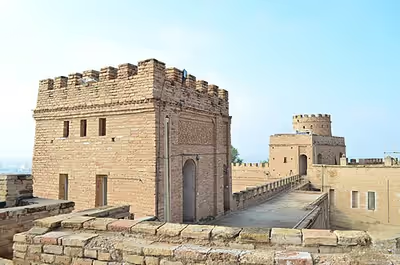
- Iwan of Hermes, and Iwan of Karkheh, two enigmatic ruins north of Susa.
Economy
Khuzestan is the major oil-producing region of Iran, and as such is one of the wealthiest provinces in Iran. Khuzestan ranks third among Iran's provinces in GDP.
In 2005, Iran's government announced it was planning the country's second nuclear reactor to be built in Khuzestan province. The 360 MW reactor was to be a light water pressurized water reactor.
Khuzestan is also home to the Arvand Free Trade Zone, one of six free trade zones in Iran, and to the Petrochemical Special Economic Zone (PETZONE) at Mahshahr.
Because of high temperatures and the concentration of heavy industry, Khuzestan is the largest consumer of energy in Iran after Tehran province. The province's thermal and gas-fired power stations include Ramin, Zargan, Abadan, Khorramshahr and Fajr. The long hours of sunshine in the province have been identified as a significant potential resource for solar power.
The electricity industry in the province dates to the oil era: a 600 kW steam plant was built at Tembi in Masjed Soleyman to power the pumping station carrying crude oil to the Abadan Refinery, and it also lit the installations and parts of the town. Ahvaz received its first generating plant around 1929, built by the merchant Mirza Hossein Khan Moqarrar on the eastern bank of the Karun; at first electricity was billed by the number of lamps rather than by meter.
Shipping
The Karun River is the only navigable river in Iran. The British, up until recent decades, after the discovery by Austen Henry Layard, transported their merchandise via the Karun's waterways, passing through Ahvaz all the way up to Langar near Shushtar, and then by road to Masjed Soleyman, the site of their first oil wells in the Naftoon oil field. Commercial navigation as far as Ahvaz has since ceased for lack of maintenance.
The ports of Abadan and Khorramshahr (reached from the Bahmanshir), Mahshahr and Bandar Imam Khomeini were commercially important before the Iran–Iraq War and, together with the Khorramshahr–Tehran railway, formed a major transport corridor; they were severely damaged during the war and have recovered only slowly.
Agriculture
The abundance of water and the fertility of the soil have made this region a rich and well-endowed land. The variety of agricultural products such as wheat, barley, oilseeds, rice, eucalyptus and medicinal herbs; the existence of many palm and citrus farms; the proximity of mountains suitable for raising olives; and of course sugar cane all show the great potential of this fertile region. In 2005, 51,000 hectares of land were planted with sugar cane, producing 350,000 tons of sugar. The province is also Iran's leading producer of dates, with a harvest of about 560,000 tonnes in 2020. The abundance of water supplies, rivers, and dams also supports fishery industries.
The Abadan island is an important area for the production of dates, but it suffered from the Iraqi invasion during the Iran–Iraq War. The palm groves are irrigated by tidal irrigation. At high tide, the water level in the rivers rises and the river flow enters the irrigation canals dug from the river towards the inland plantations. At low tide, the canals drain the unused part of the water back to the river.
Industry
There are several cane sugar mills in Khuzestan province, among them Haft Tepe and Karun Agro Industry near Shushtar. The Haft Tepe complex has long produced paper from sugar-cane residue.
Steel, rolling and pipe-making plants are among the industries with the greatest effect on the provincial economy; they include Khuzestan Steel Company, the National Iranian Steel Industrial Group, Kavian rolling mill and the Ahvaz Pipe and Rolling Mills Company.
The Karun 3 and 4 dams, and the Karkheh Dam, as well as the petroleum reserves, provide Iran with national sources of revenue and energy. The petrochemical and steel industries, pipe making, the power stations that feed the national electricity grid, the chemical plants, and the large refineries are some of Iran's major industrial facilities.
Oil
The province is also home to Yadavaran Field, which is a major oil field in itself and part of the disputed Al-Fakkah Field. Khuzestan holds 80% of Iran's onshore oil reserves, and thus 57% of Iran's total oil reserves, making it indispensable to the Iranian economy.
Higher education
- Shahid Chamran University of Ahvaz
- Ahvaz Jundishapur University of Medical Sciences
- Petroleum University of Technology
- Abadan University of Medical Sciences
- Dezful University of Medical Sciences
- Amirkabir University of Technology, Mahshahr campus
- Khorramshahr University of Nautical Sciences and Technologies
- Agricultural Sciences and Natural Resources University of Khuzestan
- Institute for Higher Education ACECR Khuzestan
- Rahnama Institute of Higher Education
- MehrArvand Institute of Technology
- Payame Noor University, Ahvaz and Abadan branches
- Islamic Azad University, Ahvaz Branch
- Islamic Azad University, Masjed Soleyman Branch
- Islamic Azad University branches at Abadan, Behbahan, Izeh, Mahshahr, Omidiyeh, Shushtar and the Khuzestan Science and Research Branch
Notable people
- Antiochus III the Great, 6th ruler of the Seleucid Empire
- Abu Nuwas, poet
- Majusi, physician
- Naubakht, astronomer
- Seyyed Nematollah Jazayeri, Shia scholar
- Mohammad Ali Mousavi Jazayeri, Ahvaz Friday Imam
- Ezzat Negahban, pioneer of modern Iranian archaeology
- Ahmad Mahmoud, novelist
- Kaiser Aminpour, poet
- Hamid Dabashi, intellectual historian and literary critic
- Mehrangiz Kar, lawyer and human rights activist
- Nasser Taghvaee, director and photographer
- Parviz Abnar, sound recordist
- Siavash Ghomeyshi, singer and composer
- Siavash Shams, pop singer and record producer
- Mohsen Chavoshi, singer
- Bizhan Emkanian, actor
- Patrick Monahan, comedian
- Hamed Haddadi, basketball player
- Saeed Abdevali, wrestler
- Parviz Dehdari, footballer and coach
- Masoud Shojaei, footballer
- Hossein Kaebi, footballer
- Jalal Kameli Mofrad, footballer
- Iman Mobali, footballer
- Ali Shamkhani, Minister of Defense (1997–2005) and Secretary of the Supreme National Security Council
- Mohsen Rezaee, Secretary of the Expediency Discernment Council until 2021
- Mohammad Reza Eskandari, Minister of Agriculture
- Ali Hashemi, commander in the Iran–Iraq War