

Nizami Ganjavi
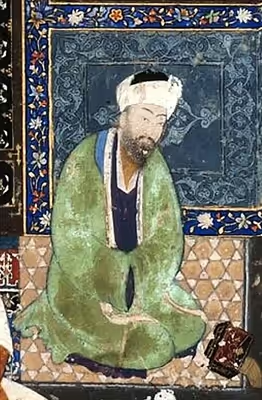
Persian poet (c. 1141 – 1209)
- 15 min read
- 4 chapters

Related on Lably
Through Afghanistan, Armenians and Mathematics
Life
Born into a Persian family, his personal name was Ilyas and his chosen pen-name was Nizami (also spelled Nezami). He was born of an urban background in Ganja (Seljuq empire, now Republic of Azerbaijan) and is believed to have spent his whole life in the South Caucasus. According to De Blois, Ganja had a predominantly Iranian population at the time. The Armenian historian Kirakos Gandzaketsi (c. 1200 – 1271) mentions that "This city [Ganja] was densely populated with Iranians and a small number of Christians". Because Nizami was not a court poet, he does not appear in the annals of the dynasties. Tazkerehs, which are the compilations of literary memoirs that include maxims of the great poets along with biographical information and commentary of styles, refer to him briefly. Much of this material in these tazkerehs are based on legends, anecdotes, and hearsays. Consequently, few facts are known about Nizami's life, the only source being his own work, which does not provide much information on his personal life.
Parents
Nizami was orphaned early and was raised by his maternal uncle Khwaja Umar, who took responsibility for him and afforded him an excellent education. His mother, named Ra'isa, was of Kurdish origin. His father, whose name was Yusuf is mentioned once by Nizami in his poetry. In the same verse, Nizami mentions his grandfather's name as Zakki. In part of the same verse, some have taken the word Mu'ayyad as a title for Zakki while others have interpreted it as the name of his great-grandfather. Some sources have stated that his father might be possibly from Qom. Nizami is variously mentioned as a Persian and/or Iranian.
Family
Nizami was married three times. His first wife was an enslaved Kipchak who was sent to him by Fakhr al-Din Bahramshah, the ruler of Darband, as part of a larger gift. According to Iraj Bashiri she became Nizami's "most beloved" wife. His only son Mohammad was from this wife. She died after "Khosrow and Shirin" was completed. Mohammad was seven at the time. Nizami mentions his son again in Layli and Majnun adding that now this son is 14 years old and "apple of my eyes". In "Haft Peykar" (Seven Beauties), he also mentions and advises his son about taking more responsibility as the father was growing more frail.
Some modern writers in the late 20th century have claimed that this wife was called Afaq. Vahid Dastgerdi seems to be the first writer to propose this name for Nizami's first wife, but Said Nafisi (at the same time) and a recent source have challenged this interpretation of the corresponding verse in Nizami's work and the assumption that Afaq was the real name of his wife and have taken the Afaq in that verse to simply mean "horizon" rather than a proper name. Strangely enough, Nizami's two other wives, too, died prematurely – the death of each coinciding with the completion of an epic, prompting the poet to say, "God, why is it that for every mathnavi I must sacrifice a wife!".
Sign in to keep reading
3 more chapters are free with a Lably account.
Education
Nizami was not a philosopher in the sense of Avicenna or an expositor of theoretical Sufism in the sense of Ibn 'Arabi. However, he is regarded as a philosopher and gnostic who mastered various fields of Islamic thoughts which he synthesized in a way that brings to mind the traditions of later Hakims such as Qutb al-Din Shirazi.
Often referred to by the honorific Hakim ("the Sage"), Nizami is both a learned poet and master of a lyrical and sensuous style. About Nizami's prodigious learning, there is no doubt. Poets were expected to be well versed in many subjects, but Nizami seems to have been exceptionally so. His poems show that not only he was fully acquainted with Arabic and Persian literatures and with oral and written popular and local traditions, but was also familiar with such diverse fields as mathematics, astronomy, astrology, alchemy, medicine, botany, Koranic exegesis, Islamic theory and law, Iranian myths and legends, history, ethics, philosophy and esoteric thought, music, and the visual arts. His strong character, social sensibility, and knowledge of oral and written historical records, as well as his rich Persian cultural heritage unite pre-Islamic and Islamic Iran into the creation of a new standard of literary achievement. Being a product of the Iranian culture of the time, he not only created a bridge between pre-Islamic and Islamic Iran, but also between Iran and the whole ancient world.
Influences and literary scene
The recent discovery and publication of the anthology titled Nozhat al-Majales contains Persian language quatrains from Nizami and 115 other poets from the northwestern Iran (Arrān, Sharvān, Azerbaijan; including 24 poets from Ganja alone) during the same era. Unlike other parts of Persia, where the poets mostly belonged to higher echelons of society such as scholars, bureaucrats, and secretaries, a good number of poets in the northwestern areas rose from among the common people with working-class backgrounds, and they frequently used colloquial expressions in their poetry. Accordingly, the book demonstrates the social conditions at the time, reflecting the full spread of Persian language and the culture in the region, which is evidenced by the common use of spoken idioms in poems and the professions of many of the poets. The influence of the northwestern Pahlavi language, for example, which had been the spoken dialect of the region, is clearly observed in the poems contained in this anthology. However, at the same time, the Caucasus region was entertaining a unique mixture of ethnic cultures. Khaqani's mother was a Nestorian Christian, Mojir Baylqani's mother was an Armenian, and Nizami's mother was a Kurd. Their works reflect the cultural and linguistic diversity of the region.
By the end of the 10th century, Persian literature became widespread from the eastern Mediterranean to the banks of the Indus. The earliest extant example of Persian poetry from the area is that of Qatran Tabrizi (1009–1072) who served in the courts of the Shaddadid and Rawadid dynasties. Qatran Tabrizi, is credited with what some scholars in the last century have termed as the founder of the "Azerbaijan" or "Trans-Cacausian" school or "Tabriz School" or "Shirvan School" or "Arranian Style" of Persian poetry. This school produced a distinctive style of poetry in Persian, which contrasted with "Khurasani" ("Eastern") style in its rhetorical sophistication, its innovative use of metaphor, its use of technical terminology and Christian imagery, the presence of Persian archaism while borrowing from Arabic vocabulary, as well as new concepts. Other sources including the Encyclopaedia of Islam and traditional Iranian literary sources have used the term "'Iraqi" style for the Persian poetry of Nizami.
The Seljuqs took control of Ganja from the Shaddadids in 1075 and spread Persian literary westwards to their courts. In the middle of the 12th century, the Seljuk Empire's control of the region weakened and their provincial governors, virtually autonomous local princes, further encouraged Persian culture, art and poetry in their courts. Persian culture characteristically flourished in this era, when political power was diffused and Persian remained the primary language, Persian civil servants and merchants were in great demand and rival dynasties continued to vie for the service of Persian poets. This was especially true in Ganjeh, the Caucasian outpost town where Nizami lived. Nizami was patronized by different rulers and dedicated his epics to various rival dynasties, including the Seljuqs, Eldiguzids (who maintained control of Ganja during most of the later 12th century), Shirvanshahs, the ruler of Ahar and Ahmadilis. Although he enjoyed the patronage of various rulers and princes, he avoided the courts and is generally believed to have lived a secluded life. Since he was not a court poet, he does not appear in the annals of the dynasties, which list the names of events of the ruling families.
According to literary scholar Chelkowski, "it seems that Nizami's favorite pastime was reading Ferdowsi's monumental epic Shahnameh (The book of Kings)." Nizami mentioned Ferdowsi as the Sage (hakim) and Knower/Wise (dānā) and the great master of discourse, "who has decorated words like new bride." Nizami advises the son of the Shirvanshah to read the Shahnameh and to remember the meaningful sayings of the wise. Nizami used the Shahnameh as a source in his three epics of Haft Peykar, Khosrow and Shirin and Eskandar-Nameh.
The story of Vis and Ramin also had an immense influence on Nizami. Although Nizami takes the bases for most of his plots from Ferdowsi, but the basis for his rhetoric comes from Gorgani. This is especially noticeable in Khosrow and Shirin, which is of the same meter and imitates some scenes from Vis and Ramin. Nizami's concern with astrology also has a precedent in an elaborate astrological description of the night sky in Vis and Ramin. Nizami had a paramount influence on the romantic tradition, and Gorgani can be said to have initiated much of the distinctive rhetoric and poetic atmosphere of this tradition, with the absence of the Sufi influences, which are seen in Nizami's epic poetry.
The first monumental work of Nizami, the Makhzan al-Asrar is influenced by Sanai's Hadikat al-Hakika. Nizami acknowledges this, but considers his work to be superior. The main similarities between Sanai's poem and Nizami's are in its ethico-philosophical genre, although Nizami uses a different metre and organized the whole work in a different fashion. Khaqani Sherwani daring imagery, was to have a momentous influence on Nizami Ganjavi and through the latter on Persian poetry in general.
Legacy
Nizami, whose works are all written in Persian, has a very high reputation in Iran, Afghanistan and Tajikistan, where Persian is the official language. His poetry is especially well known in Iran, and is also very popular in Azerbaijan, where his birthplace and mausoleum are located. He is known in other countries, especially in India and Pakistan.
Persian culture
The influence of Nizami's work on the subsequent development of Persian literature has been enormous and the Khamseh became a pattern that was emulated in later Persian poetry (and also in other Islamic literatures). The legacy of Nizami is widely felt in the Islamic world and his poetry has influenced the development of Persian, Arabic, Turkish, Kurdish and Urdu poetry amongst many other languages. In the history of Persian miniature painting, the stories in Nizami's poems alongside those of Ferdowsi's Shahnama have been the most frequently illustrated literary works. According to the Encyclopædia Britannica, Nizami is "admired in Persian-speaking lands for his originality and clarity of style, though his love of language for its own sake and of philosophical and scientific learning makes his work difficult for the average reader." Nizami composed his verses in Persian language and Western encyclopedias such as Encyclopedia of Islam, Encyclopædia Iranica, Encyclopædia Britannica and orientalists of many countries consider Nizami as a significant Persian poet and hail him as the greatest exponent of romantic epic poetry in Persian literature. Amongst the many notable poets who have taken the Five Treasures of Nizami as their model may be mentioned Amir Khusro, Jalal Farahani, Khwaju Kermani, Mohammad Katebi Tarr-Shirini, Abdul Rahman Jami, Hatefi Jami, Vahshi Bafqi, Maktabi Shirazi, Ali-Shir Nava'i, Abdul Qader-e Bedel Dehlavi, Fuzuli, Hashemi Kermani, Fayzi, Jamali and Ahmad Khani. Not only poets, but also historians such as Rawandi were influenced by Nizami's poetry and used his poems as a source for rendering history. Besides these, scores of poets have started their composition with the first line of the Makhzan al-Asrar. According to Rudolf Gelpke, "Many later poets have imitated Nizami's work, even if they could not equal and certainly not surpass it; Persians, Turks, Indians, to name only the most important ones. The Persian scholar Hekmat has listed not less than forty Persian and thirteen Turkish versions of Layli and Majnun." Nizami's work also stresses various natural elements that are at the heart of Persian culture. The emphasis on stones and jewels are seen, such as in Iskandarnama, where Alexander the Great was about to destroy a golden statue of Buddha, but is stopped by a girl telling him of the jewels' story. Nizami's poetry also a botanic dimension, with mentions of plants and trees. Poetry and science are intertwined for Nizami. He also shows a tendering adoration towards animals throughout his poetry, demonstrating the Persian love for animals.
Nizami is considered to be one of the most celebrated poets in the world due to his universal themes speaking on the love for life and the various beauties of the world. According to Vahid Dastgerdi, "If one would search all existing libraries, one would probably find more than 1000 versions of Layla and Majnun." Jami in his Nafahatol Ons remarks that: "Although most of Nizami's work on the surface appear to be romance, in reality they are a mask for the essential truths and for the explanation of divine knowledge." Jami in his Baharestan mentions that "Nizami's excellence is more manifest than the sun and has no need of description." Hashemi of Kerman remarks: The empire of poetry obtained its law and order from Nizami's beautiful verses and to present words before Nizami's silent speech is a waste of time."
Indian subcontinent
Nizami's poems were very popular in the Indian subcontinent. The Persian language and literature have had a great impact on the entire Indian subcontinent. Nizami Ganjavi has been imitated by many poets due to his unique style of speech and language of poetry. Poets who have imitated Nizami's include: Amir Khusro Delhi, Khwaju Kermani, Jami, Hatefi, Ghasemi, Vahshi Bafqi, 'Orfi Shirazi, Maktabi, Faizi, Ashraf Maraghi, Azar Bigdeli, Badriddin Hilali, Rumi Kermani, Maulana Navidi Shirazi and Salman Savaji. Amir Khusro Dehlavi praises Ganjavi in his poems as a master of the art of praise. Amir Khusro writes:
"The ruler of the kingdom of words, famed hero,
Scholar and poet, his goblet [glass] toasts.
In it – pure wine, it's drunkenly sweet,
Yet in goblet [glass] beside us – only muddy setting." A portrait of Nizami hangs in the Ashoka Hall of the Rashtrapati Bhavan, the presidential palace of India. The hall is also decorated with poems by Nizami and other Persian poets. The Khamsa was a popular subject for lavish manuscripts with painted miniatures at the Persian and Mughal courts in later centuries. Examples include the Khamsa of Nizami (British Library, Or. 12208), created for the Mughal emperor Akbar in the 1590s.
Soviet Union
In the early 1940s and to mark the 800th anniversary of Nizami Ganjavi, Azerbaijani composer Uzeyir Hajibeyov planned to write seven songs based on Nizami's poem about the Seven Beauties. However, Hajibeyov wrote only two songs: Sensiz (Without You, 1941) and Sevgili Janan (Beloved, 1943). Another Azerbaijani composer Gara Garayev, composed Seven Beauties (ballet) in 1947–48 based on Nizami's eponymous poem that won an international acclaim. He also composed Leyli and Majnun (ballet) that premiered on 25 May 1969 at the Azerbaijan State Academic Opera and Ballet Theater in Baku and later was recorded as a film. A minor planet, called 3770 Nizami, was discovered by Soviet astronomer Lyudmila Chernykh in 1974 and named after him. Further, the Museum of Azerbaijan literature in Baku is named after Nizami.
Azerbaijan
Nizami was depicted on the obverse of the Azerbaijani 500 manat banknote of 1993–2006. In 2008, coinciding with the 800th anniversary of his death, the National Bank of Azerbaijan minted a 100 manat gold commemorative coin dedicated to his memory. The Nizami Museum of Literature is located in Baku, Republic of Azerbaijan. One of the Baku Metro stations is also named after Nizami Ganjavi. There is Institute of Literature named after Nizami and Cinema named after Nizami in Baku. One of the districts of Baku is called Nizami raion. The life of Nizami Ganjavi is shown in the Azerbaijani movie "Nizami" (1982), in which the leading role, role of Nizami Ganjavi, was played by Muslim Magomayev. The Nizami Mausoleum, built in honor of Nizami, stands just outside the city of Ganja in Azerbaijan. It is a tall cylindrical building, surrounded by gardens. To one side, there is a metal statue commemorating Nizami's epic poems. The mausoleum was originally built in 1947 in place of an old collapsed mausoleum and rebuilt in its present form when the Azerbaijani Republic regained its independence after the fall of the Soviet Union in 1991.
Monuments to Nizami exist in many cities of Republic of Azerbaijan and Iran, as well as in Moscow, St. Petersburg and Udmurtiya (Russia), Kyiv (Ukraine), Beijing (China), Tashkent (Uzbekistan), Marneuli (Georgia), Chişinău (Moldova), Rome (Italy).
2021 was declared as "Year of Nizami Ganjavi" in the country.
Japanese translation
- "The Story of the Seven Queens (Haft Peykar)", translated into Japanese by Tsuneo Kuroyanagi, published by Heibonsha, July 1971. (Toyo Bunko 191)
- "Khosrow and Shireen", translated by Emiko Okada, published by Heibonsha, June 1977. (Toyo Bunko 310)
- "Layla and Majunoon", translated by Emiko Okada, Heibonsha, February 1981. (Toyo Bunko 394) ."
Western reception
German poet and writer Johann Wolfgang von Goethe wrote: "A gentle, highly gifted spirit, who, when Ferdowsi had completed the collected heroic traditions, chose for the material of his poems the sweetest encounters of the deepest love. Majnun and Layli, Khosrow and Shirin, lovers he presented; meant for one another by premonition, destiny, nature, habit, inclination, passion staunchly devoted to each other; but divided by mad ideas, stubbornness, chance, necessity, and force, then miraculously reunited, yet in the end again in one way or another torn apart and separated from each other."
In regard to the recitation of his poetry, Peter Chelkowski states: "The memorization and recitation of their literary heritage has always been vital to Iranians, whose attitude towards the power of the written and spoken word is reverential. Even today the national passion for poetry is constantly expressed over radio and television, in teahouses, in literary societies, in daily conversation, and in the Musha'areh, the poetry recitation contest. Nizami's work serves as a vehicle and a symbol of this tradition, for it unites universality with deep-rooted artistic endeavor, a sense of justice and passion for the arts and sciences with spirituality and genuine piety. For richness and fineness of metaphor, accuracy, and profundity of psychological observation, and sheer virtuosity of storytelling, Nizami is unequalled".
Nizami's story Layla and Majnun also provided the namesake for a hit single by Eric Clapton, also called "Layla". Recorded with the group Derek and the Dominos, the song was released on the 1970 album Layla and Other Assorted Love Songs. The album was influenced by Nizami and his poetry of unrequited love. The fifth song of the album, "I Am Yours", was based on a poem by Nizami, set to music by Clapton.
In 2004, a conference on Nizami was held at the University of Cambridge. The proceedings of this conference were published under the title Nizami: A Key to the Treasure of Hakim in 2011.