


Related on Lably
Through Watercolor painting, Portrait and Topography
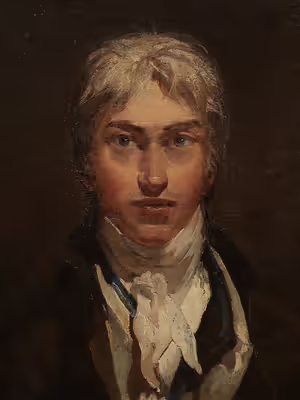
Turner started his career as an architectural draughtsman and watercolourist and gained academic recognition as an oil painter. A child prodigy, Turner was accepted as a student at the Royal Academy of Arts at age 14 and had a rapid ascent to recognition, fame and financial success. By his early twenties, he was selling his oil paintings at top market prices to wealthy art collectors and gaining high praise from the academic establishment. When he was 27 years old, Turner was elected as a Royal Academician, the highest artistic honour at the time, becoming one of the youngest painters to achieve this distinction in the Academy's history. In spite of these accomplishments, he was constantly criticised by a few influential critics in aristocratic circles because of his working-class origins.
Turner's artistic style evolved during his lifetime as he never stopped experimenting with new painting techniques. He was a versatile artist and was able to emulate the different styles of Old Masters, producing works that generated admiration from Academicians and art critics. Early on, he started painting in an increasingly expressionistic style, using sketches from his extensive travels throughout England and Europe as inspiration. To complement his depictions of the ocean, rivers and mountains, he experimented with the representation of natural phenomena, like sunlight, storms, clouds, and fog. Turner's later landscapes became more abstract and were not well received at the time, but are considered masterpieces today.
Turner mastered different printmaking techniques, preferring mezzotints. He spent 12 years completing a collection of over 70 prints using this technique, which he called the Liber Studiorum or Book of Studies. While a commercial failure, it was influential in elevating the status of landscape painting; a genre that, before Turner, was considered of lower artistic value than history painting and portraits, according to the long-established hierarchy of genres.
Turner died a rich man in 1851, aged 76. He was a prolific artist, producing about 550 oil paintings and over 2,000 watercolours during his lifetime. He bequeathed to the nation around 100 finished and 200 unfinished oil paintings. His will included the donation of £140,000 in investments and property to provide financial assistance to painters, but it was distributed among his relatives after a prolonged trial. Many of his paintings are displayed at the National Gallery and the Tate Britain museum in London, among other museums.
Biography
Childhood
Joseph Mallord William Turner was born on 23 April 1775 in Maiden Lane, in the working-class district of Covent Garden in London; during the day it was a thriving commercial market and a busy area at night due to its concentration of theatres, taverns and brothels. The family moved to Hand Court, on the other side from Maiden Lane, when Turner was five years old.Turner was sent to different towns to attend elementary school, including Brentford, Margate, and Sunningwell (now part of Oxfordshire).
Turner's father, William Turner, had a barbershop and wig store on the first floor. By the time Turner was ten years-old, he proudly displayed his young son's drawings in the window, which he let customers view up close for one shilling. His father boasted to the artist Thomas Stothard: "My son, sir, is going to be a painter". He would later retire as a barber to help his son in various tasks in his studio and paint gallery.
His mother, Mary Marshall, came from a family of butchers. She started to show symptoms of mental disorder and as they got worse, Turner's father was forced to place her in St Luke's Hospital for Lunatics. She was later moved to Bethlem Hospital, a mental asylum commonly known as "bedlam", where she died in 1804.
Adult life
The inspiration Turner found in the river Thames motivated him to occupy several second homes on or very near the river. The river allowed him to relax by fishing and boating, two of his favourite activities. He rented houses in Isleworth (1804–1806) and Hammersmith, where he converted a boat into a floating studio (1807–1811). In 1811 he bought a plot of land in Twickenham, where he built a house he named Sandycombe Lodge.
Turner never married, and reportedly said: "I hate married men, they never make any sacrifice to the Arts, but are always thinking of their duty to their wives and families, or some rubbish of that sort." From the beginning, he kept his personal life separate from his professional activities. He had a discreet 12-year relationship with his housekeeper, the widow Sarah Danby, and is generally believed to have been the father of her two older daughters, Evelina (b. 1801) and Georgiana (b. 1811).
Old age
Turner's appearance in his later years disconcerted those who met him, as it was difficult to imagine how such an unprepossessing man could produce paintings of such beauty. Observers reported he reminded them of "an English farmer", a "long-stage coachman" or a "river-boat sailor", rather than a renowned painter. When he was young, he invested in fine clothes in order to fit into academic circles, but in his fifties, following his father's death, he became careless about his appearance.
In his seventies, Turner formed a relationship with the widow Sophia Caroline Booth. He frequently stayed with her under the pseudonym "Mr Booth" or "Admiral Booth", in her house at 6 Davis's Place (now Cheyne Walk) in Chelsea, where he died in 1851, at the age of 76.
Turner is buried in St Paul's Cathedral where, according to his wish, he lies near the painter and first president of the Royal Academy, Sir Joshua Reynolds.
Bequest
In an unprecedented gesture, Turner bequeathed to the nation about 100 finished oil paintings as well as 200 unfinished canvases, over 19,000 sketches, drawings and watercolours and some 200 sketchbooks. The finished oil paintings were worth a small fortune, considering that they had been regularly purchased for no less than 200 guineas and up to 450 guineas during his lifetime.
His investments and properties were valued at £140,000, today's equivalent of around £17 million. In 1856, after five years of legal disputes started by his cousins, his financial assets were divided among the family and the Academy received £20,000.
Turner specified that a special gallery should be built to house the bequeathed paintings. At the time, this did not happen because there was disagreement over the final site. In 1987, Tate Britain inaugurated the Clore Gallery, fulfilling his final wishes, 136 years after his death.
Sign in to keep reading
5 more chapters are free with a Lably account.
Career
Early commercial work
While still a young man, he secured a reliable income thanks to the rising demand for topographical and architectural watercolours. He worked for several architects, including Thomas Hardwick, James Wyatt and Joseph Bonomi the Elder. In 1789, he began to study under the topographical draughtsman Thomas Malton, who specialised in London views.
He was also hired to paint scenery for theatres. According to Bailey, this "made a lasting impression on him, [as] demonstrated in paintings in the following decades, in which he indulged his fondness for bright lights and flaring colours."
The Academy
Turner was recognised as a child prodigy and was accepted as a student in the Royal Academy Schools in 1789, at the age of 14., where he was an accomplished student and made very rapid progress. Only a year after starting his studies, the watercolour A View of the Archbishop's Palace, Lambeth was accepted to the Academy's Annual Exhibition. In 1796, the Academy awarded the eighteen-year-old the Greater Silver Palette award for landscape drawing.
Works Turner exhibited early in his career in the annual Royal Academy Exhibition
At the age of 21, he exhibited the oil painting Fishermen at Sea, a dramatic moonlit seascape. The work drew widespread acclaim from contemporary critics and established Turner's reputation as a promising talent in marine painting. During his years at the Academy, Turner was keenly focused on obtaining academic recognition. He followed the teachings of Sir Joshua Reynolds, which at the time, defined the Academy's criteria for judging artistic excellence. Reynolds advocated the study and emulation of the Old Masters, in particular those from Italy, Spain and the Netherlands.
Dutch Boats in a Gale, which copied the style of 17th century marine Dutch painters, was presented the next year by Turner at the Royal Academy Exhibition of 1801 and "took the Academy by storm". It was hung in the best location of the whole exhibition: in the Great Room, centred, and opposite to the entrance. It so impressed the Academy and the art critics that the following year Turner was admitted as a Royal Academician. At only 27 years of age, he became the second youngest artist in the institution's history to achieve the highest artistic academic recognition in England.
Commercial success
In October 1798, he boasted to his friend Joseph Farington that he had 60 commissions for watercolours from different customers, and that he was "earning more money than he could spend." During his sketching excursions, he was always searching for visual ideas but also on the lookout for saleable subjects.
Even though the Napoleonic Wars had considerably reduced the demand for large historical paintings, Turner kept selling them at top prices and receiving substantial commissions from wealthy patrons, which disconcerted elder members of the Academy. He took advantage of the demand for pendants – works that were commissioned to hang next to an existing painting. As early as 1799, Turner had received 150 guineas for The Fifth Plague of Egypt from William Beckford. In 1801, Francis Egerton, 3rd Duke of Bridgewater, one of the richest men in England, paid him 250 guineas (equivalent to around £20,000 today) for the commissioned marine painting Dutch Boats in a Gale. He also sold many smaller pieces, which generated a steady income.
Following the teachings of Joshua Reynolds, the first president of the Academy, Turner studied and emulated the old masters. Hamilton notes: "Turner could pick up his brushes and play anybody's tune: He made paintings in the style of Rembrandt, Rubens, Watteau, the Dutchmen Ruysdael, van Goyen and Cuyp, Claude, Poussin, Canaletto – the list goes on. No other great master had demonstrated this chameleon tendency with such seriousness even to the slightest degree." His talent allowed him to go beyond pastiches and make each style his own; a sort of homage (and in some cases an indirect critique) of these classic works and "this playful chameleon tendency was extraordinarily disarming and had the effect of seducing the collector, catching him off guard."
In 1804 Turner opened his own gallery so he could sell his paintings directly, as he was distrustful of dealers. Also, a gallery allowed him to group pictures that he wanted to be seen together, something that was not under his control in the Royal Academy exhibitions. His father left his barbershop business to assist him in various tasks in the gallery and studio. For over a decade, the gallery was a regular feature of the London exhibition season of new artworks.
Patrons
An early patron, the art collector Thomas Monro, allowed young artists to study his collection. At Monro's home, Turner copied works of the major topographical and architectural draughtsmen of his time, perfecting his drawing skills.
Important support for his work also came from Walter Fawkes, owner of Farnley Hall, near Otley in Yorkshire. He visited Farnley Hall many summers from 1808 to 1824 and became almost part of the family, with a room assigned for his exclusive use.
While he was young, Turner visited his patrons as a hired artist, but as he gained the status of the best painter in England, he was acknowledged as a self-made man and an equal by the aristocracy. He was a frequent guest of the rich and powerful George Wyndham, 3rd Earl of Egremont, at Petworth House in West Sussex, stayed as a guest and even had his own studio at Egremont's large country house.
Critics
Turner's more classical paintings from 1810 to 1830 were, in general, received with very positive reviews. His most successful works, like Dido and Aeneas (1814), Dido building Carthage (1815), The Bay of Baiae, with Apollo and the Sibyl (1823), Regulus (1828), and Ulysses Deriding Polyphemus (1829), garnered him a reputation as a painter that surpassed the old masters.
Early on, Turner started innovating in the representation of light and color. These paintings elicited very negative comments, even from those who recognized his "earlier" genius. As an art critic wrote in 1827: "When we look back at the works of Turner of some twenty or twenty five years standing and see nature in all her truthfulness glowing under his powerful hand, it makes us as sick as she looks in his pictures now to see so needless a falling off.".
Of what is considered today one of his masterpieces, Snow Storm: Steam-Boat off a Harbour's Mouth (1842), The Athenaeum wrote dismissively: “This gentleman has, on former occasions, chosen to paint with cream, or chocolate, yolk of egg, or currant jelly – here he uses his whole array of kitchen stuff. Where the steam-boat is – where the harbour begins or where it ends... are matters past our finding out.” And in 1840, John Eagles called the displayed paintings "absurd extravagances [that] disgrace the Exhibition".
However, Turner also had passionate supporters. In 1816, the essayist William Hazlitt (1778-1830) described Turner as an artist that "delights to go back to the first chaos of the world, or to that state of things when the waters were separated from the dry land, and light from darkness." He insightfully described his landscapes as "pictures of nothing, and very like [their subjects]. They are pictures of the elements of air, earth, and water [...] forms are mere outlines to catch the eye in passing, and are not intended to be stopped at."
Turner's working-class origins generated friction with aristocratic members of the Academy as he started to gain increasing recognition. He had a strong cockney (working-class) accent which he never made any effort to disguise. The influential Sir George Beaumont was one of his most acrimonious critics, describing his paintings as "blots" or the sea in his widely acclaimed Dutch Boats in a Gale as looking "like pease [sic] soup". Academy tensions occasionally produced personal invective; following a heated Academy council meeting in 1803, fellow Academician Sir Francis Bourgeois publicly called Turner a "little reptile."
In spite of the criticism and personal attacks by senior members of the Royal Academy, Turner always held it in the highest regard. The value of his bequest to the Academy is a good indication of the esteem that Turner had for the institution.
Printmaking
Since an early age, Turner understood the commercial opportunities in printmaking; only rich people could afford original oil paintings, but quality prints could be acquired for a few shillings. He favoured mezzotints, as they are especially suited to reproducing the tonal density of oil painting.
Turner's major venture into printmaking was the Liber Studiorum or "Book of Studies", a set of about 70 mezzotints that he worked on from 1806 to 1819. The Liber Studiorum was an ambitious print project that was inspired by the landscape painter Claude's Liber Veritatis, a set of prints based on his paintings. The Liber Studiorum was meant as a manifesto for British landscape art and a way to promote Turner's creative range. The plates were categorised into six genres: marine, mountainous, pastoral, historical, architectural, and epic pastoral. Although the artistic value of these prints was widely recognised, as a commercial endeavour they were a failure, due to his poor handling of the sales and distribution process. However, the Liber Studiorum was successful in elevating the prestige of landscape painting, a life-long struggle of Turner.
Professor of Perspective
In 1811 Turner made his first public lecture, after being elected as Professor of Perspective at the Royal Academy Schools three years earlier. As a former architectural draughtsman, Turner knew his topic well. In the three-year period of preparation since his nomination and the start of his lectures, he had done a great amount of research and he presented ideas on many other subjects other than perspective, including the role of poetry in painting and of course, landscape painting techniques.
Turner argued that the classic notions of single linear perspective were not applicable in all cases, because a painter had to take into account the curvature of things, for instance, to depict a meandering river in a graceful manner, with one of his students later commenting that "his pictures always looked right, even if the perspective in them was theoretically faulty."
Unfortunately, Turner had very poor lecturing skills and those in attendance had trouble understanding him. He was very disorganized and frequently got confused about where he was and what came next, he strayed from the main topic and he used unintelligible sentences. His association of ideas was complex and not understood by his audience. But for all his shortcomings as a lecturer, Turner was valued as a teacher in the Academy Schools and former students wrote they were grateful for the valuable advice he gave them during their studio classes.
The "grand old man" of the Academy
In spite of the criticism and personal attacks by senior members of the Academy, Turner held a deep, lifelong loyalty to it. In one of his lectures he referred to it as the institution "to which I owe everything". His post as a Professor of Perspective changed his attitude towards the Academy; from a critic in his youth, starting in 1811 he became a combative defender of its reputation and worked constantly to improve the quality of its teaching.
In his old age, Turner became the "undisputed grand old man of the Academy". Yet he was not considered as a candidate to become its president. Because the institution depended on royal and aristocratic patronage, it required a leader with courtier skills. Turner’s lack of diplomacy, unprepossessing appearance and working-class origins disqualified him from this position.
Travels
Beginning in 1791, Turner established an annual routine that he followed until his sixties. He stayed in London during the exhibition of the Royal Academy in the summer, and travelled during the following months. He was an avid sketcher, capturing everything he encountered: panoramic vistas, clouds and rock formations. He used these sketches as a reference for his watercolours, prints, and oil paintings, even years later. During his lifetime, he filled nearly 300 sketchbooks, most of them during this travels.
The Thames
With the exception of the sea, the Thames is his most repeated subject and appears in hundreds of artworks during his 60-year career. Born only a few yards from the river, he always lived very near to it.
During the summer of 1805 he systematically sketched places along much of the river, from Oxford to the Thames Estuary. These intense months of observation so inspired him that for the next five or six years he presented many river-themed paintings in each of his annual gallery shows, based on his sketchbooks' contents. In the period from 1822 to 1824 he painted The Rivers of England, a series of watercolours commissioned by the printmakers George and Bernard Cooke.
Tours of England and Scotland
During the years of war in Europe, the variability of Britain’s climate and geography started to be considered a valuable source of artistic inspiration. Early on he had started producing topographical works; views of places having historical or antiquarian interest, such as landscapes or old buildings, many of which were old ruins.
Turner toured England and Scotland extensively, motivated as always by the thrill of new landscapes, but also for commercial reasons. In 1799, he travelled to Lancashire to produce views for Thomas Dunham Whitaker's History of Whalley. In 1811, he entered into a publishing partnership with John Murray and the Cooke brothers to print Picturesque Views on the Southern Coast of England. During the 1820s, he worked in several topographical print commissions: he completed Picturesque Views on the Southern Coast of England (1814-1826) and The Rivers of England (1822–1826) for the Cooke brothers; provided drawings for Picturesque Views in England and Wales (1824–1838) commissioned by Charles Heath; and for The Ports of England (1825–1828) by commission from Thomas Lupton.
Discovering Europe
Due to the French Revolutionary and Napoleonic Wars, the one-year period of the Peace of Amiens (1802-1803) was the only time without wars in Europe from 1793 to 1814 and in that year a consortium of noblemen sponsored a visit to Paris, which allowed Turner to see old master paintings in the Louvre, and then he toured the Swiss Alps. His Alpine sketches would later allow him to impressively represent "the sublime"; one of the key aesthetic principles of the 18th and 19th centuries, in paintings such as The Fall of an Avalanche in the Grisons (1810), Snow Storm: Hannibal and his Army Crossing the Alps (1812), and Snow Storm, Avalanche and Inundation (1837). Turner would go back to Switzerland three more times during his lifetime.
In the twenty-year period from 1821 to 1844, Turner visited several European countries, where he studied the works of old masters and took long hikes into the countryside. His desire to see the world took him to Paris, Normandy and Brittany (1829); a second visit to Paris three years later (1832); Vienna and Venice, traveling down the Danube and returning via the Rhine (1833); Denmark, Prussia, Hamburg and Rotterdam (1835); France and Switzerland and across the Alps to the Val d'Aosta valley (1836); a second trip to Venice, also visiting Trieste and Coburg (1840); and two final trips to Switzerland in his sixties (1841 and 1844).
Italy
In 1819, Turner made his first extended journey through Italy, visiting Turin, Milan, Como, Venice, Rome, Naples and other cities, while producing numerous sketches and watercolours. His Italian travels became central to the development of his mature style. The later trip to Venice (1833) in particular, inspired important works such as Venice, from the Porch of Madonna della Salute (1835), Venice, the Bridge of Sighs (1840), and The Sun of Venice Going to Sea (1843).
Art
Early Influences
In his formative years, Turner was influenced by Thomas Gainsborough (1727-1788), Philip James de Loutherbourg (1740-1812), Henry Fuseli (1741-1825) and Richard Wilson (1714 -1782). His most lasting pictorial influence was the French painter Claude Lorrain (c. 1600-1682). In 1799, the very wealthy art collector John Julius Angerstein invited him to see his paintings. Standing in front of Claude’s The Embarkation of the Queen of Sheba (1648), Turner burst into tears. When questioned by the disconcerted Angerstain, he passionately explained: “Because I shall never be able to paint anything like that picture!” When he finished Dido building Carthage (1815), he felt he had finally achieved something comparable to Claude's painting.
But it was the teachings of Sir Joshua Reynolds that provided the central aesthetic principles that Turner followed throughout his career. When he was a young painter, Turner emulated Old Master's paintings, as Reynolds suggested. For landscape painting, Reynolds recommended that rather than trying to paint the landscape as it was – and therefore as determined by chance – the painter should aim to find a deeper truth in it, by adding fictional and idealised pictorial elements; as Shanes explains it, depicting "the most attractive features of several places as viewed in the most beautiful of weather and lighting conditions, thus transcending the arbitrary." In 1793, he showed the oil titled The Rising Squall, Hot Wells, which foreshadowed his later dramatic landscapes.
Style and Technique
Turner's early works, such as Tintern Abbey (1795), were mainly focused on architectural watercolours, which made use of his superior drawing skills. Turner's en plein air paintings and sketches are bold and fresh, as he was always seeking novel ways to capture what he was seeing.
Early on he started experimenting with a distinctive style of painting, in which he used watercolour techniques with oil paints. Rediscovered in 2025, his first exhibited oil painting, The Rising Squall, Hot Wells (1792), already shows a 17-year-old Turner applying a diluted oil paint as if it was a watercolour. He also discovered that washes over white pages convey a greater luminosity to oil paintings, which allowed him to generate much brighter colors than had ever achieved by previous landscape painters.
Turner's imagination was sparked by natural phenomena, such as sunlight, storms, rain, and fog. The 19th century English art critic John Ruskin described him as the artist who could most "stirringly and truthfully measure the moods of Nature". During his whole career, Turner was particularly fascinated by the violent power of the sea; from Fishermen at Sea – the first marine painting he exhibited at the Royal Academy in his early twenties – to The Slave Ship (1840) and Seascape: Folkestone, painted 1850, the year before his death. According to Riding and Johns, marine painting "was being reinvented, and Turner played the leading role in that process."
Widespread appreciation of his later, more abstract works is relatively recent. Kenneth Clark, director of the National Gallery from 1934 to 1945, reports that in the late 1940s, he found "rolls of these [abstract Turner paintings] stacked in the cellars of the National Gallery where they were thought to be old tarpaulins, and glimpsing a watercolour sheet patching a broken window."
Elevating landscape painting
One of Turner's main artistic achievements was to make landscape painting the equal of history painting, by combining it with poetry, moral teachings and complex symbolic associations. Turner's landscapes and seascapes are more than just pictorial representations of nature. They usually tell a story by including human figures who are experiencing nature; in his most striking paintings, when nature is at its most violent, such as in The Shipwreck (1805).
In Slavers Throwing overboard the Dead and Dying—Typhon coming on (1840) – which depicts a real event – Turner makes a scathing comment on the greed and evilness of the slave trade. "Turner was most decidedly not just a landscape and marine artist", observes Shanes, "equally he was a painter of mankind. As such he afforded us profound insights into the nature of the human condition."
In his obituary of Turner, the British writer Peter Cunningham, wrote that it was: "recognised by the wiser few as a noble attempt at lifting landscape art out of the tame insipidities ... [and] evinced for the first time that mastery of effect for which he is now justly celebrated".
Painting as poetry
Reynolds also taught that painting should be akin to poetry, aiming to convey the whole of human experience. In his Liber Studiorum, Turner defined a new sub genre of landscape painting that he called the "Poetic Pastoral;" part of his life-long effort to increase the reputation of landscape painting."
Many of Turner's paintings were explicitly associated to poems, in some cases even composed by him, like in Snow Storm: Hannibal and his Army Crossing the Alps. In Hannibal, he also included historical references and moral teachings, as he did in many other future works, in order to demonstrate that it could have as much intellectual value as history paintings, considered the most prestigious genre according to the long-established hierarchy of genres.
Another example is The Field of Waterloo (1818), in which rather than depicting a scene of valiant victory – as other British painters had done to celebrate Napoleon's defeat, – Turner presents us with a battlefield littered with corpses; an indictment of the horrors of war. The same year an art critic recognized his mastery in combining painting and poetry: "If there is one man in existence whose works possess the quality [of poetry] in a higher degree than another, it is Turner."
The picturesque
Often overshadowed by his more dramatic landscape works, the pastoral and picturesque side of Turner is as notable and he continued painting them, in parallel with his most abstract works, for example Windsor Castle from the Thames (1805), Scene in Derbyshire (1827) and The Golden Bough (1834). The majority of his pastoral landscapes were made in watercolour, based from his sketches, and at times en plein air – a practice that had been in use in Britain since the 17th century.
Painting the Industrial Revolution
Turner was born in the age of sailing ships and horse wagons and witnessed their replacement by steam ships and locomotives. While painters of his generation like Constable kept painting the English countryside, Turner's curiosity allowed him to discover the beauty in the iron, fire and smoke of this modern industrial "landscape".
In Keelmen Heaving in Coals by Moonlight (1835) Turner depicts the port of Newcastle in the Tyne River at night. He has reinterpreted the composition of converging lines converging towards the source of light of a classic Claude painting, replacing the ancient buildings and historical figures with the fires furnaces and industrial workers of modern Britain.
In 1844, when he was 69 years old, he painted his masterpiece Rain, Steam and Speed – The Great Western Railway, which features a train hurtling across the canvas over a railway bridge, the objects are barely recognizable as his objective was to convey the – as yet novel – perception of speed.
Turner did not view the machine as the enemy of art, which allowed him to discover a new kind of beauty: the modern sublime, the sublime of the machine age.
Materials
Turner's most important innovations were in watercolour. According to Wilson, "by the age of 25, he had developed it into a new medium, capable of much the same expressive power as oils. The large watercolour views he made in North Wales in 1798 are among the great landscapes of European art", such as his depiction of Caernarvon Castle.
In oil painting, Turner experimented with a wide variety of oil pigments. He used formulations like carmine, against the advice of contemporary experts to use more durable pigments. As a result, many of his colours have now faded. Ruskin complained at how quickly his work decayed; Turner was indifferent to posterity and chose materials that looked good when freshly applied. By 1930, there was concern that both his oils and his watercolours were fading.
Legacy
- Turner's use of colour and his experiments with the depiction of light exerted a powerful influence on the early impressionists Monet and Pissarro, who saw his paintings during a visit to London in 1870, twenty years after Turner's death.
- The Royal Academy of Arts, St Paul's Cathedral, and the Victoria & Albert Museum all hold statues of Turner. The City of Westminster unveiled a memorial plaque at the site of his birthplace at 21 Maiden Lane, Covent Garden, on 2 June 1999.
- The Turner Prize was created in 1984. It is presented every year to a British visual artist, and includes a cash award of £40,000. In keeping with Turner's resolve to challenge established artistic traditions, it is awarded to artists that aspire to change the norms, so it usually generates considerable controversy and media coverage.
- In 2005, Turner's The Fighting Temeraire was voted Britain's "greatest painting", in a public poll organised by the BBC.
- In February 2020, the Bank of England included a portrait of Turner, with a backdrop of The Fighting Temeraire, on the £20 note.
In popular culture
Leo McKern played Turner in The Sun Is God, a 1974 Thames Television production directed by Michael Darlow. The programme aired on 17 December 1974, during the Turner Bicentenary Exhibition in London.
British filmmaker Mike Leigh wrote and directed Mr. Turner, a biopic of Turner's later years, released in 2014. The film stars Timothy Spall as Turner, Dorothy Atkinson, Marion Bailey and Paul Jesson, and premiered in competition for the Palme d'Or at the 2014 Cannes Film Festival, with Spall taking the award for Best Actor.