

Jinhua
Prefecture-level city in Zhejiang, People's Republic of China
- 7 min read
- 11 chapters

Related on Lably
Through Buddhism and Earth structure
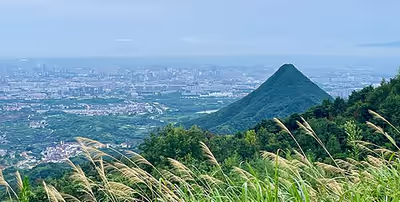
Jinhua is rich in red soil and forest resources. The Jinhua or Wu River flows through the Lan and Fuchun to the Qiantang River beside Hangzhou, which flows into Hangzhou Bay and the East China Sea. In medieval China, it formed part of the water network feeding supplies to the southern end of the Grand Canal. It is best known for its dry-cured Jinhua ham.
History and culture
The history of Jinhua dates back to the 2nd century BC, when it was a county subordinate to Shaoxing. It was given the name Jinhua under the Sui dynasty in AD 598 and later became the seat of a prefecture. The present city and its walls date to the Yuan dynasty in 1352.
The most famous native of Jinhua is Huang Chuping, a Daoist holy man of the 4th century and reputed immortal whose descendants still live in the area. Wuyang Shan ("Reclining Sheep Mountain") is said to be a sheep which was turned to stone by Huang, a trick which he learned through his years of diligently studying Daoism.
Economically Jinhua has always prospered from its position as the regional collecting and processing center for agricultural and forestry products (chiefly rice and bamboo). It is currently the second most important grain producing area in Zhejiang. In 1985 Jinhua was promoted to City status, and now is responsible for administering four cities, three counties and two districts. Animals raised there include dairy cattle, meat hogs (for the production of Jinhua ham, a famous local product for 900 years) and honeybees. Jinhua's industrial sector has developed more recently, producing machinery, metallurgy, pharmaceuticals, building supplies and electrical and electronic equipment.
The Tang dynasty painter Guan Xiu (Kuan-hsiu) was born in Jinhua. He is known for his paintings of Buddhist holy men.
There are numerous scenic and historical sites in the Jinhua region, including many places associated with the Immortal Huang, and a palace of the Dukes of the Taiping Heavenly Kingdom.
Sign in to keep reading
10 more chapters are free with a Lably account.
Geography
Jinhua is located at latitudes 28° 32'−29° 41' N and longitudes 119° 14'−120° 46' E in the center of Zhejiang. It borders Hangzhou to the northwest, Quzhou to the southwest, Lishui to the south, Taizhou to the east, and Shaoxing to the northeast.
Climate
Jinhua has a humid subtropical climate (Köppen Cfa) with four distinctive seasons, characterised by hot, humid summers and chilly, cloudy and drier winters (with occasional snow). The mean annual temperature is 17.33 °C (63.2 °F), with monthly daily averages ranging from 5.2 °C (41.4 °F) in January to 29.0 °C (84.2 °F) in July. The city receives an average annual rainfall of 1,450 millimetres (57.1 in) and is affected by the plum rains of the Asian monsoon in June, when average relative humidity also peaks.
Administrative divisions
The prefecture-level city of Jinhua administers 9 county-level divisions, including 2 districts, 4 county-level cities and 3 counties.
These are further divided into 191 township-level divisions, including 107 towns, 73 townships and 11 subdistricts.
Architecture
Jinhua architecture, also known as Wu-school architecture, is a style of traditional Chinese architecture that is characterized by large apartments, large courtyards, large open halls, horse-head walls. This style is different from the courtyard houses in Beijing and the earth buildings in Fujian.
Representative of the Ming and Qing Dynasty residences, Jinhua architecture typically features a clear central axis and a symmetrical layout. These buildings were often constructed by the royal family or the descendants of Confucianism, and served as both living spaces and cultural artifacts that reflect the values and beliefs of Confucianism.
The common characteristic of Confucian inheritance is the emphasis on respecting teachers, education, law, and rules. This philosophy is reflected in the spatial design and construction of Jinhua architecture. These houses are built with a harmonious balance between Yin and Yang and embody symmetry and balance.
Economy
Jinhua has a rather flexible economic system with distinctive economic characteristics in different areas. 90% of enterprises are in and about 88% of its GDP are from private sector.
Industry
Jinhua enjoys an advanced civilian-owned economy, with its industry mainly supported by processing and manufacturing. Leading industries of the city include clothing and textile, mechanics and electronics, pharmacy and chemistry, manufacturing crafts, metalwork processing architecture and building materials, automobile-and-motorcycle accessories, food processing, and plastic ware.
Industries are distributed with different characteristics in different counties or county-level cities. For instance, Yiwu is characterized by its light-industry commodities, Yongkang by its automobile-and-motorcycle accessories and mechanical and electric tools, Dongyang by its clothing, architecture and magnetic materials, the Jinhua Proper by its pharmacy, construction materials and industrial measures, Lanxi by its non-ferrous metal, cement, towels and daily chemicals, and Pujiang by its textile, lockmaking, and lantern ornaments of crystals.
Handicrafts
Traditional handicrafts have been flourishing in Jinhua, such as the wood carving and bamboo weaving in Dongyang, the straw plaiting, lace purling and crystals carving in Pujiang, and the hardware crafts in Yongkang.
Education
Higher education
There are 2 major colleges / universities in Jinhua: the provincial public university Zhejiang Normal University (ZJNU), and the municipal public university Jinhua University of Vocational Technology.
High schools
Major provincial key high schools in Jinhua include Jinhua No. 1 High School, High School Affiliated to Zhejiang Normal University, Aiqing High School, Jinhua Tangxi Senior High School, Jinhua Foreign Language School, Lanxi No. 1 High School, Zhejiang Dongyang High School, Zhejiang Yiwu High School, Yiwu No. 2 High School, Yongkang No. 1 Senior Middle School, Zhejiang Pujiang High School, Wuyi No. 1 High School, and Pan'an High School.
International cooperations
Many education cooperations happen in Jinhua. Jinhua has been leading China-Africa education cooperation since the 1980s with the help of colleges and universities. Zhejiang Normal University began to recruit short-term international students in China in the 1980s. To date, the university has trained more than 8,000 African students in the Chinese language, international education in Chinese, business administration, comparative education, software engineering, mechanical design, and manufacturing and automation.
Cuisine
Jinhua ham
Jinhua ham has bright colors, with red and white hues. The lean meat has a sweetness, while the fat imparts a flavor without being overly greasy. It is a rich source of protein, fat, multiple vitamins and minerals. Jinhua ham is produced during winter and matured throughout the summer, which allows for fermentation. Its consumption is associated with various health benefits, such as nourishing the stomach and kidneys, strengthening bone marrow, and promoting wound healing.
Jinhua ham features thin skin, with bright yellow skin and a lute-like shape. Its flesh is red and aromatic, earning it the reputation of the "four perfections" for its combination of color, fragrance, taste, and shape.
Yongkang Roumaibing
Yongkang Roumaibing (meat patties) is a traditional snack of Yongkang. Throughout Yongkang's history, local farmers have prepared meat patties as a staple dish during harvest festivals. Despite its coarse appearance, Yongkang meat patties are regarded and deemed as an example of the idiom "Don't judge a book by its cover."
Yongkang meat patties are generally divided into two types. One is the thin patty (also known as the triangle patty), which is flat and large in area. The whole thin patty is cut into several triangle patties and sold with pork and dried vegetable filling. The other is the thick patty, a thicker, smaller patty filled with potato, tofu, cowpea, lotus root, etc.
Transportation
Railways
Main railway stations:
- Jinhua railway station
- Jinhuanan railway station
- Yiwu railway station
Jinhua enjoys convenient transportation, being the communications center in southeast China between coastal and inland areas. It is one of the major hubs of land transportation in the country. The Zhejiang-Jiangxi, Jinhua-Wenzhou and Jinhua-Qiandaohu railways intersect in the city. The Hangzhou-Jinhua-Quzhou Expressway, the Jinhua-Lishui-Wenzhou Expressway, the No. 330 and 320 National Highways, and other provincial highroads traverse the area. The city aggregation around Jinhua Proper has formed a "Half-an-Hour's-Ride Economic Circle", there being merely a 90-minute and a 3-hour journey driving from the city to Hangzhou and Shanghai respectively.
Public transit
Metro
Jinhua Rail Transit is a metro system in Jinhua. Jinyidong Line connects the 2 districts of Jinhua to Yiwu and Dongyang. It was opened on August 30, 2022.
Airports
Yiwu Airport provides service to major cities in China mainland and Hong Kong.
Landmarks
Jinhua Architecture Park, a collection of 17 pavilions designed by Chinese and international architects, is set on the banks of the Yiwu River.
Demographics
According to the Seventh National Census in 2020, the city's Permanent Population (hukou) was 7,050,683. Compared with 5,361,572 people in the Sixth National Census in 2010, there was a total increase of 1,689,111 people over the decade, an increase of 31.5%, and an average annual growth rate of 2.78%. In the city's population, the male population was 3,716,342, accounting for 52.71%, and the female population was 3,334,341, accounting for 47.29%. The sex ratio of the total population (100 females, male to female ratio) was 111.46, an increase of 3.96 compared with the sixth national census in 2010.
Notable people
- Chen Wei
- Guo Guangchang
- Hu Hailan
- Pan Jianwei
- Lou Jiwei