

Johan Christian Fabricius
Danish zoologist (1745–1808)
- 3 min read
- 2 chapters

Related on Lably
Through Insect, Taxonomy (biology) and Paris
Biography
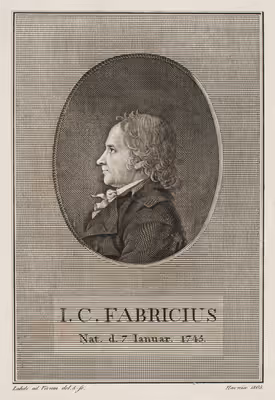
Johann Christian Fabricius was born on 7 January 1745 at Tønder in the Duchy of Schleswig, where his father was a doctor. He studied at the gymnasium at Altona and entered the University of Copenhagen in 1762. Later the same year he travelled together with his friend and relative Johan Zoëga to Uppsala, where he studied under Carl Linnaeus for two years. On his return, he started work on his Systema entomologiae, which was finally published in 1775. Throughout this time, he remained dependent on subsidies from his father, who worked as a consultant at Frederiks Hospital.
Fabricius was appointed a professor at the Charlottenborg-Institution in Copenhagen in 1768 with two years to travel before he joined. When he joined in 1770, the salary was much reduced. The fall of Johann Friedrich Struensee led to him taking up a position in Germany in 1775 at the University of Kiel. As professor of natural history and economics, he was promised that they would build a natural history museum and a botanical garden. Although he tried to resign three times, on one occasion only being prevented by an appeal from his students to the Danish King and Duke of Schleswig, Christian VII, Fabricius held the position at Kiel for the rest of his life.
During his time in Kiel, Fabricius repeatedly travelled to London in the summer to study the collections of British collectors, such as Joseph Banks and Dru Drury. Towards the end of his career, Fabricius spent much of his time living in Paris with his wife, where he frequently met with naturalists such as Georges Cuvier and Pierre André Latreille; he was also interested in the events of the French Revolution. He spent summers in Copenhagen to study the collections of his students O. R. Sehested and Tønder Lund. On hearing of the British attack on Copenhagen in 1807, Fabricius returned to Kiel, damaging his already fragile health. He died on 3 March 1808, at the age of 63.
Possessing a great knowledge of languages, Fabricius travelled through the northern and middle states of Europe, collecting new materials and frequenting various museums from which he described all those insects of which description had not hitherto been published. Fabricius was of an amiable disposition, and is said to have been reproached by a fellow professor for his extreme modesty which his friend urged would retard his advancement.
His daughter died in an accident in Paris, but he was survived by two sons, who both studied medicine.
Sign in to keep reading
One more chapter is free with a Lably account.
Evolution
The evolutionary ideas of Fabricius are not well known. He believed that man originated from the great apes and that new species could be formed by the hybridization of existing species. He also has been called the "Father of Lamarckism" because of his belief that new species could form from morphological adaptation. Fabricius wrote about the influence of environment on development of species and selection phenomena (females preferring the strongest males). He suggested the use of male genitalia features for differentiating closely resembling insect species.