

Juana Inés de la Cruz
Mexican Catholic nun, philosopher, composer and poet (1648–1695)
- 22 min read
- 6 chapters

Related on Lably
Through Saint, Women's rights and Americas
Sor Juana has been significant to many communities across time, having been presented as a candidate for Catholic sainthood; a symbol of Mexican nationalism; and a paragon of freedom of speech, women's rights, and sexual diversity,
Life
Early life
Juana was born in San Miguel Nepantla (presently Nepantla de Sor Juana Inés de la Cruz) near Mexico City as the illegitimate daughter of Don Pedro Manuel de Asuaje y Vargas-Machuca (1602-1680), a Spanish navy captain from the Canary Islands involved in colonial transatlantic shipping and trade, and Doña Isabel Ramírez de Santillana y Rendón (1626-1690), a distinguished criolla, whose father leased the Hacienda de Panoayan, near Mexico City.
There are two different baptism registrations that have been attributed to her, one under the name of "Juana" in 1648, and another one under the name of "Inés" in 1651, still a matter of academic research and debate. There is, nevertheless, agreement that she was one of the three children that Doña Isabel Ramírez de Santillana had out of wedlock with Don Pedro de Asuaje. Since Sor Juana's father left her life at an early age and remained largely unknown to her, Sor Juana's infancy occurred entirely around her mother's family in the hacienda of Panaoyan, in Amecameca, leased by her maternal grandfather, and home to the ample Ramírez de Santillana family. Among her relatives, several women with the name "Inés" have been noted, including her grandmother Inés de Brenes, her maternal-aunt Inés Ramírez de Santillana, and her first-cousin Inés de Brenes y Mendoza, married to a grandson of Antonio de Saavedra Guzmán, the first ever published American-born poet.
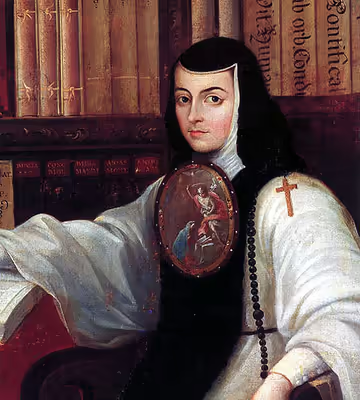
Later described as a child prodigy, Sor Juana was educated at home at the Hacienda de Panoayan, being exposed to Latin and Nahuatl, and learning philosophy, and mathematics. She was given free access to her grandfather's private library, the wide array of which lent itself well to her self-taught studies.
During her childhood, Inés often hid in the hacienda chapel to read her grandfather's books from the adjoining library, something forbidden to girls. By the age of three, she had learned how to read and write Latin. By the age of five, she reportedly could do accounts. At age eight, she composed a poem on the Eucharist. By adolescence, Inés had mastered Greek logic, and at age thirteen she was teaching Latin to young children. For long it was thought that she also learned Nahuatl, an Aztec language, and wrote short poems in that language as a child, but this has been challenged by more recent scholarship.
In 1664, at the age of 16, Inés was sent to live in Mexico City. She asked her mother's permission to disguise herself as a male student so that she could enter the university there, without success. Without the ability to obtain a formal education, Juana continued her studies privately. Her family's influential position had gained her the position of lady-in-waiting at the colonial viceroy's court, where she came under the tutelage of the Vicereine Donna Eleonora del Carretto, a member of one of Italy's most prominent families, and wife of the Viceroy of New Spain Don Antonio Sebastián de Toledo, Marquis of Mancera. The viceroy Marquis de Mancera, wishing to test the learning and intelligence of the 17-year-old, invited several theologians, jurists, philosophers, and poets to a meeting, during which she had to answer many questions unprepared and explain several difficult points on various scientific and literary subjects. The manner in which she acquitted herself astonished all present and greatly increased her reputation. Her literary accomplishments garnered her fame throughout New Spain. She was much admired in the viceregal court, and she received several proposals of marriage, which she declined.
After joining a nunnery in 1667, Sor Juana began writing poetry and prose dealing with such topics as love, women's rights, and religion. She turned her nun's quarters into a salon, visited by New Spain's female intellectual elite, including Doña Eleonora del Carreto, Marchioness of Mancera, and Doña Maria Luisa Gonzaga, Countess of Paredes de Nava, both Vicereines of New Spain, among others. Her criticism of misogyny and the hypocrisy of men led to her condemnation by the Bishop of Puebla, and in 1694 she was forced to sell her collection of books and focus on charity towards the poor. She died the next year, having caught the plague while treating her sisters.
Sign in to keep reading
5 more chapters are free with a Lably account.
Religious life and name change
In 1667, Inés entered the Monastery of St. Joseph, a community of the Discalced Carmelite nuns, as a postulant, where she remained but a few months. Later, in 1669, she entered the monastery of the Hieronymite nuns, which had more relaxed rules, where she changed her name to Sor Juana Inés de la Cruz, probably in reference to Sor Juana de la Cruz Vázquez Gutiérrez, a Spanish nun whose intellectual accomplishments earned her one of the few dispensations for women to preach the gospel. Another potential namesake was Saint Juan de la Cruz, one of the most accomplished authors of the Spanish Baroque. She chose to become a nun so that she could study as she wished since she wanted "to have no fixed occupation which might curtail my freedom to study."
In the convent and perhaps earlier, Sor Juana became intimate friends with Don Carlos de Sigüenza y Góngora, who visited her in the convent's locutorio. She stayed cloistered in the Convent of Santa Paula of the Hieronymite in Mexico City from 1669 until her death in 1695, and there she studied, wrote, and collected a large library of books. The Viceroy and Vicereine of New Spain became her patrons; they supported her and had her writings published in Spain. She addressed some of her poems to paintings of her friend and patron María Luisa Manrique de Lara y Gonzaga, daughter of Vespasiano Gonzaga, Duca di Guastala, Luzara e Rechiolo, and Inés María Manrique, 9th Countess de Paredes, whom she also addressed as Lísida.
In November 1690, the bishop of Puebla, Manuel Fernández de Santa Cruz published, under the pseudonym of Sor Filotea, and without her permission, Sor Juana's critique of a 40-year-old sermon by Father António Vieira, a Portuguese Jesuit preacher. Although Sor Juana's intentions for the work, called Carta Atenagórica are left to interpretation, many scholars have opted to interpret the work as a challenge to the hierarchical structure of the Catholic Church.
Along with Carta Atenagórica, the bishop also published his own letter in which he said she should focus on religious instead of secular studies. He published his criticisms to use them to his advantage against the priest, and while he agreed with her criticisms, he believed that as a woman, she should devote herself to prayer and give up her writings.
In response to her critics, Sor Juana wrote a letter, La Respuesta a Sor Filotea de la Cruz (Reply to Sister Philotea), in which she defended women's right to formal education. She also advocated for women's right to serve as intellectual authorities, not only through the act of writing, but also through the publication of their writing. By putting women, specifically older women, in positions of authority, Sor Juana argued, women could educate other women. Resultingly, Sor Juana argued, this practice could also avoid potentially dangerous situations involving male teachers in intimate settings with young female students. In 1691, she was reprimanded and ordered to stop writing after the exposure of a private letter in which she wrote of the right of women to education.
In addition to her status as a woman in a self-prescribed position of authority, Sor Juana's radical position made her an increasingly controversial figure. She famously remarked by quoting an Aragonese poet and echoing St. Teresa of Ávila: "One can perfectly well philosophize while cooking supper." In response, Francisco de Aguiar y Seijas, Archbishop of Mexico joined other high-ranking officials in condemning Sor Juana's "waywardness." In addition to opposition she received for challenging the patriarchal structure of the Catholic Church, Sor Juana was repeatedly criticized for believing that her writing could achieve the same philanthropic goals as community work.
By 1693, Sor Juana seemingly ceased writing to avoid risking official censure. Although there is no undisputed evidence of her renouncing her writing, there are documents showing her agreeing to undergo penance. Her name is affixed to such a document in 1694, but the tone of the supposed handwritten penitentials is in rhetorical and autocratic, in contrast to her normally lyrical style. One is signed "Yo, la Peor de Todas" ("I, the worst of all women"). She is said to have sold all her books, then an extensive library of more than 4,000 volumes, as well as her musical and scientific instruments. Other sources report that her defiance toward the Church led to the confiscation of all of her books and instruments, although the bishop himself agreed with the contents of her letters.
Of more than one hundred unpublished works, only a few of Sor Juana's writings have survived, which are known as the Complete Works. According to Octavio Paz, her writings were saved by the vicereine.
On 17 April 1695, at the age of just 46, Sor Juana died after ministering to other nuns stricken during a plague. Sigüenza y Góngora delivered the eulogy at her funeral.
Translations and interpretations
Octavio Paz is credited with re-establishing the importance of the historic Sor Juana in modern times, and other scholars have been instrumental in translating Sor Juana's work to other languages. The only translations of Carta Atenagorica are found in Sor Juana Inés de la Cruz: Selected Writings by Pamela Kirk Rappaport and The Tenth Muse: Sor Juana Inés de la Cruz by Fanchon Royer. Translations of Sor Juana's La Respuesta are credited to Electa Arenal and Amanda Powell, Edith Grossman, Margaret Seyers Peden, and Alan S. Trubeblood. These translations are respectively found in The Answer/La Respuesta, Sor Juana Ines de la Cruz: Selected Works, A Woman of Genius: The Intellectual Biography of Sor Juana Inés de la Cruz and Poems, Protest, and a Dream, and A Sor Juana Anthology.
Since Sor Juana's works were rediscovered after her death, scholarly interpretations and translations are both abundant and contrasting.
Octavio Paz
Octavio Paz was a Mexican Nobel Prize laureate and scholar. In his 1982 book, Sor Juana Inés de la Cruz o las trampas de la fe (translated to English by Margaret Sayers Peden as Sor Juana: Or, The Traps of Faith), Paz examines and contemplates Sor Juana's poetry and life in the context of the history of New Spain, particularly focusing on the difficulties women then faced while trying to thrive in academic and artistic fields. Primarily, Paz aims to explain why Sor Juana chose to become a nun. In Juana Ramírez, Octavio Paz and Diane Marting find that Sor Juana's decision to become a nun stemmed from her refusal to marry; joining the convent, according to Paz and Marting, was a way for Juana to obtain authority and freedom without marrying.
In his analyses of Sor Juana's poetry, Octavio Paz traces some of her influences to the Spanish writers of the Golden Age and the Hermetic tradition, mainly derived from the works of a noted Jesuit scholar of her era, Athanasius Kircher. Paz interprets Sor Juana's most ambitious and extensive poem, Primero Sueño ("The First Dream"), as a representation of the desire of knowledge through a number of hermetic symbols, albeit transformed in her own language and skilled image-making abilities. In conclusion, Paz makes the case that Sor Juana's works were the most important body of poetic work produced in the Americas until the arrival of 19th-century figures such as Emily Dickinson and Walt Whitman.
Tarsicio Herrera Zapién
Tarsicio Herrera Zapién, a classical scholar, has also devoted much of his career to the study of Sor Juana's works. Some of his publications (in Spanish) include Buena fe y humanismo en Sor Juana: diálogos y ensayos: las obras latinas: los sorjuanistas recientes (1984); López Velarde y sor Juana, feministas opuestos: y cuatro ensayos sobre Horacio y Virgilio en México (1984); Poemas mexicanos universales: de Sor Juana a López Velarde (1989) and Tres siglos y cien vidas de Sor Juana (1995).
Feminist analyses and translations
Scholars such as Scout Frewer argue that because Juana's advocacy for religious and intellectual authority would now be associated with feminism, she was a protofeminist. In the twenty-first century, Latin American philosophers and scholars generally interpret Sor Juana as a feminist before the time of feminism.
For instance, scholars like Rachel O'Donnell argue that Sor Juana occupied a special place in between socially acceptable and socially unacceptable roles in seventeenth century Mexico. By examining Sor Juana intersectionally, they prioritize the context of New Spain, specifically the influence of religion, race, and social norms, in understanding Sor Juana as a female theologian and poet.
According to O'Donnell, in colonial Mexico, education was an undertaking reserved for men, especially activities like writing and reading. Consequently, scholars like Octavio Paz argue, religion became a way for women to avoid marriage. Since Sor Juana was opposed to marriage, Paz argues, entering the convent was a socially acceptable way to be a single woman in seventeenth century Mexico. Entering the convent also meant that Sor Juana could read and write about religion despite the barriers to formal education for women. O'Donnell argues that Sor Juana was called a rare bird because although theology was only an acceptable pursuit for men in the Catholic Church, she actively studied religion. Sor Juana likely perceived wisdom and religion as inseparable, so she probably also believed that to follow God was to pursue wisdom. A third perspective suggests that considering the colonial context of New Spain and Sor Juana's background as a criolla, she represented colonial knowledge in a way that defied colonial religious structures.
Luis Felipe Fabre criticized 'Sorjuanista' scholarship as a whole, arguing that the discourse is binary rather than complex and multilayered.
Luis Felipe Fabre
Luis Felipe Fabre, a Mexican writer and scholar, ridicules other scholars, whom he collectively calls Sorjuanistas, who idolize Sor Juana. In his book, Sor Juana and Other Monsters, Fabre argues that the appropriation and recontextualization immanent in scholars' interpretations of Sor Juana construct Sor Juana as either a heretic or a lesbian. Fabre suggests that such representations constitute Sor Juana as a monstrosity or abnormality rather than as a complex woman. He suggests that rather than locating Sor Juana in a fixed identity, scholarship on Sor Juana should be a fluctuating and multilayered conversation.
Margaret Sayers Peden
Margaret Sayers Peden's 1982 A Woman of Genius: The Intellectual Autobiography of Sor Juana Ines de la Cruz, was the first English translation of Sor Juana's work. As well, Peden is credited for her 1989 translation of Sor Juana: Or, the Traps of Faith. Unlike other translations, Peden chose to translate the title of Sor Juana's best known work, First Dream, as "First I Dream" instead. Peden's use of first person instills authority in Sor Juana as an author, as a person with knowledge, in a male-dominated society. Peden also published her English translations of Sor Juana's work in an anthology called Poems, Protest, and a Dream. This work includes her response to authorities censuring her, La Respuesta, and First Dream.
Electa Arenal and Amanda Powell
An equally valuable feminist analysis and interpretation of Sor Juana's life and work is found in The Answer/La Respuesta by Sor Juana Inés de la Cruz by Electa Arenal, a Sor Juana scholar who is recognized among feminists who changed America, and Amanda Powell, a poet and translator. The original publication, released in 1994 by The Feminist Press, was re-released in an updated second edition in 2009, also by The Feminist Press. The bilingual publication includes poems, an annotated publication of Sor Juana's response to Church officials and her impassioned plea for education of women, analysis and a bibliography. The Answer applies a valuable gender lens to Sor Juana's writings and life. In their feminist analysis, Powell and Arenal translate the viewpoint of Sor Juana's writing as gender-ambiguous. Released in an updated second edition in 2009, also by The Feminist Press, the bilingual publication includes poems, an annotated publication of Sor Juana's response to Church officials and her impassioned plea for education of women, analysis and a bibliography.
Theresa A. Yugar
Theresa A. Yugar, a feminist theologian scholar in her own right, wrote her Master's and Doctoral theses on Sor Juana. Her book, Sor Juana Inés de la Cruz: Feminist Reconstruction of Biography and Text, discusses the life of Sor Juana through a feminist lens and analysis of her texts, La Respuesta (The Answer) and El Primero Sueño (First Dream).
Yugar aims to understand why individuals in Mexico in the twenty-first century have more knowledge of Frida Kahlo than Sor Juana. She celebrates poet Octavio Paz for crossing national borders with his internationally acclaimed work on Sor Juana: Or, The Traps of Faith. However, while Paz establishes Sor Juana's historical relevance, Yugar expands on his work to establish Sor Juana's importance in the twenty-first century.
Yugar argues that Sor Juana is the first female bibliophile in the New World. She also argues that Sor Juana's historic focus on gender and class equality in education (the public sphere) and the household (the private sphere), in addition to her advocacy for language rights, and the connection between indigenous religious traditions and ecological protection were paramount in the seventeenth century. Today's similar advocacy ignores her primal position in that work which is currently exclusively associated with ecofeminism and feminist theology.
Historical influence
Philanthropy
The Sor Juana Inés Services for Abused Women was established in 1993 to pay Sor Juana's dedication to helping women survivors of domestic violence forward. Renamed the Community Overcoming Relationship Abuse (CORA), the organization offers community, legal, and family support services in Spanish to Latin American women and children who have faced or are facing domestic violence.
Education
The San Jerónimo Convent, where Juana lived the last 27 years of her life and where she wrote most of her work is today the University of the Cloister of Sor Juana in the historic center of Mexico City. The Mexican government founded in the university in 1979.
Political controversy
While Sor Juana was a famous and controversial figure in the seventeenth century, she is also an important figure in modern times.
During renovations at the cloister in the 1970s, bones believed to be those of Sor Juana were discovered. A medallion similar to the one depicted in portraits of Juana was also found, with Margarita López Portillo, the sister of President José López Portillo (1976–1982), taking possession of the relic. During the tercentennial of Sor Juana's death in 1995, a member of the Mexican congress called on Margarita López Portillo to return the medallion. Portillo returned the medallion to Congress on November 14, 1995, with the event and description of the controversy reported in The New York Times a month later. Whether or not the medallion actually belonged to Juana, the incident sparked discussions about Juana and the abuse of official power in Mexico.
Contribution to feminism
Historic feminist movements
Amanda Powell locates Sor Juana as a contributor to the Querelles des Femmes, a three-century long literary debate about women. Central to this early feminist debate were ideas about gender and sex, and, consequently, misogyny.
Powell argues that the formal and informal networks and pro-feminist ideas of the Querelles des Femmes were important influences on Sor Juana's work, La Respuesta. For women, Powell argues, engaging in conversation with other women was as significant as communicating through writing. However, while Teresa of Ávila appears in Sor Juana's La Respuesta, Sor Juana makes no mention of the person who launched the debate, Christine de Pizan. Rather than focusing on Sor Juana's engagement with other literary works, Powell prioritizes Sor Juana's position of authority in her own literary discourse. This authoritative stance not only demonstrates a direct counter to misogyny, but was also typically reserved for men. As well, Sor Juana's argument that ideas about women in religious hierarchies are culturally constructed, not divine, echoes ideas about the construction of gender and sex.
Modern feminist movements
Yugar connects Sor Juana to feminist advocacy movements in the twenty-first century, such as religious feminism, ecofeminism, and the feminist movement in general.
Although the current religious feminist movement grew out of the Liberation Theology movement of the 1970s, Yugar uses Sor Juana's criticism of religious law that permits only men to occupy leadership positions within the Church as early evidence of her religious feminism. Based on Sor Juana's critique of the oppressive and patriarchal structures of the Church of her day, Yugar argues that Sor Juana predated current movements, like Latina Feminist Theology, that privilege Latina women's views on religion. She also cites modern movements such as the Roman Catholic Women Priest Movement, the Women's Ordination Conference, and the Women's Alliance for Theology, Ethics and Ritual, all of which also speak out against the patriarchal limitations on women in religious institutions.
Yugar emphasizes that Sor Juana interpreted the Bible as expressing concern with people of all backgrounds as well as with the earth. Most significantly, Yugar argues, Sor Juana expressed concern about the consequences of capitalistic Spanish domination over the earth. These ideas, Yugar points out, are commonly associated with modern feminist movements concerned with decolonization and the protection of the planet.
A symbol
Colonial and indigenous identities
As a woman in religion, Sor Juana has become associated with the Virgin of Guadalupe, a religious symbol of Mexican identity, but was also connected to Aztec goddesses. For example, parts of Sor Juana's Villancico 224 are written in Nahuatl, while others are written in Spanish. The Virgin of Guadalupe is the subject of the Villancico, but depending on the language, the poem refers to both the Virgin of Guadalupe and Cihuacoatl, an indigenous goddess. It is ambiguous whether Sor Juana prioritizes the Mexican or indigenous religious figure, or whether her focus is on harmonizing the two.
Sor Juana's connection to indigenous religious figures is also prominent in her Loa to Divine Narcissus (Spanish "El Divino Narciso") (see Jauregui 2003, 2009). The play centers on the interaction between two Indigenous people, named Occident and America, and two Spanish people, named Religion and Zeal. The characters exchange their religious perspectives, and conclude that there are more similarities between their religious traditions than there are differences. The loa references Aztec rituals and gods, including Huitzilopochtli, who symbolized the land of Mexico.
Scholars like Nicole Gomez argue that Sor Juana's fusion of Spanish and Aztec religious traditions in her Loa to Divine Narcissus aims to raise the status of indigenous religious traditions to that of Catholicism in New Spain. Gomez argues that Sor Juana also emphasizes the violence with which Spanish religious traditions dominated indigenous ones. Ultimately, Gomez argues that Sor Juana's use of both colonial and indigenous languages, symbols, and religious traditions not only gives voice to indigenous peoples, who were marginalized, but also affirms her own indigenous identity.
Through their scholarly interpretations of Sor Juana's work, Octavio Paz and Alicia Gaspar de Alba have also incorporated Sor Juana into discourses about Mexican identity. Paz's accredited scholarship on Sor Juana elevated her to a national symbol as a Mexican woman, writer, and religious authority. On the contrary, Gaspar de Alba emphasized Sor Juana's indigenous identity by inserting her into Chicana discourses.
Connection to Frida Kahlo
Paul Allatson emphasizes that women like Sor Juana and Frida Kahlo masculinized their appearances to symbolically complicate the space marked for women in society. Sor Juana's decision to cut her hair as punishment for mistakes she made during learning signified her own autonomy, but was also a way to engage in the masculinity expected of male-dominated spaces, like universities. According to Paul Allatson, nuns were also required to cut their hair after entering the convent. These ideas, Allatson suggests, are echoed in Frida Kahlo's 1940 self-portrait titled Self-Portrait with Cropped Hair, or Autorretrato con el pelo corto.
As well, the University of the Cloister of Sor Juana honored both Frida Kahlo and Sor Juana on October 31, 2018, with a symbolic altar. The altar, called Las Dos Juanas, was specially made for the Day of the Dead.
Official recognition by the Mexican government
In present times, Sor Juana is still an important figure in Mexico.
In 1995, Sor Juana's name was inscribed in gold on the wall of honor in the Mexican Congress in April 1995. Sor Juana also appears on the Mexican currency obverse. She was first included on the 1000 pesos AA family bill in 1978, which was in circulation until 1992. Between 1994 and 2020, she appeared on the 200 pesos C, D, D1, and F family bills. She currently appears on the 100 pesos G bill, which has been in circulation since 2020. The town where Sor Juana grew up, San Miguel Nepantla in the municipality of Tepetlixpa, State of Mexico, was renamed in her honor as Nepantla de Sor Juana Inés de la Cruz.
Veneration
In 2022, the Episcopal Church of the United States gave final approval and added her feast to the liturgical calendar. Her feast day is April 18.
Popular culture
Literature
- American poet Diane Ackerman wrote a verse drama, Reverse Thunder, about Sor Juana (1992).
- Canadian poet and novelist Margaret Atwood's 2007 book of poems The Door includes the poem "Sor Juana Works in the Garden".
- Puerto Rican poet Giannina Braschi wrote the postmodern Spanglish novel Yo-Yo Boing! in which characters debate the greatest women poets, acknowledging both Sor Juana and Emily Dickinson.
- Canadian novelist Paul Anderson devoted 12 years writing the 1300-page novel Hunger's Brides (2004) on Sor Juana. His novel won the 2005 Alberta Book Award.
- A fictionalized Sor Juana appears in the 2007 novel Sor Juana's Second Dream by Alicia Gaspar de Alba.
Music
- American composer John Adams and director Peter Sellars used two of Sor Juana's poems, Pues mi Dios ha nacido a penar and Pues está tiritando in their libretto for the Nativity oratorio-opera El Niño (2000).
- Composer Allison Sniffin's original composition, Óyeme con los ojos – (Hear Me with Your Eyes: Sor Juana on the Nature of Love), based on text and poetry by Sor Juana, was commissioned by Melodia Women's Choir, which premiered the work at the Kaufman Center in New York City.
- Composer Daniel Crozier and librettist Peter M. Krask wrote With Blood, With Ink, an opera based around her life, while both were students at Baltimore's Peabody Institute in 1993. The work won first prize in the National Operatic and Dramatic Association's Chamber Opera Competition. In 2000, excerpts were included in the New York City Opera's Showcasing American Composers Series. The work in its entirety was premiered by the Fort Worth Opera on April 20, 2014, and recorded by Albany Records.
- Puerto Rican singer iLe recites part of one of Sor Juana's sonnets in her song "Rescatarme".
- Brazilian composer Jorge Antunes recorded the 2013 electroacoustic musical work CARTA ATHENAGÓRICA with the support of Ibermúsicas. The composition honors Sor Juana with musical structure and musical objects based on rhetoric and figures of speech, using the chiasmus, also called retruécano, from Sor Juana's poems.
Video
- Mexican actress Andrea Palma portrayed her in the 1935 biopic Sor Juana Inés de la Cruz.
- Spanish actress Amparo Rivelles portrayed her in the 1962 telenovela series Sor Juana Inés de la Cruz.
- Spanish actress Assumpta Serna portrayed her in the 1990 film I, the Worst of All (Yo, la peor de todas), written and directed by María Luisa Bemberg, based on the 1982 Octavio Paz book.
- Mexican actress Arcelia Ramírez portrayed her in the 2016 miniseries Juana Inés, coproduced by Canal Once for Netflix.
Theater
- Helen Edmundson's play The Heresy of Love, based on the life of Sor Juana, was premiered by the Royal Shakespeare Company in early 2012 and revived by Shakespeare's Globe in 2015.
- Jesusa Rodríguez has produced a number of works concerning Sor Juana, including Sor Juana en Almoloya and Striptease de Sor Juana, based on Juana's poem "Primero Sueño".
- Playwright, director, and producer Kenneth Prestininzi wrote Impure Thoughts (Without Apology), which follows Sor Juana's experience with Bishop Francisco Aguilar y Seijas. " Archived 2017-10-11 at the Wayback Machine".
- Tanya Saracho's play The Tenth Muse, a fictionalized 18th-century drama about women in a convent in Colonial Mexico included seven female characters and their discovery of and relationship to Sor Juana's writings, debuted at the Oregon Shakespeare Festival.