


Related on Lably
Through Paleolithic
History
Earliest evidence of human presence around Kashan date back to Paleolithic period that have been found at Neyasar, Kaftar Khoun and Sefid-Ab. The Tepe Sialk, linked to the Zayandeh River Culture, dates back to around the 6th millennium BC. Middle Paleolithic stone tools were discovered at travertine spring of Niasar and the travertine of Kaftar Khoun. Upper Paleolithic groups were living around Sefid-Ab spring at SW of Kashan.
It is uncertain as to when what is now Kashan was established. By some accounts, although not all, Kashan was the origin of the three wise men who followed the star that guided them to Bethlehem to witness the nativity of Jesus, as recounted in the Bible. For example, medieval traveler Friar Odoric of Pordenone related this story in 1330 after having visited there.
According to a legend dating from the Safavid era, Abu Lu'lu'a, the Persian skilled craftsman who was enslaved by the Islamic conquerors and who eventually assassinated the caliph Umar ibn al-Khattab in 644, fled to Kashan after the assassination. The shrine that was built over his supposed tomb is one of Kashan's landmarks (see gallery below).
During the Timurid era, Kashan was patronized by Ulugh Beg, grandson of Timur. Thereafter, Kashan successively came under the rule of the Qara Qoyunlu, and then the Aq Qoyunlu. Kashan was also a leisure vacation spot for the Safavid shahs.
The earthquake of 1778 leveled the city of Kashan and all the edifices of Abbas the Great, leaving 8000 casualties. However, the city was rebuilt.
This city is also known as Dar al-Mominin.
Sign in to keep reading
8 more chapters are free with a Lably account.
Demographics
Population
At the time of the 2006 National Census, the city's population was 248,789 in 67,464 households. The following census in 2011 counted 275,325 people in 80,015 households. The 2016 census measured the population of the city as 304,487 people in 91,935 households.
Geography
Kashan is divided into two parts, mountainous and desert.
Location
The city of Kashan is located in the north of Isfahan province, north of the Karkas Mountains and west of Dasht-e Kavir desert, where it is poor in terms of vegetation and where bushes and shrubs are more or less found.
Mountains
Dare mountain is next to Dare village and 14 kilometers southwest of Kashan with a height of 2,985 meters overlooking the city of Kashan, and Mount Gargash is the second highest peak of the Karkas mountain range (the first is mount Karakas in Natanz), 33 kilometers southwest of Kashan and 12 kilometers southwest of Qamsar and 7 kilometers northeast of Kamu with a height of 3,600 meters. Ardahal peak is located 35 kilometers west of Kashan with a height of 3505 meters after Gargash, is the highest point of Kashan heights (continuation of the central mountain range) in the vicinity of Niaser and the villages Nashlej and Mashhad.
After assessment of 40 summits in Iran for construction of a national observation facility regarding their surrounding light pollution, Mount Gargash was chosen as the site of Iranian National Observatory in 2003. After 18 years, the facility was inaugurated in 2021.
Climate
Kashan has a hot desert climate, with (BWh) designation in Köppen climate classification and (BW) in Trewartha climate classification, with cold winters (although warmer than other Iranian cities) and very hot and dry summers. Kashan is significantly warmer than other cities in the Iranian Plateau due to its lower elevation.
Main sights
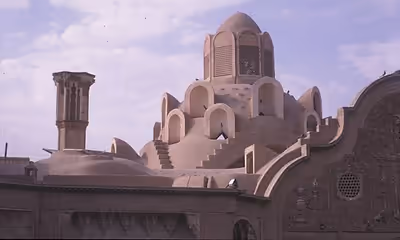
On 9 August 2007, Iran placed the Historical Axis of Fin, Sialk, Kashan on its Tentative List for possible future nomination as a UNESCO World Heritage Site. The exact definition of what locations within Kashan proper might be nominated was not made clear. In 2012, Iran successfully nominated the Fin Garden separately for inscription by UNESCO as a part of its Persian gardens World Heritage Site. Despite this the "Historical-Cultural Axis of Fin, Sialk, Kashan" remains in full on Iran's Tentative List. The Borujerdi House is one of the historical places from the Qajar era.
Kashan's architectural sights include:
- Abbāsi House
- Agha Bozorg Mosque
- Āmeri House
- Bazaar of Kashan
- Borujerdi House
- Fin Garden
- Jalali Castle
- Jameh Mosque of Kashan
- Meydan Mosque
- Shrine of Abu Lu'lu'a (shrine dedicated to the assassin of Umar, the second Islamic caliph)
- Sultan Amir Ahmad Bathhouse
- Tabatabai House
- Tabriziha Mosque
- Tepe Sialk
Today
Kashan is known for the manufacture of carpets, silk and other textiles.
Education
There are more than 10,000 students currently studying in various fields (e.g.:Applied sciences, Engineering, Art, Law, Medical sciences, Nano technology, literature, Carpet and Handicrafts, etc.) at universities of Kashan. Colleges and universities in Kashan include:
- Kashan University of Medical Sciences
- Islamic Azad University of Kashan
- University of Kashan
Accessibility
- Road 71
- Freeway 7, located near the city
Kashan is connected via freeways to Isfahan and Natanz to the South, and Qom, which is an hour drive away to the north. Kashan railway station is along the main north–south railways of Iran. Kashan Airport reopened on 2 June 2016 after twenty years hiatus with an ATA Airlines flight from Mashhad International Airport.
Notable people
- Reza Abbasi, Persian miniaturist
- David Alliance, Baron Alliance, businessman, politician, and member of the House of Lords
- Amir Ghafour, volleyball player
- Saeed Hajjarian, reformist political strategist, journalist, pro-democracy activist and former intelligence officer.
- Ehsan Hajsafi, professional footballer
- Ghyath ad-Din Jamshid Kashani
- Mohsen Feyz Kashani, Akhbari Twelver Shi'i Muslim, mystic, poet, philosopher, and muhaddith
- Afdal al-Din Kashani, poet and philosopher
- Kalim Kashani, poet
- Molla Fathollah Kashani, jurisprudent, theologian, and commentator
- Muhtasham Kashani, poet
- Javad Kazemian, football winger
- Isaac Larian (born 1954), Iranian-born American businessman, founder and the chief executive officer of MGA Entertainment, the world's largest privately owned toy company
- Ustad Ali Maryam, architect
- Kamal-ol-Molk, painter
- Sani ol molk, painter, artist, and illustrator
- Mohammad Motamedi, traditional vocalist, and a ney player
- Mulla Muhammad Mahdi Naraqi
- Ghotb Ravandi
- Sohrab Sepehri, poet and painter
- Yedidia Shofet (1908 –2005), Chief Rabbi of Iran
- Pari Zangeneh, folk singer and actor
- Moluk Zarabi, singer and actor
Twin towns – sister cities
- Neishabour, Iran