


Related on Lably
Through Central Asia, Russia and China
Like other Turkic languages, Kazakh is an agglutinative language and employs vowel harmony. Kazakh builds words by adding suffixes one after another to the word stem, with each suffix expressing only one unique meaning and following a fixed sequence. Ethnologue recognises three mutually intelligible dialect groups: North-Eastern Kazakh—the most widely spoken variety, which also serves as the basis for the official language—Southern Kazakh, and Western Kazakh. The language shares a degree of mutual intelligibility with the closely related Karakalpak language, while its Western dialects maintain limited mutual intelligibility with the Altai languages.
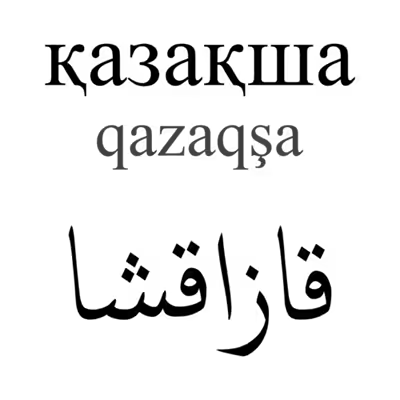
In October 2017, the then president, Nursultan Nazarbayev, decreed that the writing system would change from Cyrillic to Latin script by 2025. The proposed Latin alphabet has been revised several times and, as of January 2021, is close to the inventory of the Turkish alphabet, though it lacks the letters C and Ç and has four additional letters: Ä, Ñ, Q, and Ū (though other letters, such as Y, have different values in the two languages). It is scheduled to be phased in from 2023 to 2031. Over one million Kazakh speakers in Xinjiang use a modified version of the Perso-Arabic script for writing.
Geographic distribution
Speakers of Kazakh are spread over a vast territory, from the Tian Shan to the western shore of the Caspian Sea. Kazakh is the official state language of Kazakhstan, with nearly 10 million speakers (based on information from the CIA World Factbook on population and proportion of Kazakh speakers).
In China, nearly two million ethnic Kazakhs and Kazakh speakers reside in the Ili Kazakh Autonomous Prefecture of Xinjiang.
Sign in to keep reading
4 more chapters are free with a Lably account.
History
The Kipchak branch of Turkic languages, to which Kazakh belongs, was largely consolidated during the period of the Golden Horde. The modern Kazakh language is thought to have taken shape around 1465 AD, during the formation of the Kazakh Khanate. Modern Kazakh is likely a descendant of both Chagatay Turkic, as spoken by the Timurids, and Kipchak Turkic, as spoken in the Golden Horde.
Kazakh contains a substantial number of loanwords from Persian and Arabic, owing to frequent historical interactions between Kazakhs and Iranian ethnic groups to the south. Furthermore, Persian served as a lingua franca in the Kazakh Khanate, enabling Kazakhs to incorporate Persian words into their spoken and written vernacular. Meanwhile, Arabic was used by Kazakhs in mosques and mausoleums, functioning as a language reserved for religious contexts—much as Latin served as a liturgical language in the Western European cultural sphere.
The Kazakhs used the Arabic script to write their language until approximately 1929. In the early 1900s, the Kazakh activist Akhmet Baitursynuly reformed the Kazakh–Arabic alphabet, but his work was largely overshadowed by the Soviet presence in Central Asia. Subsequently, the new Soviet regime compelled the Kazakhs to adopt a Latin script and, later, a Cyrillic script in the 1940s. Today, Kazakhs use both the Cyrillic and Latin scripts to write their language, although a presidential decree issued in 2017 ordered the transition from Cyrillic to Latin by 2031.
Although not classified as an endangered language, Kazakh was described in 2024 as being in a somewhat vulnerable position by Kazakhstan's Minister of Science and Higher Education, Sayasat Nurbek, falling into a category where the number of speakers is not increasing as rapidly as had been anticipated.
Phonology and orthography
Kazakh exhibits tongue-root vowel harmony, with some words of recent foreign origin (e.g., from Russian, Persian, or Arabic) being exceptions. There is also a system of rounding harmony which resembles that of Kyrgyz, but which does not apply as strongly and is not reflected in the orthography. This system applies only to the mid vowels (and not ), and operates in the following syllables. Thus, jūldyz 'star', bügın 'today', and ülken 'big' are actually pronounced as jūldūz, bügün, and ülkön, respectively.
Consonants
The following chart depicts the consonant inventory of standard Kazakh; many of the sounds, however, are allophones of other sounds or appear only in recent loanwords. The 18 consonant phonemes listed by Vajda are without parentheses—since these are phonemes, their listed place and manner of articulation are very general, and will vary from what is shown. ( rarely appears in normal speech.) Kazakh has 19 native consonant phonemes: these are the stops , fricatives , nasals , liquids , and two glides . The sounds are found only in loanwords. is heard as an alveolo-palatal affricate in the Kazakh dialects of Uzbekistan and China. The sounds and may be analysed as allophones of and in words with back vowels, but exceptions occur in loanwords.
- Voiced obstruents syllable-finally become devoiced, as normally indicated in the orthography.
- // can never occur in word initial position.
- occur word-initially only in loanwords.
- // is velarized [] in words with back vowels.
- Voiceless stops are aspirated , and the voice onset time is highest in word-initial position. If followed by another obstruent, they may be unreleased .
- // is often heard as a tap [] in rural speech, as well as in dialects spoken in China.
Vowels
Kazakh has a system of roughly eight or nine phonemic vowels. The rounding contrast and generally occur only as phonemes in the first syllable of a word, but do occur later allophonically; see the section on harmony below for more information. Moreover, has been included artificially due to the influence of Arabic, Persian, and, later, Tatar during the Islamic period. It can be found in some native words, however.
According to Vajda, the front/back quality of vowels is actually one of neutral versus retracted tongue root.
Phonetic values are paired with the corresponding character in Kazakh's Cyrillic and Latin alphabets.
- There is significant debate over the Kazakh vowel chart, but many analyses agree on an eight-vowel system with being artificially added due to influence from Arabic and Persian.
- The vowel is often pronounced as the diphthong at the beginning of words, with the exception of root e-. Urban Kazakh speakers have a greater tendency to palatalize all , caused by Russian influence.
- Some analyses include the vowels and , resulting in an 11-vowel system. Other analyses analyze these as sequences of vowels with or , respectively, since they can be either front or back in vowel harmony.
Vowel harmony
Kazakh exhibits tongue-root vowel harmony (also called soft-hard harmony), and arguably weakened rounding harmony, which is implied in the first syllable of the word. All vowels after the first rounded syllable are subject to this harmony, with the exception of , and in the following syllables—e.g., өмір , қосы . Notably, urban Kazakh speakers tend to violate rounding harmony, as well as pronouncing Russian borrowings against the rules.
Syllable structure
Kazakh's syllable structure is (C)V(C)(C). Syllables containing consonant clusters CC typically consist of a combination of a sonorant () and a stop (mainly ). Other types of syllables are also permitted due to recent loanwords, mainly from Russian.
Stress
Most words in Kazakh are stressed in the last syllable, except:
- When counting objects, numbers are stressed in the first syllable, but stressed in the last syllable in collective numbers suffixed by -eu (bıreu, altau from bır, alty):
- bır, ekı, üş, tört, bes, alty, jetı, ...
- 'one, two, three, four, five, six, seven, ...'
- Definite and negative pronouns are stressed in the first syllable:
- bärıne eşkımge
- 'to everyone, to no one'
- Individual onomatopoeic words and interjections are stressed on the first syllable
- Certain suffixes do not take stress, including:
- the predicate suffixes -mın/-myn, -sıñ/-syñ, -mız/-myz (e.g., baqyttymyz 'we are happy', balasyñ 'you're a child')
- the suffixes -dei/-dai, -tei/-tai (e.g., börıdei 'like a wolf')
- the optative suffix -iın/-iyn (e.g., jazaiyn 'let's write')
- the negative suffixes -me/-ma, -be/-ba, -pe/-pa (e.g., jylama 'don't cry', qoryqpa 'fear not')
- particles and postpositions -şı/-şy (e.g., qaraşy! 'look!'), ğoi, etc.
Orthography
Nowadays, Kazakh is mostly written in the Cyrillic script, with an Arabic-based alphabet being used by Kazakh speakers in China. On 26 October 2017, by Presidential Decree 569, Kazakhstan announced that it would adopt the Latin script by 2025. However, this transition has since been delayed.
Since the Cyrillic alphabet was originally designed for Slavic languages, it had to be modified to better fit the sounds of Turkic languages such as Kazakh. Several new letters were added, and some existing ones were modified: ә, ғ, қ, ң, ө, ұ, ү, һ, і.
The Cyrillic letter у, when following a consonant, represents a combination of sounds , , ы , or with the glide , for example: кіру , су , көру , and атысу . The Cyrillic letter ю undergoes the same process but with at the beginning.
The letter и represents a combination of sounds (in front-vowel contexts) or (in back vowel contexts) with the glide , e.g., тиіс , оқиды . In Russian loanwords, particularly in educated speech, it is often realised as (when stressed) or (when unstressed), e.g., изоморфизм .
The letter я represents either or depending on vowel harmony.
The letter щ represents , e.g. ащы .
Meanwhile, the letters в, ё, ф, х, һ, ц, ч, ъ, ь, and э are used only in loanwords—mostly those of Russian origin, but sometimes of Persian and Arabic origin as well. They are often substituted in spoken Kazakh.
The table below compares the various scripts.
Grammar
Kazakh is generally verb-final, though various permutations of the SOV (subject–object–verb) word order can be used, for example, as a result of topicalization. Inflectional and derivational morphology, both verbal and nominal, in Kazakh, exists almost exclusively in the form of agglutinative suffixes. Kazakh is a nominative-accusative, head-final, left-branching, dependent-marking language.
Nouns
Kazakh has no noun class or gender system. Nouns are declined for number (singular or plural) and one of seven cases:
The suffix for case is placed after the suffix for number.
Additionally, there exist inflectional suffixes, which can be attached to nouns:
- -dai/-dei/-tai/-tei
- -syz/-sız
The suffixes -dai/-dei/-tai/-tei serve a role similar to that of the semblative case.
The suffixes -syz/-sız serve a role similar to that of the abessive case.
Pronouns
There are eight personal pronouns in Kazakh:
The declension of the pronouns is outlined in the following chart. Singular pronouns exhibit irregularities, while plural pronouns do not. Irregular forms are highlighted in bold.
Additionally, the 3rd person singular exhibits irregularities for the inflectional suffixes -dai/-dei/-tai/-tei and -syz/-sız:
- ondai
- onsyz
In addition to the pronouns, there are several more sets of morphemes dealing with person.
Adjectives
Adjectives in Kazakh are not declined for any grammatical category of the modified noun. Being a head-final language, adjectives are always placed before the noun that they modify. Kazakh has two varieties of adjectives:
- Qualitative – used to describe properties of the noun, such as color
- Relational – adjectives formed from words from other parts of speech
Degrees of comparison
Comparative
The comparative form can be created by appending the suffix -(y)raq/-(ı)rek or -tau/-teu/-dau/-dau to an adjective.
Superlative
The superlative form can be created by placing the morpheme eñ before the adjective. The superlative form can also be expressed by reduplication.
Verbs
Kazakh may express different combinations of tense, aspect, and mood through the use of various verbal morphology or through a system of auxiliary verbs, many of which might better be considered light verbs. The present tense is a prime example of this: the progressive tense in Kazakh is formed with one of four possible auxiliaries. These auxiliaries—otyr 'sit', tūr 'stand', jür 'go', and jat 'lie'—encode various shades of meaning regarding how the action is carried out, and also interact with the lexical semantics of the root verb: telic and non-telic actions, semelfactives, durative and non-durative, punctual, and so on. There are selectional restrictions on auxiliaries: motion verbs, such as бару 'go' and келу 'come', may not combine with otyr. However, any verb can combine with jat 'lie' to express a progressive tense meaning.
While it is possible to think that different categories of aspect govern the choice of auxiliary, it is not so straightforward in Kazakh. Auxiliaries are internally sensitive to the lexical semantics of predicates, for example, verbs describing motion:
In addition to the complexities of the progressive tense, there are many auxiliary-converb pairs that encode a range of aspectual, modal, volitional, evidential and action- modificational meanings. For example, the pattern verb + köru, with the auxiliary verb köru 'see', indicates that the subject of the verb attempted or tried to do something (compare the Japanese てみる temiru construction).
Annotated text with gloss
From the first stanza and refrain of "Menıñ Qazaqstanym" ("My Kazakhstan"), the national anthem of Kazakhstan: