


Related on Lably
Through Population density, Shipyard and Unicameralism
History
The area of Kure is part of ancient Aki Province, and the port of Kure was an important seaport for Hiroshima Domain in the Edo period.
The Kure Naval District was first established in 1889, leading to the construction of the Kure Naval Arsenal and the rapid growth of steel production and shipbuilding in the city. Kure was formally incorporated on October 1, 1902. From 1889 until the end of the Pacific War, the city served as the headquarters of the Kure Naval District.
Kure dockyards recorded a number of significant engineering firsts including the launching of the first major domestically built capital ship, the battlecruiser Tsukuba (1905) and the launching of the largest battleship ever built, the Yamato (1940).
During the Pacific War, Kure acted as the Imperial Japanese Navy's single-largest naval base and arsenal. Most of the city's industry and workforce were employed in the service of the naval installations, munitions factories and associated support functions. In the later stages of the conflict Kure came under sustained aerial bombardment culminating in the bombing of Kure in June and July 1945.
From February 1946 until the end of Japan's postwar occupation in 1952, military establishments in Kure served as the operational headquarters for the British Commonwealth Occupation Force.
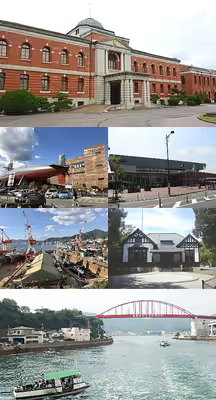
Since 2005, Kure has attracted attention as a tourism center with the Yamato Museum hosting a 1:10 scale model of the Yamato alongside a waterfront JMSDF museum of Japanese naval history.
The city continues as a major maritime center hosting both the dockyards of Japan Marine United and numerous shore-based facilities of the JMSDF including training centers and a major hospital. The city serves as the home port of an Escort Flotilla (Destroyers), a Submarine Flotilla and the Training Squadron of the JMSDF Regional Kure District.
Historic timeline
- July 1, 1889 — Kure Naval District established.
- 1895 — Kure naval shipyard established, initially as a subsidiary of the Onohama Shipyards in Kobe.
- October 1, 1902 — The towns of Washō and Futagawa and the villages of Miyahara and Sōyamada merge to form the city of Kure.
- November 10, 1903 — Kure Naval Arsenal established.
- December 27, 1903 Kure rail line opens providing direct rail access to Hiroshima
- April 1, 1928 — The towns of Kegoya, Yoshiura, and Aga merge into Kure.
- April 21, 1941 — The town of Nigata and the village of Hiro incorporated into Kure.
- March 19, 1945 — US Navy aircraft attack Japanese warships at Kure
- May 5, 1945 — Bombing of Hiro Naval Arsenal.
- June 22, 1945 — Bombing of Kure Naval Arsenal.
- July 1, 1945 — Kure Air Raid.
- July 24–28, 1945 — Battle of Kure, American bombers attack the remaining fleet in Kure Naval Base.
- July 1, 1954 — Japan Maritime Self-Defense Force founded.
- October 1, 1956 — The town of Tennō and the village of Shōwa in Aki District, and the village of Gōhara in Kamo District merge into Kure.
- November 1, 2000 — Kure becomes a Special City
- April 1, 2003 — The town of Shimokamagari (from Aki District) was merged into Kure.
- April 1, 2004 —The town of Kawajiri (from Toyota District) was merged into Kure.
- March 20, 2005 — The towns of Ondo, Kurahashi and Kamagari (all from Aki District), and the towns of Yasuura, Toyohama and Yutaka (all from Toyota District) were merged into Kure.
- April 1, 2016 — Kure officially became a Core city with increased local autonomy
Sign in to keep reading
10 more chapters are free with a Lably account.
Government
Kure has a mayor-council form of government with a directly elected mayor and a unicameral city council of 31 members. Kure contributes five members to the Hiroshima Prefectural Assembly. In terms of national politics, the city is part of the Hiroshima 5th district of the lower house of the Diet of Japan.
List of mayors of Kure (from 1903 to present)
Geography
Kure is located 20 kilometres (10 mi) south-east of Hiroshima city and faces the Seto Inland Sea. Surrounded by steep hillsides to the north, the two major commercial and industrial centers of the city are bisected by Mount Yasumi 497 m (1,631 ft). The city is next to the Setonaikai National Park. As well as densely populated urban and industrial centers, the city also incorporates sparsely inhabited outlying islands such as Kurahashi-jima, Shimo-kamagari, Kami-kamagari and Toyoshima.
Adjoining municipalities
- Etajima
- Higashihiroshima
- Kumano
- Minami-ku, Hiroshima
- Ōsakikamijima
- Saka
Climate
Kure has a humid subtropical climate (Köppen climate classification Cfa) with hot summers and cool winters. Precipitation is significant throughout the year and is heaviest in summer.
Demographics
Per Japanese census data, the population of Kure has been declining for the past 40 years.
Economy
- Disco Corporation has three manufacturing plants in Kure
- Japan Marine United, formerly IHI Marine United, has a shipyard in the city
- Mitsubishi Hitachi Power Systems
- Mitutoyo
- Nisshin Steel
- Oji Paper Company
- Sailor Pen Company
- Yodogawa Steel Works
Education
Colleges and Universities
- Goko Academy
- Japan Coast Guard Academy
- Kure Kyosai Hospital Nursing College
- Kure University
- National Institute of Technology, Kure College
Primary and secondary education
Kure has 37 public elementary schools, 25 public junior high schools and one public high school operated by the city government, and seven public high school operated by the Hiroshima Prefectural Board of Education. There are also one private middle school and three price high schools. The prefecture also operates two special education schools for the disabled.
Transportation
Railway
JR West (JR West) - Kure Line
- Yasuura - Ato - Akikawajiri - Nigata - Hiro - Shin-Hiro - Akiaga - Kure - Kawaraishi - Yoshiura - Karugahama - Tennō - Kure-Portopia
Highways
- Higashihiroshima-Kure Expressway
- Hiroshima-Kure Road
- National Route 31
- National Route 185
- National Route 375
- National Route 487
Sister cities
As of September 2017, Kure has sister city agreements with the following cities.
Sister cities
- Bremerton, Washington, United States (since August 1970)
- Marbella, Andalusia, Spain (since December 1990)
- Jinhae-gu, Changwon, South Gyeongsang, South Korea (since October 1999)
- Keelung, Taiwan (since April 2017)
Friendship cities
- Daisen, Tottori (since September 1995)
Friendship ports
Local attractions
Museums
- Irifuneyama Memorial Museum
- JMSDF Kure Museum (Displaying Yūshio-class submarine Akishio), nicknamed Iron Whale Museum
- Kurahashi-cho Nagato Museum of Shipbuilding History
- Kure Municipal Museum of Art and Museum Avenue
- Rantokaku Art Museum
- Sannose Gohonjin Art and Culture
- Yamato Museum
Shrines
- Kameyama Shrine
Historical places
- Former Kure-chinjufu
- Former House of Prince Takamatsu
- House of Kimiyo Fujii
- Takechimaru anti-invasion cement ships
Parks and gardens
- Allay Karasu Kojima Park
- Kure Port-pia Park
- Nagasako Park
- Nikokyo Park
- Ondono-seto and Park
- Setonaikai National Park
- Rekishi-no-mieru-Oka and Park
Mountains
- Haiga-mine
- Honjo Suigenchi
- Mount Noro
- Mount Yasumi
- Nikyu-kyo
Beaches
- Kajigahama Beach
- Romantic Beach Karuga
Festivals
- Kure Port Festival
- Kure Fireworks above the Sea (late July or early August)
- Kameyama Shrine Festival (2nd Sunday in October, and the day before)
Notable people from Kure
Musicians
- Michiru Jo
- Machico
- Miyu Matsuki
- Akira Sakata
- Hitomi Shimatani
Authors
- Hirofumi Kamigaki
- Hiromu Ono
- Shinji Wada
Sports
- Fumio Fujimura
- Shinji Hamazaki
- Ryō Hirakawa
- Tatsuro Hirooka
Politicians
- Rob Lucas