

Lakes and rivers of Titan
Hydrocarbon lakes on Titan, a moon of Saturn
- 12 min read
- 6 chapters

Related on Lably
Through Methane, Hydrocarbon and Hubble Space Telescope
History and discovery
The possibility of seas on Titan was first suggested by data from the Voyager 1 and Voyager 2 space probes, which flew past Titan in 1980 and 1981. The observations showed that Titan has a thick atmosphere with a temperature and composition potentially capable of supporting liquid hydrocarbons. In 1995, observations from the Hubble Space Telescope and other instruments provided indirect evidence for liquid methane, either in isolated bodies or in oceans spanning much of the moon's surface, analogous to Earth's oceans.
The Cassini mission continued the search for surface liquids after arriving in the Saturn system in 2004. Scientists hoped to detect hydrocarbon lakes or seas through specular reflections of sunlight from their surfaces, but no such reflections were initially observed.
The Huygens probe provided the first close-up observations of Titan's surface when it landed near the equator on January 14, 2005. Images taken during its descent showed no open bodies of liquid but provided evidence that liquid had flowed across the surface in the recent past. Pale hills were crossed by dark drainage channels that led into a broad, flat, dark region. Initially, this region was thought to be a lake or a deposit of a tar-like substance. However, Huygens landed on the region and found it to be solid, with no evidence of liquid. A penetrometer initially indicated that the surface resembled wet clay or a hard crust over a sticky material, but subsequent analysis suggested that the reading resulted from Huygens displacing a large pebble during landing. The surface is now thought to consist of ice grains resembling sand. Images taken after landing showed a flat plain covered with rounded pebbles, which may be composed of water ice and may have been shaped by flowing liquid.
Measurements made by Huygens indicated that heat was conducted away from the probe unusually quickly, suggesting that the ground was damp. One image also appears to show light reflected by a droplet falling through the camera's field of view. Because Titan receives little sunlight, evaporation is slow: about 1 cm of liquid per year, compared with about 1 m of water on Earth. Its atmosphere can hold the equivalent of about 10 meters (33 ft) of liquid before rain forms, compared with about 2 cm (0.79 in) on Earth. Titan's climate is therefore expected to include intense rainfall and flash floods separated by decades or centuries of drought.
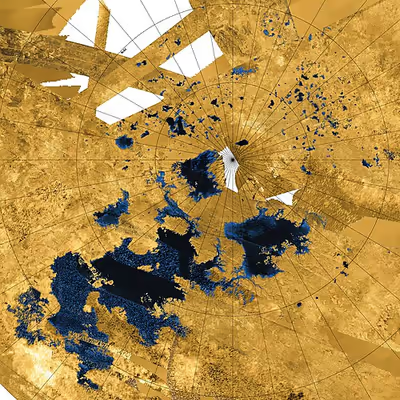
Scientists expected liquid ethane and methane to be especially abundant and stable in Titan's polar regions. In the south polar region, a dark feature known as Ontario Lacus was the first suspected lake identified. It may have formed from precipitation associated with clouds that frequently occur in the area. Radar imagery also revealed a possible shoreline near the pole. During a Cassini flyby on July 22, 2006, radar observations of the northern latitudes, then in winter, revealed numerous large, smooth regions that appeared dark to radar. Based on these observations, scientists announced in January 2007 that they had definitive evidence of methane-filled lakes on Titan. The Cassini–Huygens team concluded that these features were almost certainly the long-sought hydrocarbon lakes, the first stable bodies of surface liquid known outside Earth. Some lakes have associated channels and occupy topographic depressions. The limited erosion observed along some channels suggests that erosion on Titan is extremely slow or that more recent processes have erased older river channels and other landforms. Overall, Cassini's radar observations showed that lakes cover only a few percent of Titan's surface and are concentrated near the poles, making Titan substantially drier than Earth. Methane evaporation from lakes covering only 0.002–0.02% of Titan's total surface area may be sufficient to maintain the high relative humidity of methane in the lower atmosphere.
During a Cassini flyby in late February 2007, radar and camera observations revealed several large features in the north polar region interpreted as expanses of liquid methane and ethane. One of these, Ligeia Mare, covers about 126,000 km2 (49,000 sq mi), making it slightly larger than Lake Michigan–Huron, the largest freshwater lake on Earth. Another, Kraken Mare, was later found to be about three times larger. A flyby of Titan's southern polar region in October 2007 revealed similar but much smaller lake-like features.
During a Cassini flyby in December 2007, the Visual and Infrared Mapping Spectrometer observed Ontario Lacus in the south polar region. The instrument identifies materials by how they absorb and reflect infrared light. Radar measurements made in July 2009 and January 2010 indicated that Ontario Lacus is extremely shallow, with an average depth of 0.4–3.2 m (1 ft 4 in – 10 ft 6 in) and a maximum depth of 2.9–7.4 m (9 ft 6 in – 24 ft 3 in). It may therefore resemble a terrestrial mudflat. By comparison, Ligeia Mare in the northern hemisphere has a depth of about 170 m (560 ft).
On December 21, 2008, Cassini passed directly over Ontario Lacus at an altitude of 1,900 km (1,200 mi) and detected a specular reflection in radar observations. The signal was much stronger than expected and saturated the spacecraft's receiver. Its strength indicated that the lake's surface level varied by no more than 3 mm (0.12 in) across a reflecting area about 100 m (330 ft) wide. The reflecting surface was smoother than any natural dry surface on Earth. These observations suggested that surface winds in the area were minimal at the time or that the lake's liquid was more viscous than expected.
On July 8, 2009, Cassini's Visual and Infrared Mapping Spectrometer detected a specular reflection in 5 μm infrared light from a body of liquid in the northern hemisphere at 71° N, 337° W. The feature was initially identified as being near the southern shoreline of Kraken Mare, but combined radar and VIMS observations later showed that it was a separate lake, subsequently named Jingpo Lacus. The observation occurred shortly after the northern polar region emerged from 15 years of winter darkness. Because the liquid body was near the pole, the observation required a phase angle close to 180 degrees.
Despite Titan's arid equatorial conditions, Cassini observed only one equatorial rainstorm between 2004 and 2012. Several long-lived tropical hydrocarbon lakes were unexpectedly discovered in 2012. One, near the Huygens landing site in the Shangri-La region, is about half the size of Utah's Great Salt Lake and at least 1 m (3.3 ft) deep. Underground aquifers are a possible source of these lakes, suggesting that the arid equatorial regions may contain localized reservoirs of liquid hydrocarbons.
Sign in to keep reading
5 more chapters are free with a Lably account.
Composition and surface properties
According to Cassini data, scientists announced on February 13, 2008, that Titan hosts within its polar lakes "hundreds of times more natural gas and other liquid hydrocarbons than all the known oil and natural gas reserves on Earth." The desert sand dunes along the equator, while devoid of open liquid, nonetheless hold more organics than all of Earth's coal reserves. It has been estimated that the visible lakes and seas of Titan contain about 300 times the volume of Earth's proven oil reserves. In June 2008, Cassini's Visible and Infrared Mapping Spectrometer confirmed the presence of liquid ethane beyond doubt in a lake in Titan's southern hemisphere. The exact blend of hydrocarbons in the lakes is unknown. According to a computer model, 3/4 of an average polar lake is ethane, with 10 percent methane, 7 percent propane and smaller amounts of hydrogen cyanide, butane, nitrogen and argon. Benzene is expected to fall like snow and quickly dissolve into the lakes, although the lakes may become saturated just as the Dead Sea on Earth is packed with salt. The excess benzene would then build up in a mud-like sludge on the shores and on the lake floors before eventually being eroded by ethane rain, forming a complex cave-riddled landscape. Salt-like compounds composed of ammonia and acetylene are also predicted to form. However, the chemical composition and physical properties of the lakes probably varies from one lake to another (Cassini observations in 2013 indicate Ligeia Mare is filled with a ternary mixture of methane, ethane, and nitrogen and consequently the probe's radar signals were able to detect the sea floor 170 m [560 ft] below the liquid surface).
No waves were initially detected by Cassini as the northern lakes emerged from winter darkness (calculations indicate wind speeds of less than 1 meter per second [2.2 mph] should whip up detectable waves in Titan's ethane lakes but none were observed). This may be either due to low seasonal winds or solidification of hydrocarbons. Titan has several lakes that reside near its northern pole that vary in size, the area these lakes cover and lower wind speeds could as well explain why there were no surface waves being detected. The area over a liquid that wind blows across is known as fetch. The larger this area is, the larger waves become as wind has more area to blow across to transfer energy. The smaller the area of fetch, the smaller waves will be. The optical properties of solid methane surface (close to the melting point) are quite close to the properties of liquid surface however the viscosity of solid methane, even near the melting point, is many orders of magnitude higher, which might explain extraordinary smoothness of the surface. Solid methane is denser than liquid methane so it will eventually sink. It is possible that the methane ice could float for a time as it probably contains bubbles of nitrogen gas from Titan's atmosphere. Temperatures close to the freezing point of methane (90.4 K; −182.8 °C; −296.9 °F) could lead to both floating and sinking ice - that is, a hydrocarbon ice crust above the liquid and blocks of hydrocarbon ice on the bottom of the lake bed. The ice is predicted to rise to the surface again at the onset of spring before melting.
Since 2014, Cassini has detected transient features in scattered patches in Kraken Mare, Ligeia Mare and Punga Mare. Laboratory experiments suggest these features (e.g. RADAR-bright "magic islands") might be vast patches of bubbles caused by the rapid release of nitrogen dissolved in the lakes. Bubble outburst events are predicted to occur as the lakes cool and subsequently warm or whenever methane-rich fluids mix with ethane-rich ones due to heavy rainfall. Bubble outburst events may also influence the formation of Titan's river deltas. An alternative explanation is the transient features in Cassini VIMS near-infrared data may be shallow, wind-driven capillary waves (ripples) moving at about 0.7 m/s (1.6 mph) and at heights of about 1.5 centimeters (0.59 in). Post-Cassini analysis of VIMS data suggests tidal currents may also be responsible for the generation of persistent waves in narrow channels (Freta) of Kraken Mare.
Cyclones driven by evaporation and involving rain as well as gale-force winds of up to 20 m/s (72 km/h; 45 mph) are expected to form over the large northern seas only (Kraken Mare, Ligeia Mare, Punga Mare) in northern summer during 2017, lasting up to ten days. However, a 2017 analysis of Cassini data from 2007 to 2015 indicates waves across these three seas were diminutive, reaching only about 1 centimeter (0.39 in) high and 20 centimeters (7.9 in) long. The results call into question the early summer's classification as the beginning of the Titan's windy season, because high winds probably would have made for larger waves. A 2019 theoretical study concluded that it is possible that the relatively dense aerosols raining down on Titan's lakes may have liquid-repelling properties, forming a persistent film on the surface of the lakes which then would inhibit formation of waves larger than a few centimetres in wavelength.
Methane cycle and lake formation
Models of oscillations in Titan's atmospheric circulation suggest that over the course of a Saturnian year, liquid is transported from the equatorial region to the poles, where it falls as rain. This might account for the equatorial region's relative dryness. According to a computer model, intense rainstorms should occur in normally rainless equatorial areas during Titan's vernal and autumnal equinoxes—enough liquid to carve out the type of channels that Huygens found. The model also predicts energy from the Sun will evaporate liquid methane from Titan's surface except at the poles, where the relative absence of sunlight makes it easier for liquid methane to accumulate into permanent lakes. The model also apparently explains why there are more lakes in the northern hemisphere. Due to the eccentricity of Saturn's orbit, the northern summer is longer than the southern summer and consequently the rainy season is longer in the north.
However, recent Cassini observations (from 2013) suggest geology may also explain the geographic distribution of the lakes and other surface features. One puzzling feature of Titan is the lack of impact craters at the poles and mid-latitudes, particularly at lower elevations. These areas may be wetlands fed by subsurface ethane and methane springs. Any crater created by meteorites is thus quickly subsumed by wet sediment. The presence of underground aquifers could explain another mystery. Titan's atmosphere is full of methane, which according to calculations should react with ultraviolet radiation from the sun to produce liquid ethane. Over time, the moon should have built up an ethane ocean hundreds of meters (1,500 to 2,500 feet) deep instead of only a handful of polar lakes. The presence of wetlands would suggest that the ethane soaks into the ground, forming a subsurface liquid layer akin to groundwater on Earth. A possibility is that the formation of materials called clathrates changes the chemical composition of the rainfall runoff that charges the subsurface hydrocarbon "aquifers." This process leads to the formation of reservoirs of propane and ethane that may feed into some rivers and lakes. The chemical transformations taking place underground would affect Titan's surface. Lakes and rivers fed by springs from propane or ethane subsurface reservoirs would show the same kind of composition, whereas those fed by rainfall would be different and contain a significant fraction of methane.
97% of Titan's lakes have been found within a bright unit of terrain covering about 900 by 1,800 kilometers (560 by 1,120 mi) near the north pole. The lakes found here have very distinctive shapes—rounded complex silhouettes and steep sides—suggesting deformation of the crust created fissures that could be filled up with liquid. A variety of formation mechanisms have been proposed. The explanations range from the collapse of land after a cryovolcanic eruption to karst terrain, where liquids dissolve soluble ice. Smaller lakes (up to tens of miles across) with steep rims (up to hundreds of feet high) might be analogous to maar lakes, i.e. explosion craters subsequently filled with liquid. The explosions are proposed to result from fluctuations in climate, which lead to pockets of liquid nitrogen accumulating within the crust during colder periods and then exploding when warming caused the nitrogen to rapidly expand as it shifted to a gas state.
Titan Mare Explorer
Titan Mare Explorer (TiME) was a proposed NASA/ESA lander that would splash down on Ligeia Mare and analyze its surface, shoreline and Titan's atmosphere. However, it was turned down in August 2012, when NASA instead selected the InSight mission to Mars.
Named lakes, seas, and rivers
Features labeled lacus are believed to be ethane/methane lakes, while features labeled lacuna are believed to be dry lake beds. Both are named after lakes on Earth.
Features labeled sinus are bays within the lakes or seas. They are named after bays and fjords on Earth. Features labeled insula are islands within the body of liquid. They are named after mythical islands. Titanean maria (large hydrocarbon seas) are named after sea monsters in world mythology. The tables are up-to-date as of 2023.