


Related on Lably
Taxonomy and systematics
The family Alaudidae was introduced in 1825 by the Irish zoologist Nicholas Aylward Vigors as a subfamily Alaudina of the finch family Fringillidae. Larks are a well-defined family, partly because of the shape of their tarsus. They have multiple scutes on the hind side of their tarsi, rather than the single plate found in most songbirds. They also lack a pessulus, the bony central structure in the syrinx of songbirds. They were long placed at or near the beginning of the songbirds or oscines (now often called Passeri), just after the suboscines and before the swallows, for example in the American Ornithologists' Union's first check-list. Some authorities, such as the British Ornithologists' Union and the Handbook of the Birds of the World, adhere to that placement. However, many other classifications follow the Sibley-Ahlquist taxonomy in placing the larks in a large oscine subgroup Passerida (which excludes crows, shrikes and their allies, vireos, and many groups characteristic of Australia and southeastern Asia). For instance, the American Ornithologists' Union places larks just after the crows, shrikes, and vireos. At a finer level of detail, some now place the larks at the beginning of a superfamily Sylvioidea with the swallows, various "Old World warbler" and "babbler" groups, and others. Molecular phylogenetic studies have shown that within the Sylvioidea the larks form a sister clade to the family Panuridae which contains a single species, the bearded reedling (Panurus biarmicus). The phylogeny of larks (Alaudidae) was reviewed in 2013, leading to the recognition of the arrangement below.
The genus level cladogram shown below is based on a molecular phylogenetic study of the larks by Per Alström and collaborators published in 2023. The subfamilies are those proposed by the authors. For two species the results conflict with the taxonomy published online in July 2023 by Frank Gill, Pamela Rasmussen and David Donsker on behalf of the International Ornithological Committee (IOC): the rusty bush lark (Mirafra rufa) and Gillett's lark (Mirafra gilletti) were found to be embedded in the genus Calendulauda. Alström and collaborators proposed that the genus Mirafra should be split into four genera: Mirafra, Plocealauda, Amirafra and Corypha.
Extant genera
The family Alaudidae contains 98 extant species which are divided into 24 genera: For more detail, see list of lark species.
Extinct genera
- † Genus Eremarida – (Eremarida xerophila)
Sign in to keep reading
3 more chapters are free with a Lably account.
Description
Larks, or the family Alaudidae, are small- to medium-sized birds, 12 to 24 cm (4.7 to 9.4 in) in length and 15 to 75 g (0.5 to 2.6 oz) in mass. The smallest larks are likely the Spizocorys species, which can weigh only around 14 g (0.49 oz) in species like the pink-billed lark and the Obbia lark, while the largest lark is the Tibetan lark.
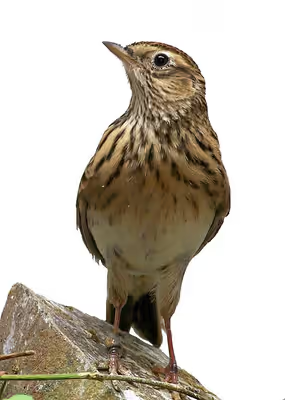
Like many ground birds, most lark species have long hind claws, which are thought to provide stability while standing. Most have streaked brown plumage, some boldly marked with black or white. Their dull appearance camouflages them on the ground, especially when on the nest. They feed on insects and seeds; though adults of most species eat seeds primarily, all species feed their young insects for at least the first week after hatching. Many species dig with their bills to uncover food. Some larks have heavy bills (reaching an extreme in the thick-billed lark) for cracking seeds open, while others have long, down-curved bills, which are especially suitable for digging.
Larks are the only passerines that lose all their feathers in their first moult (in all species whose first moult is known). This may result from the poor quality of the chicks' feathers, which in turn may result from the benefits to the parents of switching the young to a lower-quality diet (seeds), which requires less work from the parents.
In many respects, including long tertial feathers, larks resemble other ground birds such as pipits. However, in larks the tarsus (the lowest leg bone, connected to the toes) has only one set of scales on the rear surface, which is rounded. Pipits and all other songbirds have two plates of scales on the rear surface, which meet at a protruding rear edge.
Calls and song
Larks have more elaborate calls than most birds, and often extravagant songs given in display flight. These melodious sounds (to human ears), combined with a willingness to expand into anthropogenic habitats—as long as these are not too intensively managed—have ensured larks a prominent place in literature and music, especially the Eurasian skylark in northern Europe and the crested lark and calandra lark in southern Europe.
Behaviour
Breeding
Male larks use song flights to defend their breeding territory and attract a mate. Most species build nests on the ground, usually cups of dead grass, but in some species the nests are more complicated and partly domed. A few desert species nest very low in bushes, perhaps so circulating air can cool the nest. Larks' eggs are usually speckled. The size of the clutch is very variable and ranges from the single egg laid by Sclater's lark up to 6–8 eggs laid by the calandra lark and the black lark. Larks incubate for 11 to 16 days.
In culture
Larks as food
Larks, commonly consumed with bones intact, have historically been considered wholesome, delicate, and light game. They can be used in a number of dishes; for example, they can be stewed, broiled, or used as filling in a meat pie. Lark's tongues are reputed to have been particularly highly valued as a delicacy. In modern times, shrinking habitats made lark meat rare and hard to come by, though it can still be found in restaurants in Italy and elsewhere in southern Europe.
Symbolism
The lark in mythology and literature stands for daybreak, as in Chaucer's "The Knight's Tale", "the bisy larke, messager of day", and Shakespeare's Sonnet 29, "the lark at break of day arising / From sullen earth, sings hymns at heaven's gate" (11–12). The lark is also (often simultaneously) associated with "lovers and lovers' observance" (as in Bernart de Ventadorn's Can vei la lauzeta mover) and with "church services". These meanings of daybreak and religious reference can be combined, as in Blake's Visions of the Daughters of Albion, into a "spiritual daybreak" to signify "passage from Earth to Heaven and from Heaven to Earth". With Renaissance painters such as Domenico Ghirlandaio, the lark symbolizes Christ, with reference to John 16:16.
Literature
Percy Bysshe Shelley's famed 1820 poem "To a Skylark" was inspired by the melodious song of a skylark during an evening walk.
English poet George Meredith wrote a poem titled "The Lark Ascending" in 1881.
Gerard Manley Hopkins wrote a poem entitled “The Sea and the Skylark” in 1877.
In Mervyn Peake's Titus Groan, first book of the Gormenghast trilogy, "Swelter approache[s] [Lord Sepulchrave] with a salver of toasted larks" during the reception following newborn Titus's christening.
Canadian poet John McCrae mentions larks in his poem "In Flanders Fields".
Music
English composer Ralph Vaughan Williams wrote a musical setting of George Meredith's poem, completed in 1914. It was composed for violin and piano, and entitled The Lark Ascending - A Romance. The work received its first performance in December 1920. Soon afterwards the composer arranged it for violin and orchestra, in which version it was first performed in June 1921, and this is how the work remains best-known today.
The old Welsh folk song Marwnad yr Ehedydd (The Lark's Elegy) refers to the death of "the Lark", possibly as a coded reference to the Welsh leader Owain Glyndŵr.
The French-Canadian folk song Alouette refers to plucking feathers from a lark.
Pet
Traditionally, larks are kept as pets in China. In Beijing, larks are taught to mimic the voice of other songbirds and animals. A traditional habit of the Beijingers to teach their larks 13 kinds of sounds in a strict order (called "the 13 songs of a lark"; Chinese: 百灵十三套, bǎilíng shísān tào). The larks that can sing the full 13 sounds in the correct order are highly valued, while any disruption in the songs will decrease their value significantly.
Early awakening
Larks sing early in the day, often before dawn, leading to the expression "up with the lark" for a person who is awake early in the day, and the term lark being applied to someone who habitually rises early in the morning.