


Related on Lably
Through Italy, Rome and Italian fascism
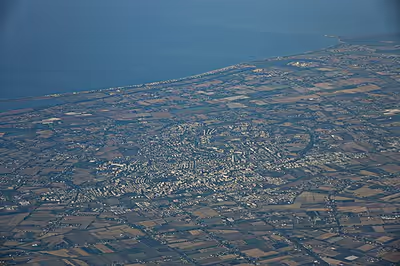
It is one of the youngest cities in Italy, being founded as Littoria in 1932 under the fascist administration, when the area surrounding it which had been a swamp since antiquity was drained.
History
Although the area was first settled by the Latins, the modern city was founded by Benito Mussolini on 30 June 1932 as Littoria, named for the fascio littorio. The city was inaugurated on 18 December of the same year, 171 days only to build up. Littoria was populated with settlers coming mainly from Friuli and Veneto, who formed the so-called Venetian-Pontine community (today surviving only in some peripheral boroughs). The edifices and the monuments, mainly in rationalist style, were designed by famous architects and artists such as Marcello Piacentini, Angiolo Mazzoni and Duilio Cambellotti.
In 1934 it became a provincial capital and, after World War II, renamed Latina in 1946. With the arrival of other people mostly from Lazio itself, the original Venetian-like dialect was increasingly substituted by a form of Romanesco dialect.
The city coat of arms is a blue shield with a stylized drawing of the City Hall Clock Tower in the middle, standing on a field of green, and flanked by two stalks of wheat tied at the base with a red ribbon engraved with the motto LATINA OLIM PALUS ("Latina, once a swamp") in Latin. The shield is surmounted by a mural crown.
Sign in to keep reading
9 more chapters are free with a Lably account.
Geography
Latina is located in the province of Latina, part of the southern section of the region of Lazio. The city is about 62 km (39 mi) south of Rome The municipality borders on Aprilia, Cisterna di Latina, Nettuno, Pontinia, Sabaudia, Sermoneta and Sezze.
Climate
Latina has a Mediterranean climate (Köppen climate classification Csa) like most of southern Italy.
Demographics
As of 2026, the population is 127,450, of which 49.2% are males, and 50.8% are females. Minors make up 14.8% of the population, and seniors make up 23.4%.
Immigration
As of 2025, immigrants make up 11.5% of the population. The 5 largest foreign countries of birth are Romania, India, Ukraine, Bangladesh, and Tunisia.
Government
Frazioni
The frazioni of Latina are: Latina Lido, Latina Scalo, Borgo Bainsizza, Borgo Carso, Borgo Faiti, Borgo Grappa, Borgo Isonzo, Borgo Montello, Borgo Piave, Borgo Podgora, Borgo Sabotino, Borgo Santa Maria, Borgo San Michele, Chiesuola, and Tor Tre Ponti.
Economy
The city has some pharmaceutical, chemical industry and a strong service sector. Latina is also an important centre for agriculture (vegetables, flowers, sugar, fruit, cheese and derivates).
The former Latina nuclear power plant has been shut down and is currently undergoing decommissioning.
Transport
There is no airport in the city. The nearest airport is Rome Fiumicino Airport, located 77 km (48 mi) north west of Latina.
In popular culture
The Italian film My Brother Is an Only Child is set in Latina.
The Amazon Prime Video original series Prisma follows the coming-of-age of a group of teenagers from Latina.
Notable people
- Manuela Arcuri, actress
- Calcutta, stage name of Edoardo d'Erme, musician and composer
- Fabrizio del Monte, racing driver
- Tiziano Ferro, pop singer
- Antonio Pennacchi, writer
- Mattia Perin, football goalkeeper
- Karin Proia, actress
- Ilaria Spada, actress
- Elena Santarelli, actress, model and television presenter
International relations
Twin towns – sister cities
Latina is twinned with:
- Palos de la Frontera, Huelva, Andalusia, Spain
- Farroupilha, Rio Grande do Sul, Brazil
- Birkenhead, Wirral, Merseyside, England