


Related on Lably
Through Semiconductor, P–n junction and China
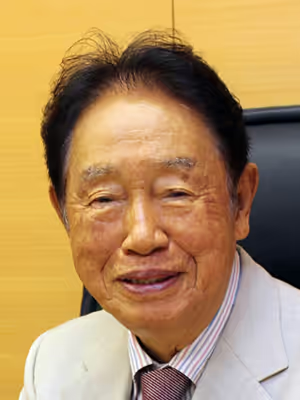
Since the death of Yoichiro Nambu in 2015, Esaki is the oldest living Japanese Nobel laureate.
Biography
Leo Esaki was born on March 12, 1925, in Osaka, Japan. Esaki studied physics at Tokyo Imperial University (now the University of Tokyo), where he received a Bachelor of Science in 1947 and a Doctor of Philosophy in 1959. In 1947, he joined the Kobe Kogyo Corporation, before becoming chief physicist at Tokyo Tsushin Kogyo (now Sony) in 1956.
In 1960, Esaki moved to the United States to join IBM's Thomas J. Watson Research Center, where he was appointed an IBM Fellow in 1967. In 1992, he returned to Japan, where he subsequently served as President of the University of Tsukuba until 1998.
Sign in to keep reading
5 more chapters are free with a Lably account.
Research
Tunneling
In 1957, Esaki recognized that when the p–n junction width of germanium is thinned, the current–voltage characteristic is dominated by the influence of the tunnel effect. As a result, he discovered that as the voltage is increased, the current decreases inversely, indicating negative resistance. This discovery was the first demonstration of solid tunneling effects in physics, and it was the birth of the first quantum electronic device, the tunnel diode.
Superlattices
In 1969, Esaki predicted that semiconductor superlattices will be formed to induce a differential negative-resistance effect via an artificially one-dimensional periodic structural changes in semiconductor crystals. His unique "molecular-beam epitaxy" thin-film crystal growth method can be regulated quite precisely in ultrahigh vacuum. A 1987 comment by Esaki regarding the original paper notes:
"The original version of the paper was rejected for publication by Physical Review on the referee's unimaginative assertion that it was 'too speculative' and involved 'no new physics.' However, this proposal was quickly accepted by the Army Research Office..."
In 1972, Esaki realized his concept of superlattices in III-V group semiconductors. Later, this concept influenced many fields like metals and magnetic materials.
Family
Esaki's daughter, Anna Esaki, is married to Craig S. Smith, former Shanghai bureau chief of The New York Times and China bureau chief of The Wall Street Journal.
Esaki's "five don'ts" rules
At the 1994 Lindau Nobel Laureate Meetings, Esaki suggested a list of "five don'ts" which anyone in realizing their creative potential should follow. Two months later, the chairman of the Nobel Committee for Physics Carl Nordling incorporated the rules in his own speech.
- Don't allow yourself to be trapped by your past experiences.
- Don't allow yourself to become overly attached to any one authority in your field – the great professor, perhaps.
- Don't hold on to what you don't need.
- Don't avoid confrontation.
- Don't forget your spirit of childhood curiosity.
Recognition
Awards
Memberships
Honorary degrees
Commemoration
In recognition of three Nobel laureates' contributions, the bronze statues of Shin'ichirō Tomonaga, Leo Esaki, and Makoto Kobayashi were set up in the Central Park of Azuma 2 in Tsukuba in 2015.