


Related on Lably
Description
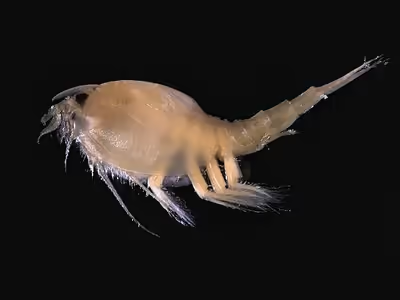
Leptostracans are usually small, typically 5 to 15 millimetres (0.2 to 0.6 in) long, but the largest species (Nebaliopsis typica) can reach 4 cm, and the Silurian Ceratiocaris could grow to 75 cm.
They are distinguished from all other members of their class in having seven abdominal segments, instead of six. Their head has stalked compound eyes, two pairs of antennae (one biramous, one uniramous), and a pair of mandibles but no maxillipeds. They are the only malacostracans with a carapace that comprises two valves. It covers the head and the thorax, including most of the thoracic appendages, and serves as a brood pouch for the developing embryos. Its anterior tip bears a movable rostrum. Also unique among malacostracans is their eight pairs of thoracic appendages which have been specialized into leaf-like filter feeding organs, and are not used for locomotion. The first six abdominal segments bear pleopods, while the seventh bears a pair of caudal furcae, which may be homologous to uropods of other crustaceans.
Leptostracans have gills on their thoracic limbs, but also breathe through a respiratory membrane on the inside of the carapace. The eggs hatch as a postlarval, or "manca" stage, which lacks a fully developed carapace, but otherwise resembles the adult.
Sign in to keep reading
One more chapter is free with a Lably account.
Classification
It is now accepted that leptostracans belong to the Malacostraca, and the sister crown group to Leptostraca is Eumalacostraca.
The order Leptostraca is divided into three families, with ten genera containing a total of around 40 validly described extant species: