

Linear combination
Sum of terms, each multiplied with a scalar
- 9 min read
- 7 chapters
- 6 labs on Lably

Learn it on Lably
Definition
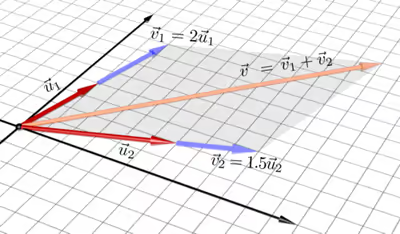
Let V be a vector space over the field K. As usual, we call elements of V vectors and call elements of K scalars. If v1,...,vn are vectors and a1,...,an are scalars, then the linear combination of those vectors with those scalars as coefficients is There is some ambiguity in the use of the term "linear combination" as to whether it refers to the expression or to its value. In most cases the value is emphasized, as in the assertion "the set of all linear combinations of v1,...,vn always forms a subspace". However, one could also say "two different linear combinations can have the same value" in which case the reference is to the expression. The subtle difference between these uses is the essence of the notion of linear dependence: a family F of vectors is linearly independent precisely if any linear combination of the vectors in F (as value) is uniquely so (as expression). In any case, even when viewed as expressions, all that matters about a linear combination is the coefficient of each vi; trivial modifications such as permuting the terms or adding terms with zero coefficient do not produce distinct linear combinations.
In a given situation, K and V may be specified explicitly, or they may be obvious from context. In that case, we often speak of a linear combination of the vectors v1,...,vn, with the coefficients unspecified (except that they must belong to K). Or, if S is a subset of V, we may speak of a linear combination of vectors in S, where both the coefficients and the vectors are unspecified, except that the vectors must belong to the set S (and the coefficients must belong to K). Finally, we may speak simply of a linear combination, where nothing is specified (except that the vectors must belong to V and the coefficients must belong to K); in this case one is probably referring to the expression, since every vector in V is certainly the value of some linear combination.
Note that by definition, a linear combination involves only finitely many vectors, except as described in the § Generalizations section. However, the set S that the vectors are taken from (if one is mentioned) can still be infinite; each individual linear combination will only involve finitely many vectors. Also, there is no reason that n cannot be zero; in that case, we declare by convention that the result of the linear combination is the zero vector in V.
Sign in to keep reading
6 more chapters are free with a Lably account.
Examples and counterexamples
Euclidean vectors
Let the field K be the set R of real numbers, and let the vector space V be the Euclidean space R3. Consider the vectors e1 = (1,0,0), e2 = (0,1,0) and e3 = (0,0,1). Then any vector in R3 is a linear combination of e1, e2, and e3.
To see that this is so, take an arbitrary vector (a1,a2,a3) in R3, and write:
Functions
Let K be the set C of all complex numbers, and let V be the set CC(R) of all continuous functions from the real line R to the complex plane C. Consider the vectors (functions) f and g defined by f(t) := eit and g(t) := e−it. (Here, e is the base of the natural logarithm, about 2.71828..., and i is the imaginary unit, a square root of −1.) Some linear combinations of f and g are:
On the other hand, the constant function 3 is not a linear combination of f and g. To see this, suppose that 3 could be written as a linear combination of eit and e−it. This means that there would exist complex scalars a and b such that aeit + be−it = 3 for all real numbers t. Setting t = 0 and t = π gives the equations a + b = 3 and a + b = −3, and clearly this cannot happen.
Polynomials
Let K be R, C, or any field, and let V be the set P of all polynomials with coefficients taken from the field K. Consider the vectors (polynomials) p1 := 1, p2 := x + 1, and p3 := x2 + x + 1.
To find out whether x2 − 1 is a linear combination of p1, p2, and p3, we consider an arbitrary linear combination of these vectors and try to see when it equals the desired vector x2 − 1. Picking arbitrary coefficients a1, a2, and a3, we want Multiplying the polynomials out, this means and collecting like powers of x, we get Two polynomials are equal if and only if their corresponding coefficients are equal, so we can conclude This system of linear equations can easily be solved. First, the first equation simply says that a3 is 1. Knowing that, we can solve the second equation for a2, which comes out to −1. Finally, the last equation tells us that a1 is also −1. Therefore, the only possible way to get a linear combination is with these coefficients. Indeed, so x2 − 1 is a linear combination of p1, p2, and p3.
On the other hand, if we try to make x3 − 1 a linear combination of p1, p2, and p3, then following the same process as before, we get the equation
However, when we set corresponding coefficients equal in this case, the equation for x3 is which is always false. Therefore, there is no way for this to work, and x3 − 1 is not a linear combination of p1, p2, and p3.
The linear span
Take an arbitrary field K, an arbitrary vector space V, and let v1,...,vn be vectors (in V). It is interesting to consider the set of all linear combinations of these vectors. This set is called the linear span (or just span) of the vectors, say S = {v1, ..., vn}. We write the span of S as span(S) or sp(S):
Linear independence
Suppose that, for some sets of vectors v1,...,vn, a single vector can be written in two different ways as a linear combination of them: This is equivalent, by subtracting these (), to saying a non-trivial combination is zero:
If that is possible, then v1,...,vn are called linearly dependent; otherwise, they are linearly independent. Similarly, we can speak of linear dependence or independence of an arbitrary set S of vectors.
If S is linearly independent and the span of S equals V, then S is a basis for V.
Affine, conical, and convex combinations
By restricting the coefficients used in linear combinations, one can define the related concepts of affine combination, conical combination, and convex combination, and the associated notions of sets closed under these operations.
Because these are more restricted operations, more subsets will be closed under them, so affine subsets, convex cones, and convex sets are generalizations of vector subspaces: a vector subspace is also an affine subspace, a convex cone, and a convex set, but a convex set need not be a vector subspace, affine, or a convex cone.
These concepts often arise when one can take certain linear combinations of objects, but not any: for example, probability distributions are closed under convex combination (they form a convex set), but not conical or affine combinations (or linear), and positive measures are closed under conical combination but not affine or linear – hence one defines signed measures as the linear closure.
Linear and affine combinations can be defined over any field (or ring), but conical and convex combination require a notion of "positive", and hence can only be defined over an ordered field (or ordered ring), generally the real numbers.
If one allows only scalar multiplication, not addition, one obtains a (not necessarily convex) cone; one often restricts the definition to only allowing multiplication by positive scalars.
All of these concepts are usually defined as subsets of an ambient vector space (except for affine spaces, which are also considered as "vector spaces forgetting the origin"), rather than being axiomatized independently.
Operad theory
More abstractly, in the language of operad theory, one can consider vector spaces to be algebras over the operad (the infinite direct sum, so only finitely many terms are non-zero; this corresponds to only taking finite sums), which parametrizes linear combinations: the vector for instance corresponds to the linear combination . Similarly, one can consider affine combinations, conical combinations, and convex combinations to correspond to the sub-operads where the terms sum to 1, the terms are all non-negative, or both, respectively. Graphically, these are the infinite affine hyperplane, the infinite hyper-octant, and the infinite simplex. This formalizes what is meant by being or the standard simplex being model spaces, and such observations as that every bounded convex polytope is the image of a simplex. Here suboperads correspond to more restricted operations and thus more general theories.
From this point of view, we can think of linear combinations as the most general sort of operation on a vector space – saying that a vector space is an algebra over the operad of linear combinations is precisely the statement that all possible algebraic operations in a vector space are linear combinations.
The basic operations of addition and scalar multiplication, together with the existence of an additive identity and additive inverses, cannot be combined in any more complicated way than the generic linear combination: the basic operations are a generating set for the operad of all linear combinations.
Ultimately, this fact lies at the heart of the usefulness of linear combinations in the study of vector spaces.
Generalizations
If V is a topological vector space, then there may be a way to make sense of certain infinite linear combinations, using the topology of V. For example, we might be able to speak of a1v1 + a2v2 + a3v3 + ⋯, going on forever. Such infinite linear combinations do not always make sense; we call them convergent when they do. Allowing more linear combinations in this case can also lead to a different concept of span, linear independence, and basis. The articles on the various flavors of topological vector spaces go into more detail about these.
If K is a commutative ring instead of a field, then everything that has been said above about linear combinations generalizes to this case without change. The only difference is that we call spaces like this V modules instead of vector spaces. If K is a noncommutative ring, then the concept still generalizes, with one caveat: since modules over noncommutative rings come in left and right versions, our linear combinations may also come in either of these versions, whatever is appropriate for the given module. This is simply a matter of doing scalar multiplication on the correct side.
A more complicated twist comes when V is a bimodule over two rings, KL and KR. In that case, the most general linear combination looks like where a1,...,an belong to KL, b1,...,bn belong to KR, and v1,…,vn belong to V.