


Learn it on Lably
Since each lunation is approximately 29+1⁄2 days, it is common for the months of a lunar calendar to alternate between 29 and 30 days. Since the period of 12 such lunations, a lunar year, is 354 days, 8 hours, 48 minutes, 34 seconds (354.36707 days), lunar calendars are 11 to 12 days shorter than the solar year. In lunar calendars, which do not make use of lunisolar calendars' intercalation, the lunar months cycle through all the seasons of a solar year over the course of a 33–34 lunar-year cycle (see, e.g., list of Islamic years). The details of when months begin vary from calendar to calendar, with some using new, full, or crescent moons and others employing detailed calculations. The term lunar new year is the first day of lunar calendar but is also widely used, especially in the US, of lunisolar new years.
History
Scholars have argued that ancient hunters conducted regular astronomical observations of the Moon back in the Upper Palaeolithic. Samuel L. Macey dates the earliest uses of the Moon as a time-measuring device back to 28,000–30,000 years ago.
Sign in to keep reading
4 more chapters are free with a Lably account.
Start of the lunar month
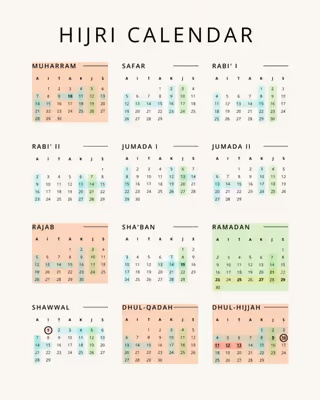
Lunar and lunisolar calendars differ as to which day is the first day of the month. Some are based on the first sighting of the lunar crescent, such as the Hijri calendar observed by most of Islam. Alternatively, in some lunisolar calendars, such as the Hebrew calendar and Chinese calendar, the first day of a month is the day when an astronomical new moon occurs in a particular time zone. In others, such as some Hindu calendars, each month begins on the day after the full moon.
Length of the lunar month
The length of each lunar cycle varies slightly from the average value. In addition, observations are subject to uncertainty and weather conditions – in Sunni Islam, the month begins with Hilal, the actual observation of the first crescent. Thus, to minimise uncertainty, there have been attempts to create fixed arithmetical rules to determine the start of each calendar month. The best known of these is the Tabular Islamic calendar: in brief, it has a 30-year cycle with 11 leap years of 355 days and 19 years of 354 days. In the long term, it is accurate to one day in about 2,500 solar years or 2,570 lunar years. It also deviates from observation by up to about one or two days in the short term. The algorithm was introduced by Muslim astronomers in the 8th century to predict the approximate date of the first crescent moon, which is used to determine the first day of each month in the Islamic lunar calendar.
List of lunar calendars
- Islamic Hijri calendar
- Javanese calendar
- The prehistoric Roman calendar is believed to have been a purely lunar calendar that later evolved into a lunisolar one, which in turn was replaced outright by the purely solar Julian calendar.
Lunisolar calendars
Most calendars referred to as "lunar" calendars are actually lunisolar calendars. Their months are based on observations of the lunar cycle, with periodic intercalation being used to restore them into general agreement with the solar year. The solar "civic calendar" that was used in ancient Egypt showed traces of its origin in the earlier lunar calendar, which continued to be used alongside it for religious and agricultural purposes. Present-day lunisolar calendars include the Chinese, Korean, Vietnamese, Hindu, Hebrew and Thai calendars.
The most common form of intercalation is to add an additional month every second or third year. Some lunisolar calendars are also calibrated by annual natural events which are affected by lunar cycles as well as the solar cycle. An example of this is the lunisolar calendar of the Banks Islands, which includes three months in which the edible palolo worms mass on the beaches. These events occur at the last quarter of the lunar month, as the reproductive cycle of the palolos is synchronized with the moon.