

Marmot
Genus of mammals (large ground squirrels)
- 3 min read
- 4 chapters

Related on Lably
Description
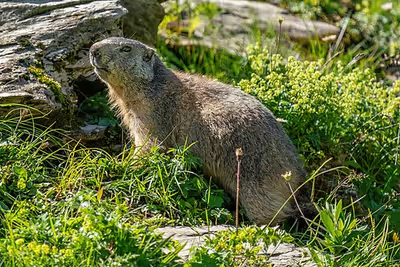
Marmots are large rodents with characteristically short but robust legs, enlarged claws that are well adapted to digging, stout bodies, and large heads and incisors to quickly process a variety of vegetation. While most species are various forms of earthen-hued brown, marmots vary in fur coloration based roughly on their surroundings. Species found in more open habitats are more likely to be paler color, while those found in well-forested regions tend to be darker.
Total length varies typically from about 42 to 72 cm (17 to 28 in) and body mass averages about 2 kg (4+1⁄2 lb) in spring in the smaller species and 8 kg (18 lb) in autumn, at times exceeding 11 kg (24 lb), in the larger species. The largest and smallest species are not clearly known. In North America, on the basis of mean linear dimensions and body masses through the year, the smallest species appears to be the Alaska marmot and the largest is the Olympic marmot. Some species, such as the Himalayan marmot and Tarbagan marmot in Asia, appear to attain roughly similar body masses to the Olympic marmot, but are not known to reach as high a total length as the Olympic species.
Using the traditional definition of hibernation, the largest marmots are considered the largest "true hibernators", since larger "hibernators" such as bears do not have the same physiological characteristics as obligate hibernating animals such as assorted rodents, bats and insectivores.
Sign in to keep reading
3 more chapters are free with a Lably account.
Biology
Some species live in mountainous areas, such as the Alps, northern Apennines, Carpathians, Tatras, and Pyrenees in Europe; northwestern Asia; the Rocky Mountains, Black Hills, the Cascade and Pacific Ranges, and the Sierra Nevada in North America; and the Deosai Plateau in Pakistan and Ladakh in India. Other species prefer rough grassland and can be found widely across North America and the Eurasian Steppe. The slightly smaller and more social prairie dog is not classified in the genus Marmota, but in the related genus Cynomys.
Marmots typically live in burrows (often within rockpiles, particularly in the case of the yellow-bellied marmot), and hibernate there through the winter. Most marmots are highly social and use loud whistles to communicate with one another, especially when alarmed.
Marmots mainly eat greens and many types of grasses, berries, lichens, mosses, roots, and flowers.
Subgenera and species
The following is a list of all Marmota species recognized by Thorington and Hoffman plus the recently defined M. kastschenkoi. They divide marmots into two subgenera.
Some extinct species of marmots are recognized from the fossil record, for example:
- †Marmota arizonae, Arizona, U.S.
- †Marmota minor, Nevada, U.S.
- †Marmota vetus, Nebraska, U.S.
History and etymology
Marmots have been known since antiquity. Research by the French ethnologist Michel Peissel claimed the story of the "Gold-digging ant" reported by the Ancient Greek historian Herodotus, who lived in the fifth century BCE, was founded on the golden Himalayan marmot of the Deosai Plateau and the habit of local tribes such as the Brokpa to collect the gold dust excavated from their burrows. Some historians believe that Strabo's λέων μύρμηξ (léōn mýrmēx), and Agatharchides's μυρμηκολέων (myrmēkoléōn), most probably are the marmot.
An anatomically accurate image of a marmot was printed and distributed as early as 1605 by Jacopo Ligozzi, who was noted for his images of flora and fauna.
The etymology of the term "marmot" is uncertain. It may have arisen from the Gallo-Romance prefix marm-, meaning to mumble or murmur (an example of onomatopoeia). Another possible origin is postclassical Latin, mus montanus, meaning "mountain mouse".
They historically formed part of the diet of Swiss Alpine peasants.
Beginning in 2010, Alaska celebrates February 2 as "Marmot Day", a holiday intended to observe the prevalence of marmots in that state and take the place of Groundhog Day.
Relationship to the Black Death
Some historians and paleogeneticists have postulated that marmots might be among the natural reservoir species for the Yersinia pestis variant that caused the Black Death pandemic, which swept across Eurasia in the 14th century.