


Related on Lably
Through Bird, Tibet and Phylogenetics
Taxonomy
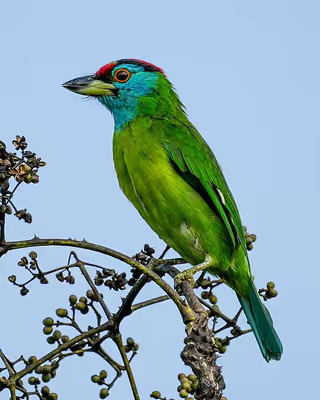
In the past the species were placed in three genera, Caloramphus, Megalaima and Psilopogon, but studies show that Psilopogon to be nested within the clade of Megalaima. Since members of this clade are better treated under a single genus, they have been moved to the genus Psilopogon which was described and erected earlier than Megalaima and is therefore chosen on the basis of taxonomic priority principles. Nearly all members of the family are now in the genus Psilopogon, with the exception of those in Caloramphus, which are thought to have genetically diverged from the common ancestor around 21.32 million years ago. The latter species are distinct enough to warrant placement in a subfamily Caloramphinae. The family name is derived from that of the genus Megalaima which means ‘large throat’, from the Greek mega (μέγας, ‘large, great’) and laimos (λαιμός, ‘throat’).
The phylogenetic relationship between the Asian barbets and the eight other families in the order Piciformes is shown in the cladogram below. The number of species in each family is taken from the list maintained by Frank Gill, Pamela C. Rasmussen and David Donsker on behalf of the International Ornithological Committee (IOC).
Sign in to keep reading
One more chapter is free with a Lably account.
Classification
Subfamily Megalaiminae
Subfamily Caloramphinae