


Related on Lably
Through Duck, Threatened species and Temperate climate
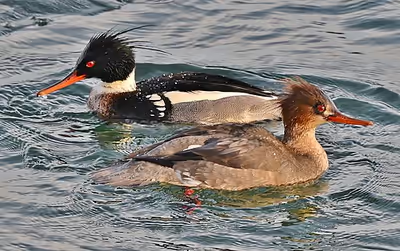
The common merganser or goosander (Mergus merganser) and red-breasted merganser (M. serrator) have broad ranges in the northern hemisphere. The Brazilian merganser (M. octosetaceus) is a South American duck, and one of the six most threatened waterfowl in the world, with possibly fewer than 250 birds in the wild. The scaly-sided merganser or "Chinese merganser" (M. squamatus) is also an endangered species; it lives in temperate eastern Asia, breeding in the northeast and wintering further south.
The hooded merganser (Lophodytes cucullatus, formerly known as Mergus cucullatus) is not currently included in this genus but is closely related, and may be embedded within it. The other "aberrant" merganser, the smew (Mergellus albellus), previously thought to be closer to goldeneyes (Bucephala) due to the occurrence of natural hybrids, is now known to be basal to all the other mergansers from genetic analysis.
Although they are seaducks, most of the mergansers prefer riverine habitats, with only the red-breasted merganser being common at sea. These large fish-eating ducks typically have black-and-white or brown, and with bottle-green heads in the male plumage, while the females are largely grey or brownish and with brown heads; both sexes have somewhat shaggy crests. All have serrated edges to their long and thin bills that help them grip their prey. Along with the smew and hooded merganser, they are therefore often known as "sawbills". The goldeneyes, on the other hand, feed mainly on mollusks, and therefore have a more typical duck-bill.
Mergus ducks are also classified as "diving ducks" because they submerge completely in looking for food. In other traits, however, the genera Mergus, Lophodytes, Mergellus, and Bucephala are very similar; uniquely among all Anseriformes, they do not have notches at the hind margin of their sternum, but holes surrounded by bone.
Taxonomy
The genus Mergus was introduced in 1758 by the Swedish naturalist Carl Linnaeus in the tenth edition of his Systema Naturae. The genus name is the Latin word for an unidentified waterbird mentioned by Pliny the Elder and other authors; some sources have identified the original mergus as referring to either a cormorant or Scopoli's shearwater. The type species was designated as Mergus serrator Linnaeus, 1758 (the red-breasted merganser) by Thomas Campbell Eyton in 1838.
Sign in to keep reading
2 more chapters are free with a Lably account.
Etymology
The genus name is a Latin word used by Pliny the Elder and other Roman authors to refer to an unspecified diving waterbird.
The English name merganser, first used in Mediaeval Latin by Conrad Gesner in 1555, and as an English loan word in 1752, means "diving goose", from merg (as in "submerge"), + Anser. The name goosander is older in English usage, first attested in 1622 with the spelling "gossander" and 1674 with its current spelling; it is of unknown etymology but possibly from a Scandinavian origin as "gossand", where goss is unknown, and -and is a duck.
Recent species
The genus contains four living species and two recently extinct species.
Fossil species
Some fossil members of this genus have been described:
- Mergus miscellus is known from the Middle Miocene Calvert Formation (Barstovian, c. 14 million years ago) of Virginia, USA.
- Mergus connectens lived in the Early Pleistocene about 2–1 million years ago, in Central and Eastern Europe.
The Early Oligocene booby "Sula" ronzoni was at first mistakenly believed to be a typical merganser. A Late Serravallian (13–12 million years ago) fossil sometimes attributed to Mergus, found in the Sajóvölgyi Formation of Mátraszőlős, Hungary, probably belongs to Mergellus. The affiliations of "Anas" albae from the Messinian (c. 7–5 million years ago) of Hungary are undetermined; it was initially believed to be a typical merganser too.