


Related on Lably
Through Taxonomy (biology), Predation and Ocean
Shell description
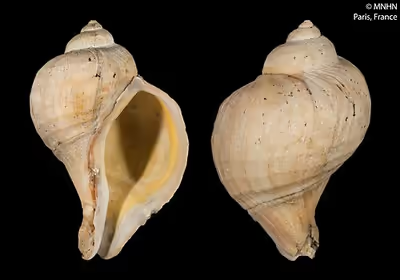
Muricid shells are variably shaped, generally with a raised spire and strong sculpture with spiral ridges and often axial varices (typically three or more varices on each whorl), also frequently bearing spines, tubercles, or blade-like processes. Periostracum is absent in this family. The aperture is variable in shape; it may be ovate to more or less contracted, with a well-marked anterior siphonal canal that may be very long. The shell's outer lip is often denticulated inside, sometimes with a tooth-like process on its margin. The columella is smoothish to weakly ridged. The operculum is corneous and of variable thickness, with the nucleus near the anterior end or at about midlength of the outer margin.
Many muricids have episodic growth, which means their shells grow in spurts, remaining the same size for a while (during which time the varix develops) before rapidly growing to the next size stage. The result is the series of above mentioned varices on each whorl.
Sign in to keep reading
4 more chapters are free with a Lably account.
Life habits
Most species of muricids are carnivorous, active predators that feed on other gastropods, bivalves, and barnacles. The access to the soft parts of the prey is typically obtained by boring a hole through the shell by means of a softening secretion and the scraping action of the radula. Because of their carnivory, some species may be considered pests because they can cause considerable destruction both in exploited natural beds of bivalves, and in farmed areas of commercial bivalves.
Muricids lay eggs in protective, corneous capsules, the size and shape of which vary by species. From these capsules the crawling juveniles, or more rarely planktonic larvae, hatch.
Historical value
Members of the family were harvested by early Mediterranean peoples, with the Phoenicians possibly the first to do so, to extract an expensive, vivid, stable dye known as Tyrian purple, imperial purple, or royal purple.
The fossil record
The family Muricidae first appears in the fossil record during the Aptian age of the Cretaceous period.
Subfamilies
According to the taxonomy of the Gastropoda by Bouchet & Rocroi (2005) the family Muricidae consists of these subfamilies:
- Aspellinae Keen, 1971
- Coralliophilinae Chenu, 1859 - synonym: Magilidae Thiele, 1925
- Ergalataxinae Kuroda, Habe & Oyama, 1971
- Haustrinae Tan, 2003
- Muricinae Rafinesque, 1815
- Muricopsinae Radwin & d'Attilio, 1971: synonym of Aspellinae Keen, 1971 ( junior subjective synonym)
- Ocenebrinae Cossmann, 1903
- Pagodulinae Barco, Schiaparelli, Houart & Oliverio, 2012
- Rapaninae Gray, 1853 - synonym: Thaididae Jousseaume, 1888
- Tripterotyphinae d'Attilio & Hertz, 1988: synonym of Muricopsinae Radwin & D'Attilio, 1971 : synonym of Aspellinae Keen, 1971 (junior subjective synonym)
- Trophoninae Cossmann, 1903: synonym of Ocenebrinae Cossmann, 1903 (junior subjective synonym)
- Typhinae Cossmann, 1903
- [unassigned] Muricidae
- Synonyms
- Subfamily Drupinae Wenz, 1938: synonym of Rapaninae Gray, 1853
- Genus Drupinia [sic]: synonym of Drupina Dall, 1923
- Genus Galeropsis Hupé, 1860: synonym of Coralliophila H. Adams & A. Adams, 1853
- Tritoninae Gray, 1847: synonym of Ranellidae Gray, 1854 (Invalid: type genus placed on the Official Index by Opinion 886 [junior homonym of Triton Linnaeus, 1758])