

Nitrogen dioxide
Compound containing nitrogen and oxygen
- 7 min read
- 7 chapters

Related on Lably
Through Paramagnetism, Nitric acid and Fertilizer
Nitrogen dioxide is poisonous and can be fatal if inhaled in large quantities. Cooking with a gas stove produces nitrogen dioxide which causes poorer indoor air quality. Combustion of gas can lead to increased concentrations of nitrogen dioxide throughout the home environment which is linked to respiratory issues and diseases. The LC50 (median lethal dose) for humans has been estimated to be 174 ppm for a 1-hour exposure. It is also included in the NOx family of atmospheric pollutants.
Properties
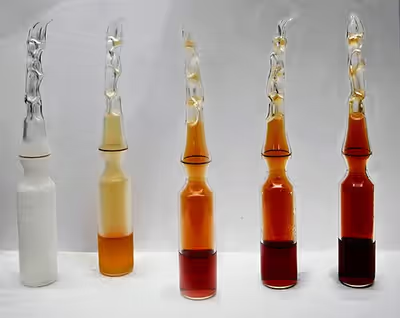
Nitrogen dioxide is a reddish-brown gas with a pungent, acrid odor above 21.2 °C (70.2 °F; 294.3 K) and becomes a yellowish-brown liquid below 21.2 °C (70.2 °F; 294.3 K). It forms an equilibrium with its dimer, dinitrogen tetroxide (N2O4), and converts almost entirely to N2O4 below −11.2 °C (11.8 °F; 261.9 K).
The bond length between the nitrogen atom and the oxygen atom is 119.7 pm. This bond length is consistent with a bond order between one and two. Nitrogen dioxide is a doublet state.
Sign in to keep reading
6 more chapters are free with a Lably account.
Preparation
Industrially, nitrogen dioxide is produced and transported as its cryogenic liquid dimer, dinitrogen tetroxide. It is produced industrially by the oxidation of ammonia, the Ostwald Process. This reaction is the first step in the production of nitric acid:
- 4 NH3 + 7 O2 → 4 NO2 + 6 H2O
It can also be produced by the oxidation of nitrosyl chloride:
- 2 NOCl + O2 → 2NO2 + Cl2
Instead, most laboratory syntheses stabilize and then heat the nitric acid to accelerate the decomposition. For example, the thermal decomposition of some metal nitrates generates NO2:
- Pb(NO3)2 → PbO + 2 NO2 + 1⁄2 O2
Alternatively, dehydration of nitric acid produces nitronium nitrate...
- 2 HNO3 → N2O5 + H2O
- 6 HNO3 + 1⁄2 P4O10 → 3 N2O5 + 2 H3PO4
...which subsequently undergoes thermal decomposition:
- N2O5 → 2 NO2 + 1⁄2 O2
NO2 is generated by the reduction of concentrated nitric acid with a metal (such as copper):
- 4 HNO3 + Cu → Cu(NO3)2 + 2 NO2 + 2 H2O
Nitric acid decomposes slowly to nitrogen dioxide by the overall reaction:
- 4 HNO3 → 4 NO2 + 2 H2O + O2
The nitrogen dioxide so formed confers the characteristic yellow color often exhibited by this acid. However, the reaction is too slow to be a practical source of NO2.
Selected reactions
Nitrogen dioxide interconverts to other N-O compounds. At low temperatures, NO2 reversibly converts to the colourless gas dinitrogen tetroxide (N2O4):
- 2 NO2 ⇌ N2O4
The exothermic equilibrium has enthalpy change ΔH = −57.23 kJ/mol.
At 150 °C (302 °F; 423 K), NO2 decomposes with release of oxygen via an endothermic process (ΔH = 14 kJ/mol):
- 2 NO2 →2 NO + O2
Nitric oxide combines with nitrogen dioxide to reversibly give dinitrogen trioxide:
- NO + NO2 ⇌ N2O3
This reaction is a step in the lead chamber process for producing sulfuric acid from sulfur dioxide. Absorption of light at wavelengths shorter than about 400 nm results in photolysis to form NO + O (atomic oxygen). In the atmosphere the addition of the oxygen atom so formed to O2 results in ozone.
Hydrolysis
NO2 reacts with water to give nitric acid and nitrous acid:
- 2NO2 + H2O → HNO3 + HNO2
The nitrous acid further degrades to nitric acid and nitric oxide.
These reactions underpin the Ostwald process for the industrial production of nitric acid from ammonia. This reaction is negligibly slow at low concentrations of NO2 characteristic of the ambient atmosphere, although it does proceed upon NO2 uptake to surfaces. Such surface reaction is thought to produce gaseous HNO2 (often written as HONO) in outdoor and indoor environments.
Conversion to nitrates
NO2 is used to generate anhydrous metal nitrates from the oxides:
- MO + 3 NO2 → M(NO3)2 + NO
Alkyl and metal iodides give the corresponding nitrates:
- TiI4 + 8 NO2 → Ti(NO3)4 + 4 NO + 2 I2
With organic compounds
The reactivity of nitrogen dioxide toward organic compounds has long been known. For example, it reacts with amides to give N-nitroso derivatives. It is used for nitrations under anhydrous conditions.
Uses
NO2 is used as an intermediate in the manufacturing of nitric acid, as a nitrating agent in the manufacturing of chemical explosives, as a polymerization inhibitor for acrylates, as a flour bleaching agent, and as a room temperature sterilization agent. It is also used as an oxidizer in rocket fuel, for example in red fuming nitric acid; it was used in the Titan rockets, to launch Project Gemini, in the maneuvering thrusters of the Space Shuttle, and in uncrewed space probes sent to various planets.
Environmental presence
Nitrogen dioxide typically arises via the oxidation of nitric oxide by oxygen in air (e.g. as result of corona discharge):
- 2 NO + O2 → 2 NO2
NO2 is introduced into the environment by natural causes, including entry from the stratosphere, bacterial respiration, volcanos, and lightning. These sources make NO2 a trace gas in the atmosphere of Earth, where it plays a role in absorbing sunlight and regulating the chemistry of the troposphere, especially in determining ozone concentrations.
Anthropogenic sources
Nitrogen dioxide also forms in most combustion processes. At elevated temperatures nitrogen combines with oxygen to form nitrogen dioxide:
- N2 + 2 O2 → 2 NO2
For the general public, the most prominent sources of NO2 are internal combustion engines, as combustion temperatures are high enough to thermally combine some of the nitrogen and oxygen in the air to form NO2. Nitrogen dioxide accounts for a small fraction (generally well under 0.1) of NOx auto emissions.
Outdoors, NO2 can be a result of traffic from motor vehicles. Indoors, exposure arises from cigarette smoke, and butane and kerosene heaters and stoves. Indoor exposure levels of NO2 are, on average, at least three times higher in homes with gas stoves compared to electric stoves.
Workers in industries where NO2 is used are also exposed and are at risk for occupational lung diseases, and NIOSH has set exposure limits and safety standards. Workers in high voltage areas especially those with spark or plasma creation are at risk. Agricultural workers can be exposed to NO2 arising from grain decomposing in silos; chronic exposure can lead to lung damage in a condition called "silo-filler's disease".
Toxicity
NO2 diffuses into the epithelial lining fluid (ELF) of the respiratory epithelium and dissolves. There, it chemically reacts with antioxidant and lipid molecules in the ELF. The health effects of NO2 are caused by the reaction products or their metabolites, which are reactive nitrogen species and reactive oxygen species that can drive bronchoconstriction, inflammation, reduced immune response, and may have effects on the heart.
Acute exposure
Acute harm due to NO2 exposure is rare. 100–200 ppm can cause mild irritation of the nose and throat, 250–500 ppm can cause edema, leading to bronchitis or pneumonia, and levels above 1000 ppm can cause death due to asphyxiation from fluid in the lungs. There are often no symptoms at the time of exposure other than transient cough, fatigue or nausea, but over hours inflammation in the lungs causes edema.
For skin or eye exposure, the affected area is flushed with saline. For inhalation, oxygen is administered, bronchodilators may be administered, and if there are signs of methemoglobinemia, a condition that arises when nitrogen-based compounds affect the hemoglobin in red blood cells, methylene blue may be administered.
It is classified as an extremely hazardous substance in the United States as defined in Section 302 of the U.S. Emergency Planning and Community Right-to-Know Act (42 U.S.C. 11002), and it is subject to strict reporting requirements by facilities which produce, store, or use it in significant quantities.
Long-term
Exposure to low levels of NO2 over time can cause changes in lung function. Cooking with a gas stove is associated with poorer indoor air quality. Combustion of gas can lead to increased concentrations of nitrogen dioxide throughout the home environment which is linked to respiratory issues and diseases. Children exposed to NO2 are more likely to be admitted to hospital with asthma.
In 2019, the Court of Justice of the EU, found that France did not comply with the limit values of the EU air quality standards applicable to the concentrations of nitrogen dioxide (NO2) in 12 air quality zones.
Environmental effects
Interaction of NO2 and other NOx with water, oxygen and other chemicals in the atmosphere can form acid rain which harms sensitive ecosystems such as lakes and forests. Elevated levels of NO
2 can also harm vegetation, decreasing growth, and reduce crop yields.